


In recent years, the term family office has become increasingly common in Spain. However, many family businesses still question what a family office really is and whether it makes sense to create one.
It is not limited to investment management. It is a professional structure designed to protect, organise and grow family wealth over the long term.
Below, we analyse what a family office is, how it works, its tax implications in Spain and when it makes sense to establish one.
What is a family office?
Index of contents
When we refer to a family office, we mean a professional structure created to manage the wealth of a family with significant assets in a comprehensive way. There is no minimum threshold to decide when to establish this structure. It depends on each family’s circumstances.
This does not mean it is simply a financial manager or a holding company. It is a private structure for organising and managing wealth, which can be implemented through companies, holdings, investment vehicles and family governance bodies. It centralises the financial, strategic and patrimonial management of a family.

In the Spanish legal system, there is no specific legal form called a family office. It is an organisational structure that can be implemented through different entities or investment vehicles, depending on each family’s strategy.
How a family office works and why it matters
A family office differs from traditional wealth management in that, in the latter, the bank proposes financial products. The client delegates decisions and receives periodic reports.
In a professional family office, the family defines the strategy and the bank acts as a provider. In addition, there is coordinated tax and corporate planning, and succession is designed in advance.
Ultimately, the key difference lies in the level of control, coordination and strategic vision over family wealth.
Types of family office: single vs multi-family office
When using a family office to manage wealth, there are two main options: single-family office (SFO) and multi-family office (MFO).
| Characteristic | Single-family office | Multi-family office |
|---|---|---|
| Managed wealth | One single family. | Several families. |
| Level of personalisation | Very high, tailored strategy. | High, although with more standardised models. |
| Structural cost | High. | Lower, as it is shared |
| Confidentiality | Maximum, fully internal. | High, but shared with other clients. |
| Management team | Dedicated internal team. | Shared professional team. |
| Typical wealth | High net worth, usually between €20 and €30 million. | Suitable for lower wealth levels, between €2 and €20 million. |
| Strategic control | Full family control. | Shared with the service provider. |
Single-family office
A single-family office is a structure created for one family only. It exclusively manages that family’s wealth.
In practice, these structures are usually created when the family wealth justifies it. In many cases, this is above €20 or €30 million, although there is no legal threshold.
Despite higher costs, it offers advantages such as greater control, higher confidentiality and a fully tailored strategy.
Multi-family office
A multi-family office provides services to several families. The team, structure and costs are shared.
It is common when wealth ranges between €2 and €20 million. It is an efficient option for those seeking professional management without the cost of a dedicated internal structure.
Family office vs holding company: key differences
Many families already have a holding or asset management company, but this is not the same as a family office.
A holding company is an entity whose main purpose is to own and manage assets such as real estate, business interests or financial investments. It is a specific corporate vehicle with an operational focus.
A family office is a broader organisational structure. It is not a single company, but a system that can integrate different entities such as holdings, asset companies or investment vehicles, together with governance structures and succession planning.
In this sense, the holding is a tool within the structure, while the family office represents the overall strategy for managing, controlling and transferring family wealth.
When should you set up a family office?
Not all families need a family office, but there are situations where it becomes particularly relevant.
Sale of a company (liquidity event)
After selling a business, the family receives significant liquidity. Without structure, wealth can become fragmented and inefficient. A family office helps preserve capital and diversify investments.
Complex succession scenarios
Succession in Spain is governed by the Civil Code or regional laws. When there are multiple heirs, international assets or complex structures, succession planning becomes more complex. A family office allows these issues to be anticipated and optimised.
International diversification
Investments in the US, Latin America or Europe require coordinated tax planning. In some cases, structures such as ETVE may be considered if requirements are met.
Asset protection
Separating business risks from personal wealth is essential. A proper structure can limit exposure to liabilities.
Multiple real estate or financial investments
When wealth includes multiple assets, direct management becomes inefficient.
Family governance
A family protocol helps prevent conflicts. It sets rules for ownership, succession and participation.
What services does a family office provide?
A professional family office typically includes:
- Investment management, including asset allocation and risk control.
- Tax planning aligned with applicable regulations.
- Corporate structuring through holdings or investment vehicles.
- Succession and inheritance planning.
- Philanthropy structures and social impact initiatives.
- Financial reporting and consolidated oversight.
- Coordination with advisors such as banks, lawyers and tax specialists.
Family office structure and governance
A family office acts as the central coordination hub for family wealth. Its objective is to manage assets holistically, combining strategy, planning and succession organisation.
It typically includes both internal teams and external advisors. Common roles include an investment manager, a family CFO and legal and tax advisors.
Many family offices also establish governance bodies:
- Family Council, defining vision and participation rules.
- Board of Directors, overseeing strategy and investments.
- Family protocol, regulating succession and governance.
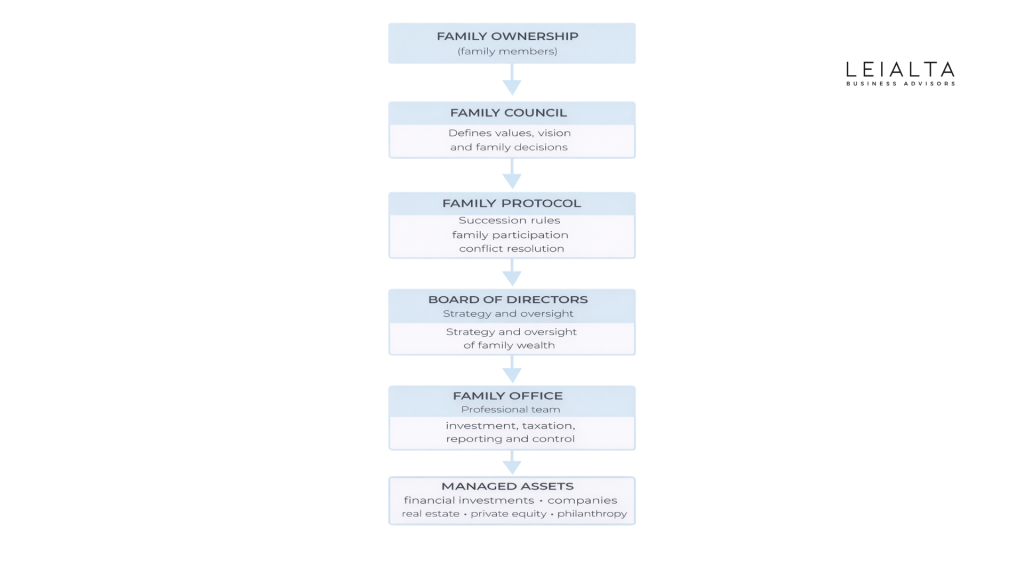
This structure separates family decisions from professional management and enables more efficient long-term administration.
Tax and legal considerations for family offices in Spain
There is no specific tax regime for family offices, but advantages arise from proper structuring.
Common structures include:
- Holding companies.
- Asset management companies.
- ETVE for international investment, allowing exemptions on foreign dividends and capital gains if requirements are met.
Advantages for business and real estate investment
Holdings may apply participation exemption on dividends under Article 21 of the Corporate Income Tax Law.
Risk protection
Separating assets across entities helps isolate risks and structure exposure.
Practical example: when it makes sense
Imagine an entrepreneur sells their company for €15 million. Their wealth structure changes significantly.
- Without structure, risks include lack of coordination, tax inefficiencies and succession conflicts.
- With a family office, a central holding is created, with defined investment strategy, governance and tax optimisation.
This is why family offices are often created after liquidity events.
What does a family office cost?
Costs depend on the model:
- Multi-family office: typically, between 0.5% and 1% of assets under management.
- Single-family office: includes salaries, audit and corporate costs.
Costs should be assessed against the risk of disorganised wealth.
How to set up a family office in Spain
Creating a family office involves several stages, from analysing family wealth to implementing the structure and ongoing monitoring. It combines legal structuring, tax planning and governance design.

When do you need professional advice?
Professional advice is recommended when wealth reaches a level that is difficult to manage or involves international complexity.
It helps avoid common mistakes:
- Creating structures without tax planning.
- Improvising succession rules.
- Allowing banks to define strategy.
- Failing to integrate international structures.
How LEIALTA helps you structure your family office in Spain
At LEIALTA, we support family businesses, entrepreneurs after a company sale and international investors with assets in Spain in creating and managing family offices through tailored, professional advice.
If you are considering setting up a family office or reviewing your current structure, now is the right time. Proper planning is key to preserving family wealth and avoiding future conflicts.


