

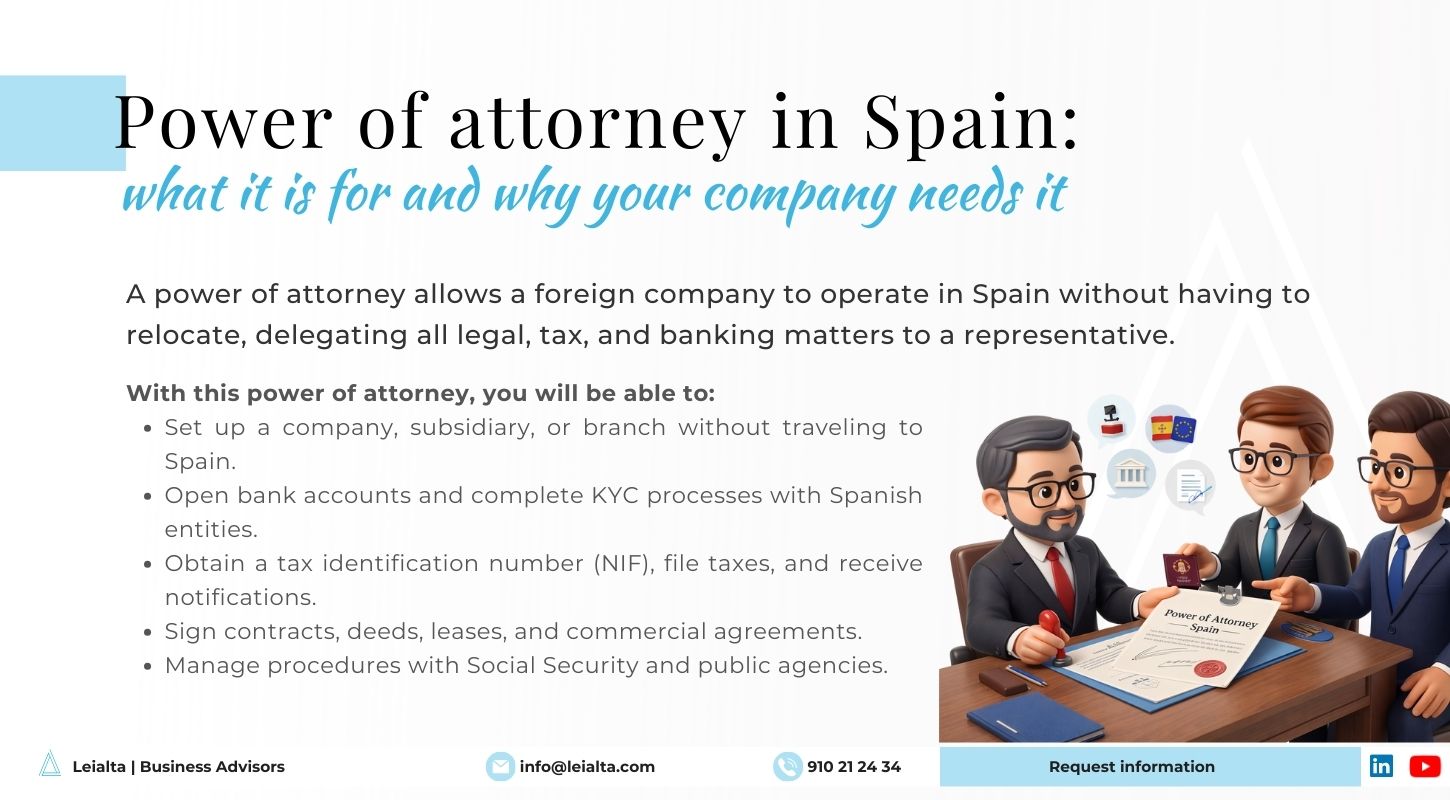
 Do you need legal representation in Spain to operate, invoice, or set up a company? For many international companies, Spain is a strategic entry point into Europe and requires a valid power of attorney to act without traveling.
This notarized document known internationally as Power of Attorney for Spain, allows a representative to act on behalf of the company before banks, the Tax Agency, notaries, and public bodies, guaranteeing full legal validity.
Any foreign company that wants to open a subsidiary, set up a limited liability company (SL) in Spain, appoint a legal representative, or simply operate with banks and the tax authorities needs a power of attorney that is valid in Spain, normally with a Hague Apostille. In this post, we explain what a power of attorney is, who can grant it, what requirements Spanish law demands, what mistakes you should avoid, and how to grant it correctly in order to operate in Spain without administrative obstacles.
What is a power of attorney in Spain and why does a foreign company need one?
Index of contents
A power of attorney is a notarized document through which a foreign company authorizes a person (attorney-in-fact) to act on its behalf in Spain with full legal validity.
Unlike the representation that an administrator may have in their country of origin, this document formally enables action in Spanish territory, especially in commercial, banking, and tax matters.
In practice, the power of attorney allows the attorney-in-fact to appear, sign, and perform legal acts as if they were the company itself, within the scope defined in the document.
Legal requirements for a valid Power of Attorney in Spain
The validity of the power of attorney in Spain is based on several regulations:
- Spanish Civil Code, articles 1710 et seq., which regulate voluntary representation.
- Notary Law and Notarial Regulations, which establish how powers of attorney used in Spain must be formalized.
- General Tax Law (Article 46), for representation before the Tax Agency.
- The Hague Convention, which requires an Apostille to validate foreign documents.
- When the power of attorney affects acts that require a public deed (e.g., incorporation of a company), Article 1280 of the Civil Code also applies.
Key difference: legal representation vs. voluntary representation
- Voluntary representation: the company freely decides who to grant power of attorney to (the usual case for foreign companies).
- Legal representation: derives from a registered position (e.g., administrator in the Commercial Registry), but only applies within the country of origin, hence the need for power of attorney to act in Spain.
Why a foreign company needs it
Without a power of attorney that is valid in Spain, a foreign company cannot:
- Sign before a Spanish notary.
- Open bank accounts or complete KYC processes.
- Obtain a tax identification number (NIF), file taxes, or deal with the Tax Agency.
- Sign rental, supply, or service contracts.
- Carry out administrative or commercial procedures on behalf of the company.
Therefore, the attorney-in-fact becomes the person who:
- Appears before notaries.
- Signs contracts and legal documents.
- Carries out tax and administrative procedures.
- Acts as an intermediary with banks, suppliers, and public bodies.
- Their powers must be expressly detailed in the power of attorney to avoid rejection by Spanish banks and notaries.
What can a Power of Attorney be used for in Spain? (POA uses for foreign companies)
A power of attorney allows a foreign company to operate in Spain without having to relocate. Among the most common uses are:
- Establishing companies (limited companies, public limited companies, branches, and subsidiaries).
- Opening bank accounts and operating with financial institutions.
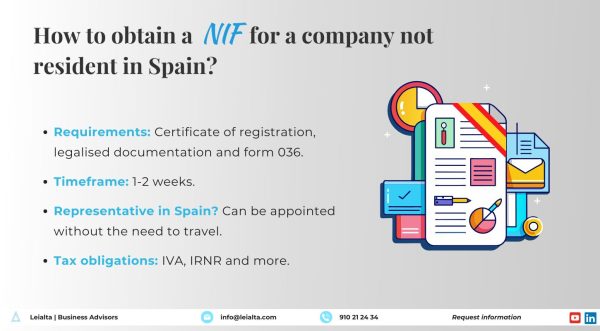
- Dealing with the Tax Agency: tax identification number (NIF), VAT, IRNR, census forms, and electronic notifications.
- Managing Social Security procedures.
- Signing commercial, rental, supply, or service contracts.
- Appointing a tax representative for economic activities in Spain.
- Obtaining a non-resident tax identification number (NIF-N) for foreign individuals or companies.
- Apply for registration in the ROI (Register of Intra-Community Operators) for operations within the EU.
- Carry out procedures with the Commercial Registry, such as the presentation of corporate acts or the registration of documents.
- Sign foreign investment declarations (form D-1A) when required.
This is an essential document for operating in the country with full legal capacity.
Who can grant a Power of Attorney on behalf of a foreign company?
The power of attorney must be granted by the person who holds legal representation of the foreign company in its country of origin. This is normally the administrators registered in the local commercial register or the administrative body with sufficient powers.
| Can grant it | Cannot grant it |
|---|---|
| Sole administrator | Shareholders without a registered position |
| Joint administrator | Non-administrative partners |
| Joint administrators | Executives without powers |
| Board of directors | Employees without powers |
Legal requirements that the power of attorney must meet
For a power of attorney granted abroad to be fully valid in Spain, it must meet a series of formal and material requirements. These elements ensure that the document can be used before banks, notaries, the Tax Agency, or any Spanish administration without risk of rejection or delays in the procedures:
- Granted before a notary or competent authority in the country of origin.
- Hague Apostille (or diplomatic legalization if not a member of the convention).
- Sworn translation into Spanish, carried out by an official translator.
- Updated certification from the commercial register of origin accrediting the signatory.
- Clear and defined powers, compatible with the acts to be performed in Spain.
- Suitability for the intended use: banks, AEAT, notary, incorporation, etc.
- Identification of the signatory by means of a valid passport or certification of signatures in accordance with the regulations of the country of origin.
- Additional documentation required by Spanish banks for KYC processes: shareholding structure, organization chart, identification of UBOs (beneficial owners), and basic corporate documentation.
Common POA mistakes that cause rejections by Spanish banks and notaries
Although it is a relatively simple procedure, many foreign companies make mistakes that delay critical operations such as incorporations, bank account openings, or contract signings. Three of the most common mistakes are:
- Insufficient powers. Some powers of attorney do not include specific wording to appear before a notary or open bank accounts, leading to rejections. Spanish banks require that the power of attorney expressly include powers such as “opening, disposing of, and closing accounts,” operating with electronic banking, and authorizing KYC verifications.
- Documentation not apostilled. Without the Hague Apostille, the power of attorney is not valid in Spain.
- Expired commercial certificates or certificates without a certified translation.
For example, a Canadian technology group submitted a general power of attorney to incorporate an SL in Spain.
The document did not expressly include the power to “sign public deeds,” so neither the bank nor the notary accepted the power of attorney. The entire process had to be repeated: new signature, new apostille, and translation. The delay meant an additional four weeks before the company could be incorporated.
Do foreign companies need to travel to Spain to grant a Power of Attorney?
No. A Power of Attorney can be granted abroad before a notary in the country of origin, as long as it includes the Hague Apostille (or diplomatic legalization when applicable). This makes it fully valid in Spain without the need for travel.
- It can be signed digitally in some jurisdictions.
- Spanish banks and notaries accept foreign POAs if properly apostilled and translated.
How to grant power of attorney step by step
To ensure that the power of attorney is fully valid in Spain, these are the steps that are usually followed:
- Define the scope of the power of attorney, determining whether it will be general or specific.
- Draft a professional document, preferably prepared by a Spanish law firm to ensure that the powers are valid before Spanish notaries and banks.
- Sign before a notary in the country of origin by the legal administrator.
- Hague Apostille of the document.
- Sworn translation into Spanish if it is written in another language.
- Delivery and validation in Spain, before a notary, banks, or the Tax Agency.
Types of powers of representation for foreign companies
The powers of representation that a foreign company can grant vary according to the scope of the powers to be delegated in Spain. Essentially, they all allow the representative to act on behalf of the company, but they differ in the degree of autonomy that the representative will have and in the specific acts that they may perform.
The most commonly used types and their practical application are summarized below.
| Type of power of attorney | Scope | Usual use |
|---|---|---|
| General commercial power of attorney | Broad. Allows the company to be managed and represented in most legal acts. | When the company needs a trusted person to act on an ongoing basis in Spain. |
| Special power of attorney | Limited to a specific act. | To set up a company, sign a specific deed, or carry out a specific transaction. |
| Tax representation power of attorney | Powers to act before the Tax Agency. | Filing taxes, receiving notifications, or complying with tax obligations for non-residents. |
| Banking power of attorney | Specifically drafted to operate with financial institutions. | Opening accounts, authorized signature, and management of banking transactions. |
When should a power of attorney be renewed or revoked?
A power of attorney should be reviewed periodically and updated when it no longer reflects the legal reality of the foreign company.
Renewal is usually necessary when the administrative body changes, the statutes governing representation are amended, or the attorney-in-fact no longer has a connection with the company. It is also advisable to revoke it when the wording becomes obsolete and Spanish banks or notaries require more specific powers.
Keeping powers of attorney up to date prevents unauthorized persons from continuing to act on behalf of the company and ensures that procedures in Spain are carried out without incident.
Relationship between power of representation and the role of legal and tax representative
The legal representative is the person who acts in Spain on behalf of the foreign company by means of a valid power of attorney. They can appear before a notary, sign contracts, manage administrative procedures, and perform the legal acts delegated to them by the company. Their role depends strictly on the powers granted in the power of attorney.
It is important to remember that the representative does not become an administrator of the company nor does he or she assume corporate responsibility. His or her function is strictly limited to the powers granted in the power of attorney.
A tax representative, on the other hand, is mandatory when a foreign company carries out activities in Spain that involve obligations to the Tax Agency. This person is responsible for receiving notifications, filing returns, responding to requests, and ensuring that the company complies with Spanish tax regulations.
Although in some situations both functions may fall to the same person, they are different roles with different responsibilities.
How LEIALTA can help you as your legal and tax representative in Spain
At LEIALTA, we offer comprehensive legal and tax representation services for non-resident companies that need to operate in Spain without a physical presence.
Our team acts as an intermediary with notaries, banks, tax agencies, and public bodies, managing relations with the administration and ensuring compliance with all formal and tax obligations.
In addition, we handle the receipt of electronic notifications, tax management, and the coordination of commercial and corporate procedures, providing foreign companies with continuous, secure support that is fully adapted to Spanish regulations.


