

 Leialta helps foreign companies and individuals set up a business in Spain. A key aspect for all business owners is understanding the regulatory and mercantile requirements under Spanish law. The fact is, no legal entity manages itself. Read on for precise information from reliable business advisors on mercantile obligations in Spain to begin trading in an efficient way, as soon as possible.
Legal entities in business in Spain
Index of contents
No matter what the product or service is, there are basic issues that need to be addressed when setting up a business in Spain. Leialta offers a wide range of soft-landing services through a team of highly qualified and experienced business advisors. This multidisciplinary team provides legal, accounting, tax and payroll solutions for legal entities in business in Spain.
There are several forms in which a company or organization can set up a business in Spain, with every legal entity of a company having certain legal rights and responsibilities. The most common existing legal entities in Spain are branch offices and subsidiaries. The differences between a branch office and subsidiary are explained in this post. The legal obligations arising from business transactions such as the sales of goods, insurance, contracts, partnerships etc., are outlined in three Spanish laws: the Commercial Code (Código de Comercio), the Capital Companies Act (Ley de Sociedades de Capital) and the Companies’s Register Regulations (Reglamento del Registro Mercantil)
How the legal entity of a business affects its mercantile obligations
A legal entity is a company or organization that has legal rights and responsibilities. There are advantages and benefits to choosing one form or another. Not getting it right may lead to unintended personal liability for the activities of a company, rather than these activities being the liability of the company itself. This legal concept is important, and our advisors explain the differences on a client by client basis, providing bespoke advice to each one. Thus, even though all companies must follow Spanish accounting standards, there are certain aspects of the Spanish regulatory system which only apply to subsidiary companies. With prior knowledge of these important aspects, Leialta’s clients gain full insight into the best pathway for them to take when setting up a business in Spain.
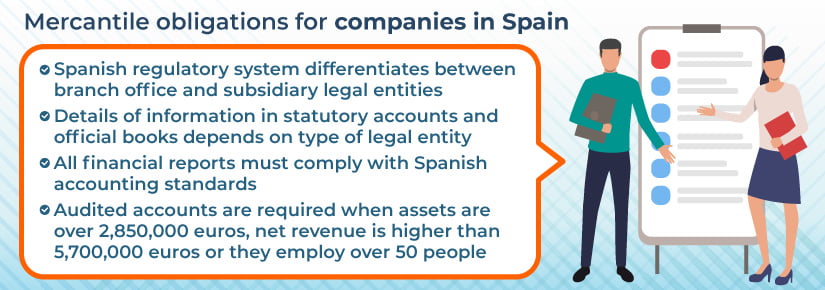
All companies registered in Spain are obliged to keep statutory accounts and official books. The amount of information that is required in these official records depends upon whether the company is registered as a branch office or as a subsidiary. For example, branch offices are only required to file proof of the annual accounts of the foreign parent company; the detailed information of these foreign annual accounts is not made public in Spain. Spanish law solely requires a notarial certification that those annual accounts have been filed. Subsidiary companies are independent legal entities and therefore are treated as resident Spanish companies that must have their own management and control bodies, official books, approved minutes of meetings and ledgers.
Legal entity accounting for companies operating in Spain
As is clearly stated in the Spanish Plan General Contable, a company’s annual accounts comprise of the balance sheet, income statement, statement of changes in equity, statement of cash flows and the notes thereto. These documents constitute a unit often referred to as ‘official books’. Bookkeeping entries must be posted in euros and must be made available in Spanish. The books, correspondence and relevant documentation is to be kept for six years from the date of the last bookkeeping entry.
All companies in Spain must submit the official books to the Mercantile Registry within three months of the year-end of the company. Thus, if the year-end is the 31st of December, the quarterly balance sheet, P&L statement, daily ledger, and general ledger must be filed by the 31st of March of the following year. These are private records that are held at the Mercantile Registry and not open to public scrutiny.
When audited accounts are required
An audit is required with legal entities meet two of the following three limits in two consecutive years. That they have total assets over 2,850,000 euros, that their net revenue is higher than 5,700,000 euros or that they employ over 50 people. An auditor is appointed at the General Meeting or General Assembly which is held prior to the end of the first financial year for which accounts need to be edited. A comprehensive financial report must be presented by the company directors which should include the balance sheet, profit and loss account, cash flow situation, a statement of changes in equity, notes to the financial statements and a management. All financial reports must comply with Spanish accounting standards.
A final recommendation
When considering the mercantile obligations of companies in Spain, we strongly recommend that the company name and brand name are registered at the Spanish Patent and Trademark Office (SPTO). Leialta can help with this and other aspects of setting up a business in Spain. Contact us today to find out how our advice can support your business today.


Hello, I had a company set up 20 years ago in Spain, the business it was set up for never materialised, so the company was not active, therefore we never put in any accounts as we did not think we needed too, I have now sold my property in Spain, I have money in a business account €2,3405.25 that I can’t access as the A.E.A.T have revoked my NIF number and they say they need my corporate tax information, I am told that i will need to produce 3 years Accounts, I have also had €302.09 Embargoes taken from my personal accounts by the A.E.A.T on the 25/02/2025, what can I do please.
Regards Anthony Lewis
Thank you for your enquiry, Anthony.
From what you describe, the situation is quite common in companies that have remained inactive for a long period. In Spain, even inactive companies are required to comply with certain tax and accounting obligations, and failure to do so over time can lead to the revocation of the NIF by the Tax Authorities.
Once the NIF is revoked, the company is effectively blocked from operating, including accessing bank accounts, until the situation is properly regularised.
To better understand what steps are involved and how this type of situation can be resolved, you may find this guide helpful:
https://www.leialta.com/en/blog/reinstate-revoked-spanish-nif-company/