

Beckham Law in Spain: requirements and how to apply for the special tax regime for inbound workers
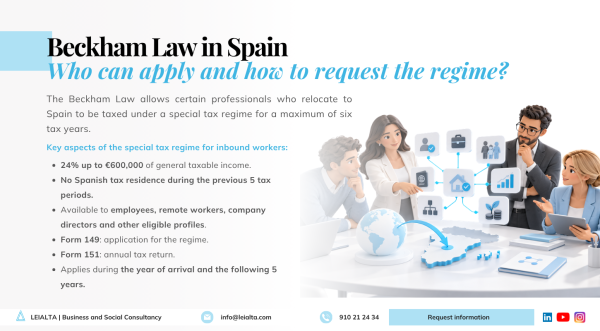
The so-called Beckham Law allows certain individuals who relocate to Spain to opt for a special tax regime during the year in which they become Spanish tax residents and the following five tax periods.
Although it is commonly known as the Beckham Law, it is actually the special tax regime for workers, professionals, entrepreneurs and investors who move to Spain, regulated under Article 93 of the Spanish Personal Income Tax Law.
In this article, we explain who can apply for the Beckham Law, the requirements that must be met, how to apply using Form 149 and how to file taxes subsequently using Form 151.
What is the Beckham Law?
Index of contents
The Beckham Law is the colloquial name given to the special tax regime established under Article 93 of the Spanish Personal Income Tax Law for certain individuals who become tax residents in Spain as a result of relocating to the country.
Individuals who opt for this regime remain Spanish Personal Income Tax taxpayers, but their tax liability is calculated according to certain rules applicable under Non-Resident Income Tax.
The regime applies during:
- The tax period in which the individual becomes a Spanish tax resident.
- The following five tax periods.
For these purposes, the Spanish Tax Agency considers the first tax period to be the first calendar year in which, following the relocation, the individual spends more than 183 days in Spain.
Since 2023, the reform introduced by Spain’s Startup Law has significantly expanded the range of individuals who can apply for the regime, including international remote workers, entrepreneurs, certain highly qualified professionals and some family members of the main taxpayer.
Beckham Law requirements
Para acogerse al régimen especial deben cumplirse varias condiciones.
1. The individual must not have been a Spanish tax resident during the previous five tax periods
Currently, the taxpayer must not have been a Spanish tax resident during the five tax periods preceding the year in which the relocation takes place.
This is one of the most important changes introduced since 2023, as the previous rules required ten years of non-residence.
2. The relocation must take place for one of the reasons established by law
Simply deciding to move to Spain is not enough. The relocation must be linked to one of the circumstances permitted under the legislation. It may take place because of:
- An employment contract.
- A posting ordered by a foreign employer.
- Remote working from Spain.
- Becoming a director of a company.
- Carrying out an economic activity classified as an entrepreneurial activity.
- Certain activities carried out by highly qualified professionals.
- Training, research, development or innovation activities that meet the applicable requirements.
Who can currently apply for the Beckham Law?
The 2023 reform considerably expanded the profiles that may benefit from the regime.
| Profile | Eligible? | Main considerations |
|---|---|---|
| Employee hired by a Spanish company | Yes | The relocation must be linked to the start of the employment relationship. |
| Employee posted by a foreign company | Yes | There must be a posting order or assignment letter. |
| International remote worker | Yes | The individual may work remotely from Spain using IT and telecommunications systems. |
| Company director | Yes | Specific rules apply where the company is considered an asset-holding entity. |
| Entrepreneur | Yes | The activity must qualify as an entrepreneurial activity under the applicable legislation. |
| Highly qualified professional | Yes, in certain cases | The individual must provide services to startups or carry out certain qualifying activities. |
| R&D&I or training professional | Yes, if the requirements are met | Income from these activities must meet the statutory conditions. |
| Professional athlete | No | Professional athletes are expressly excluded. |
International remote workers
The legislation allows individuals to apply for the regime where their employment activity is carried out remotely from Spain exclusively through IT, telematic and telecommunications systems.
This requirement is met for employees who hold an international remote work visa, although the tax regime and immigration status must be analysed separately.
Company directors
This is particularly relevant because the rules have changed compared with previous versions of the Beckham Law.
There is no longer a general rule under which a director can only qualify if they own less than 25% of the company.
Currently, a director may apply for the regime regardless of their ownership percentage. The limitation arises where the company is considered an asset-holding entity. In that case, the director’s ownership interest must not result in the existence of a related-party relationship under Article 18 of the Spanish Corporate Income Tax Law.
For this reason, where an individual moves to Spain to become a company director, it is important to analyse the corporate structure before applying for the regime.
Entrepreneurs and professionals
It is also no longer correct to state that all self-employed professionals are excluded.
The legislation allows certain individuals carrying out the following activities in Spain to apply, among others:
- An economic activity qualifying as an entrepreneurial activity.
- An activity as a highly qualified professional providing services to a startup.
- Training, research, development or innovation activities where the relevant conditions are met.
For highly qualified professionals and individuals carrying out training or R&D&I activities, the income from those activities must jointly represent more than 40% of their total business, professional and employment income.
Can spouses and children also apply?
Yes. Since 2023, certain family members may apply as taxpayers associated with the main taxpayer.
This may include:
- The spouse.
- Children under the age of 25.
- Children of any age where they have a disability.
- Where the taxpayer is not married, the other parent of their children.
They must relocate to Spain within the applicable deadlines, become Spanish tax residents, meet the prior residence and permanent establishment requirements and comply with certain limits relating to the main taxpayer’s taxable base.
Everyone must exercise the option separately. The main taxpayer submits Form 149 first, followed by the associated taxpayers.
How is an individual taxed under the Beckham Law?
One of the most common questions is whether the Beckham Law allows an individual to “pay tax only on Spanish-source income”. However, this statement requires qualification.
Generally, the regime uses certain Non-Resident Income Tax rules to determine which income is taxable in Spain. Nevertheless, there is one particularly important rule: all employment income obtained while the regime applies is considered Spanish-source income, even where part of the work relates to a foreign employer or the remuneration is paid from outside Spain. The same applies to income from economic activities classified as entrepreneurial activities.
By contrast, certain foreign-source income, such as dividends, interest or capital gains arising from assets located outside Spain, may fall outside Spanish taxation where they are not considered Spanish-source income under the Non-Resident Income Tax rules.
Therefore, determining whether the regime is beneficial requires more than simply comparing salary levels and Personal Income Tax rates. All sources of income and their tax classification need to be reviewed.
Beckham Law tax rates
For most income subject to the regime, the following rates apply:
| Taxable base | Rate |
|---|---|
| Up to €600,000 | 24% |
| From €600,000.01 | 47% |
For dividends, interest and certain capital gains arising in Spain, a different scale applies:
| Taxable base | Rate |
|---|---|
| Up to €6,000 | 19% |
| From €6,000 to €50,000 | 21% |
| From €50,000 to €200,000 | 23% |
| From €200,000 to €300,000 | 27% |
| Over €300,000 | 30% |
It would therefore no longer be correct to state that dividends or capital gains are always taxed at a flat rate of 19%.
Does the Beckham Law always mean paying less tax?
No. The 24% rate may be attractive, particularly for certain higher levels of income, but the regime should always be compared with the tax liability that would arise under the ordinary Spanish Personal Income Tax regime.
Whether the Beckham Law is advantageous will depend, among other factors, on:
- Annual salary.
- Other income obtained in Spain.
- Foreign-source income or investments.
- Family circumstances.
- The taxpayer’s assets.
- The corporate structure where the individual is a director.
- Any deductions or reductions that might apply under the ordinary regime.
For this reason, before applying for the Beckham Law, it is advisable to compare the tax implications of both scenarios. This is particularly relevant for directors, senior executives or individuals considering relocating to Spain before setting up a company.
What happens with Wealth Tax?
Individuals who apply for the special regime are subject to Spanish Wealth Tax on a limited liability basis.
Generally, this means that the analysis focuses on assets and rights located, exercisable or enforceable in Spain rather than on the individual’s worldwide assets.
In addition, the main residence may qualify for the statutory exemption of up to €300,000, provided that the applicable requirements are met.
Where significant assets are involved, a specific review of the applicable wealth taxation is advisable.
Is Form 720 required?
According to the criteria published by the Spanish Tax Agency, individuals subject to the special regime under Article 93 are not required to file Form 720 in relation to assets and rights located abroad.
This should be distinguished from the position of other family members who are not covered by the regime and who may have their own reporting obligations.
How to apply for the Beckham Law: Form 149 step by step
Application of the regime is not automatic. The option must be expressly exercised before the Spanish Tax Agency.
1. Check in advance that the requirements are met
Before submitting any application, it is advisable to review:
- Tax residence during the previous five tax periods.
- Reason for the relocation.
- Date of arrival in Spain.
- Start date of the employment relationship or activity.
- Social Security position.
- Ownership interest in the company, in the case of directors.
- Type of activity, in the case of entrepreneurs or professionals.
2. Obtain a NIF and register with the Taxpayers’ Census
The Spanish Tax Agency requires the taxpayer to have a Spanish tax identification number, NIF, and to be registered with the Taxpayers’ Census before submitting Form 149.
If the taxpayer is not yet registered, the relevant census registration must first be completed.
3. Prepare and submit the supporting documentation
Before filing Form 149, the Spanish Tax Agency’s specific procedure must be used to submit the documentation required to opt for the regime.
The registration number obtained when submitting this documentation must subsequently be included on Form 149.
The documents required will depend on the reason for the relocation. For example:
- For employees, documentation from the employer confirming the employment relationship, start date, workplace and duration.
- For international postings, the assignment letter and Social Security documentation.
- For remote workers, employer documentation confirming the employment relationship and remote working arrangement.
- For directors, company documentation confirming their appointment.
- For entrepreneurs, the corresponding favourable report may be required.
- For highly qualified professionals, their status and their relationship with the startup must be evidenced.
4. Submit Form 149
Form 149 is the notification used to opt for the regime.
Generally, the main taxpayer has a maximum period of six months from the date on which the activity begins, as stated in the Spanish Social Security registration or in the documentation allowing the individual to remain subject to the Social Security legislation of the home country.
This deadline is essential. Companies and individuals should not wait until the annual tax return is due before assessing whether the Beckham Law may be appropriate.
5. Obtain confirmation from the Spanish Tax Agency
If the application and supporting documentation are correct, the Spanish Tax Agency will issue a certificate confirming that the regime applies.
The legislation provides for a maximum period of ten working days from submission of the notification.
Form 149 and Form 151: what is the difference?
These are two different forms with different purposes.
| Form | Purpose | When is it used? |
|---|---|---|
| Form 149 | Notify the option to apply the Beckham Law. | When applying for the regime. |
| Form 149 | Notify withdrawal, exclusion or the end of the relocation. | When any of these circumstances arise. |
| Form 151 | File the annual tax return under the special regime. | Each tax year while the regime applies. |
When is Form 151 filed?
Once the regime has been recognised, the taxpayer must file Form 151 each year. This is the specific Spanish Personal Income Tax return for individuals taxed under the Beckham Law.
The initial application using Form 149 should therefore not be confused with the annual obligation to file Form 151.
Can you withdraw from the Beckham Law?
Yes, although certain conditions apply.
Withdrawal must be notified using Form 149 during November and December of the year before the calendar year in which the withdrawal is intended to take effect.
In addition, if the requirements of the regime cease to be met, the exclusion must be reported within one month of the breach.
Both withdrawal and exclusion should be analysed carefully in advance, as the legislation imposes restrictions on subsequently opting for the regime again.
What should a company be employing individuals under the Beckham Law review?
The Beckham Law does not affect only the taxpayer.
When a Spanish company hires an executive, posted employee or international professional, it is important to coordinate the tax application of the regime with labour and payroll management.
Among other matters, the company should review:
- Documentation supporting the relocation.
- The relevant Spanish Social Security registration or status.
- The withholding tax applicable through payroll.
- Evidence that the employee is covered by the special regime.
- Any changes that could result in the loss of eligibility.
- Coordination between tax, payroll and international mobility.
For employment income, the withholding rate is 24%, increasing to 47% on the portion of remuneration paid by the same payer that exceeds €600,000 per year.
This coordinated approach is particularly important for international companies that relocate several employees to Spain or need to incorporate the Beckham Law into their ongoing payroll and HR management.
At LEIALTA, our Labour Department manages expatriation and impatriation processes, non-resident workers, international postings and the application of special tax regimes such as the Beckham Law in coordination with our Tax Department.
You can find further information about our labour advisory services for companies and our tax advisory services.
Beckham Law and companies planning to establish operations in Spain
In some cases, questions about the Beckham Law arise before the company has even started operating in Spain.
For example, a foreign group may be considering relocating an executive who will become a director of a new Spanish company. In that situation, several issues should be analysed together:
- Whether the executive can apply for the special regime.
- When the relocation should take place.
- Which corporate structure will be created.
- What ownership interest the director will hold.
- How employment, payroll and Social Security will be organised.
- Which tax and corporate obligations the company will assume.
For this reason, planning for the Beckham Law can form part of a broader decision regarding business establishment in Spain.
If your company is considering setting up operations in Spain, you can also consult our company formation services in Spain.
Common mistakes when applying for the Beckham Law
The most common problems do not usually arise solely from the tax calculation itself, but from checking the requirements too late or submitting the application incorrectly.
Some of the mistakes to avoid include:
- Believing that the individual must still have been non-resident in Spain for ten years.
- Applying for the regime after the six-month deadline.
- Assuming that any relocation to Spain qualifies.
- Continuing to apply the old general 24% ownership limit to all company directors.
- Assuming that all self-employed professionals are excluded.
- Confusing Form 149 with the annual Form 151 tax return.
- Assuming that any income paid from abroad falls outside Spanish taxation.
- Failing to review how the regime affects payroll and withholding tax.
- Failing to assess whether the regime is genuinely more advantageous than the ordinary Spanish Personal Income Tax regime.
How can you determine whether the Beckham Law is right for you?
The answer depends on the individual circumstances.
Before opting for the regime, it is advisable to compare the tax liability that would arise under the ordinary Spanish Personal Income Tax regime with the liability under the special regime.
At a minimum, this analysis should consider:
- Expected remuneration in Spain.
- Foreign-source income.
- Investments and assets.
- Family circumstances.
- Expected duration of the relocation.
- Relationship with the Spanish company.
- Potential labour and Social Security obligations.
For certain profiles, the tax difference may be significant. For others, the regime may not provide a substantial advantage.
Advice on applying for the Beckham Law in Spain with LEIALTA
Applying for the special tax regime for inbound workers requires coordination between tax residence, employment status, Social Security, corporate structure and taxation.
At LEIALTA, we assess in advance whether the individual meets the requirements and whether applying for the regime is appropriate from a tax perspective.
Our multidisciplinary coordination is particularly useful where the relocation forms part of an international recruitment process or the establishment of a foreign company in Spain.
Obtaining advice before the relocation makes it possible to review the applicable deadlines, assess the potential tax savings correctly and avoid employment or corporate decisions that could subsequently prevent the special regime from applying.


Good Article
Hello, how long does it take for the tax authorities to issue the Beckham Act certificate? Best regards
Dear Tom, the tax authorities have a period of 10 days from receipt of the application. application.
However, in practice it usually takes 1-2 months.
Best regards
Hi! I understand that this special regime applies during the tax period the taxpayer acquires his tax residence in Spain and during the following five tax periods, in total six years. If I arrive in Spain in September 2022 (the year in which I wouldn´t be a tax resident in Spain), could I benefit from the regime until 2027 or 2028 inclusive? In other words, would 2022 or 2023 be considered the first of the six years of tax residence?
Best regards!
Hello, It will start in 2023. It would run from 2023 to 2028, both inclusive. Best regards!
Hola, una pregunta ¿Cuál es el plazo para solicitar la aplicación de este régimen? Gracias
Hola, la solicitud se tiene que presentar dentro de los 6 meses a partir de la fecha en la que te inscribes en la Seguridad Social como trabajador de la empresa española que te contrata. Si lo realizas después de este plazo se te denegará la petición y no podrás aplicarte el régimen. Un saludo
Great post. I’m facing some of these issues as well..