A company merger in Spain may be considered when two companies within the same group carry out similar activities, when a business wants to integrate a recently acquired Spanish company or when two organisations decide to combine their capabilities.
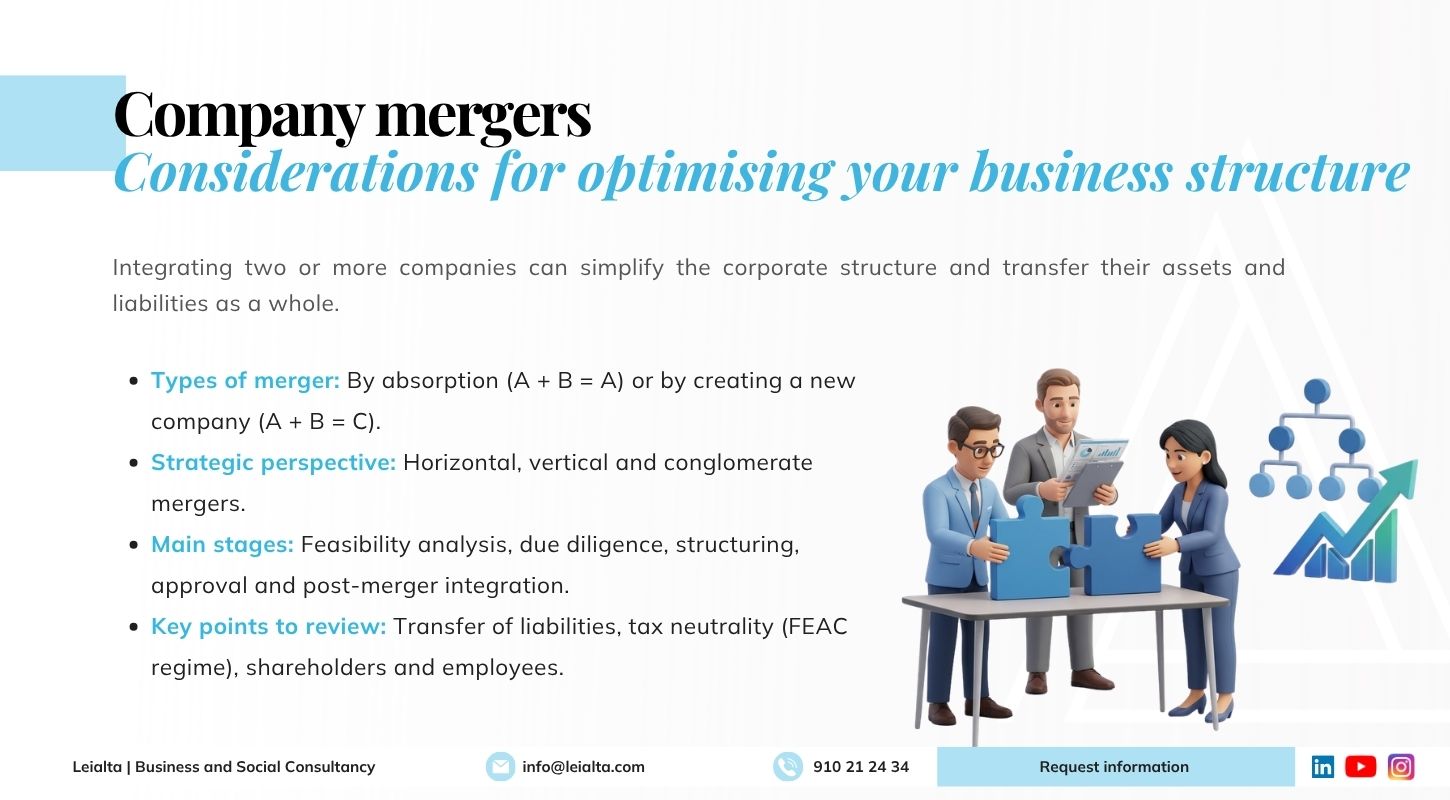
Under Spanish corporate law, a merger allows two or more companies to be integrated into a single legal entity through the transfer of their assets and liabilities as a whole. Depending on the structure, an existing company may absorb the others or a new company may be created.
However, merging companies involves much more than bringing their operations together. The transaction affects their legal structure, assets, liabilities, shareholders and employees. In this article, we explain the main types of company merger in Spain, examine real examples and outline the stages and issues that should be assessed before proceeding.
What is a company merger?
Index of contents
A company merger is a corporate transaction through which two or more companies are integrated into a single entity. Their assets and liabilities are transferred as a whole, while one or more of the participating companies cease to exist.
The resulting company may already have existed before the transaction or may be an entirely new entity.
Spanish corporate law provides for these two main possibilities: merger by absorption and merger through the creation of a new company.
In both cases, the transfer takes place by universal succession. This means that rights and assets are transferred together with obligations and liabilities.
A merger therefore involves more than combining activities or teams. It affects the legal structure of the companies involved, so the assets being integrated and the consequences for the resulting company must be analysed in advance.
Merger vs acquisition: what is the difference?
An acquisition does not necessarily involve a merger.
For example, imagine that Company A acquires 100% of the shares or equity interests in Company B. Following the acquisition, A owns B, but both companies may continue to exist as separate legal entities.
If A subsequently absorbs B, the situation changes. Company B ceases to exist and its assets and liabilities are transferred to A.
Therefore, although mergers and acquisitions are commonly considered together within M&A transactions, they are not legally the same:
- A company acquisition changes who controls a company.
- A company merger also changes the corporate structure by integrating the participating entities.
What types of company mergers are there?
Company mergers can be classified in different ways.
From a corporate law perspective, Spanish regulations mainly distinguish between:
- Merger by absorption.
- Merger through the creation of a new company.
From an economic or strategic perspective, it is also common to refer to horizontal, vertical or conglomerate mergers.
These terms help explain the relationship between the businesses involved, although they are not separate legal forms of merger.
Merger by absorption
In a merger by absorption, an existing company integrates one or more other companies.
The absorbing company continues to exist, while the absorbed companies cease to exist and transfer their assets and liabilities to the absorbing company.
The simplest structure would be:
A + B = A
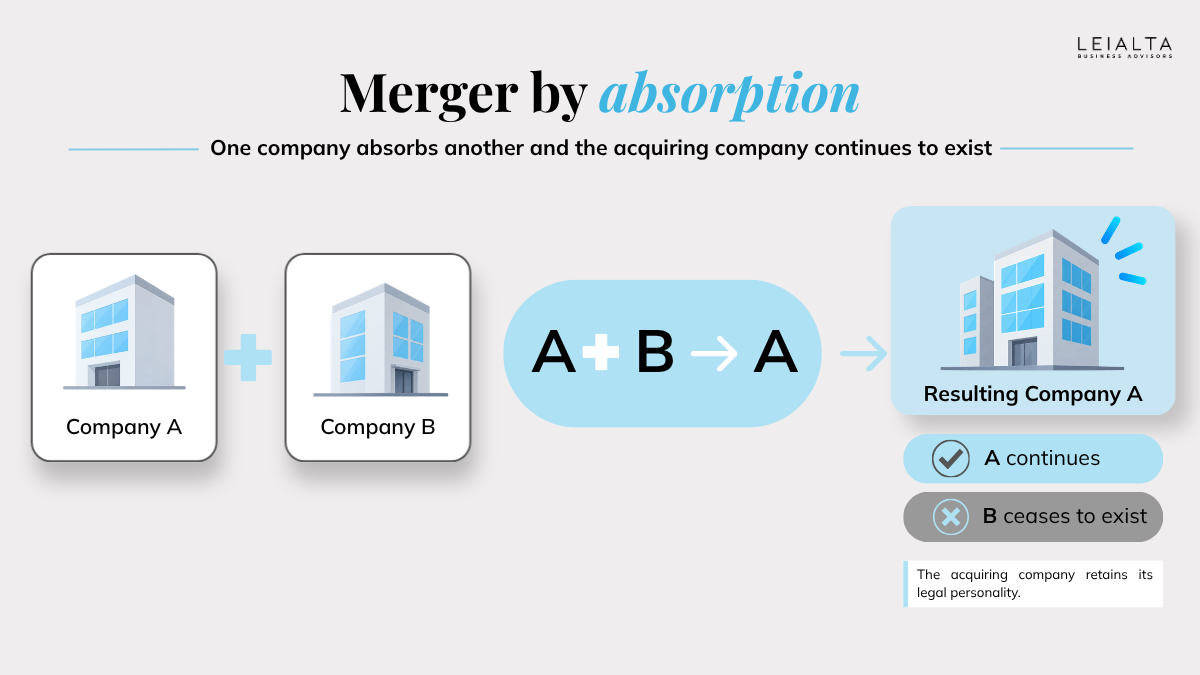
Company A absorbs Company B. After the merger, A continues to exist while B disappears as a separate legal entity.
As a result, the absorbing company acquires the rights and obligations of the absorbed company through universal succession.
Merger through the creation of a new company
The second possibility involves the participating companies ceasing to exist and transferring their assets and liabilities to a new company created as a result of the merger.
In this case:
A + B = C
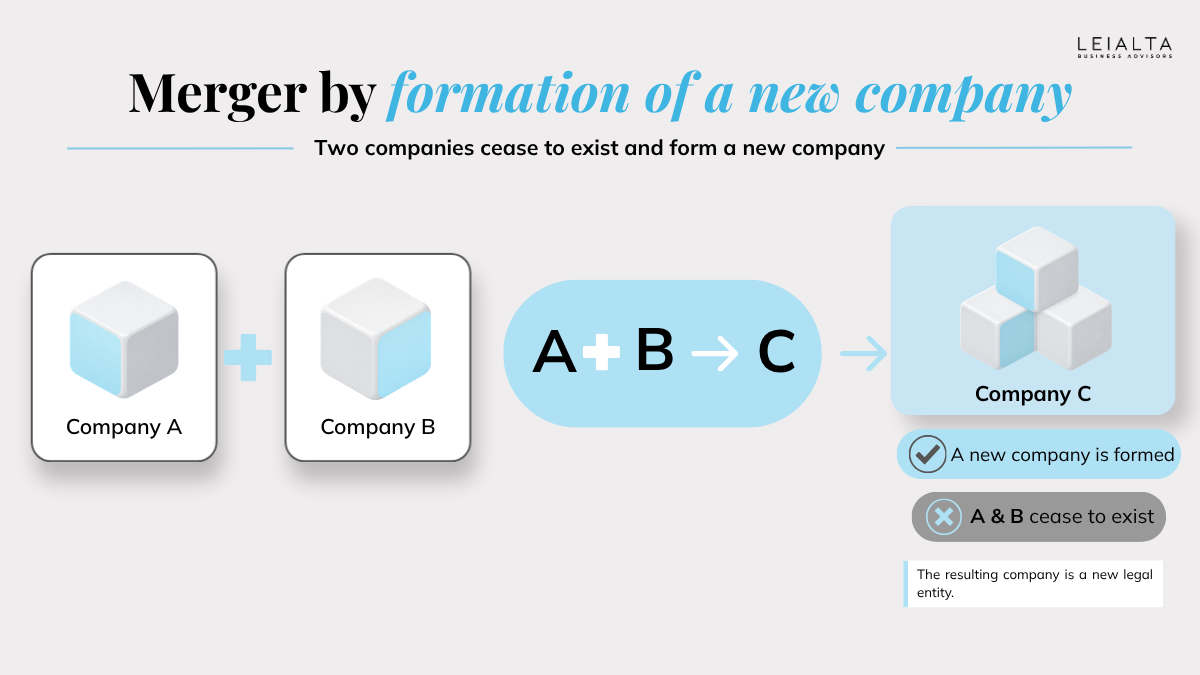
Companies A and B cease to exist independently, and a new Company C is created, receiving their respective assets and liabilities.
The main difference compared with a merger by absorption is that none of the original companies remains as the resulting entity.
Horizontal, vertical and conglomerate mergers
Mergers can also be classified according to the relationship between the activities carried out by the companies involved.
- A horizontal merger takes place between companies operating in the same or similar activities at the same level of the value chain.
- A vertical merger integrates companies operating at different stages of the same process. For example, a manufacturer may merge with a company responsible for distributing its products.
- A conglomerate merger may involve companies whose activities are not directly related.
These classifications help explain the business rationale behind the integration.
Special mergers involving wholly owned subsidiaries
A common example is the absorption of a wholly owned subsidiary by its parent company. In Spanish corporate practice, this transaction is sometimes referred to as a fusión impropia.
Spanish Royal Decree-Law 5/2023 provides for a simplified regime in certain mergers involving wholly owned subsidiaries or companies in which the absorbing company holds at least 90% of the share capital.
Examples of company mergers
To understand how company mergers work in practice, it is useful to look at several examples.
However, two different types of examples should be distinguished:
- The first examples are real and documented transactions.
- The final example is an illustrative scenario designed to explain how a merger could be used within a family-owned group.
CaixaBank’s absorption of Bankia: March 2021
One of the best-known recent merger examples in Spain is the integration of CaixaBank and Bankia.
The transaction was structured as a merger by absorption of Bankia by CaixaBank.
The merger deed was registered with the Valencia Commercial Registry on 26 March 2021. From that date, CaixaBank continued as the absorbing company and Bankia was integrated into it.
The transaction sought to bring both entities together under a single structure and increase their scale in the Spanish banking market.
It also illustrates an important point: legally completing the merger did not mean that the entire integration process was finished.
Once the merger had been registered, the operational integration of both organisations still had to take place.
Unicaja Banco as absorbing company and Liberbank as absorbed company: July 2021
Another example in Spain is the merger between Unicaja Banco and Liberbank.
In this case, Unicaja Banco acted as the absorbing company and Liberbank as the absorbed company.
The legal integration became effective on 30 July 2021, once the merger deed was registered. Liberbank then ceased to exist and transferred its assets and liabilities to Unicaja Banco.
The transaction documentation identified the integration of both businesses into a common structure as its main objective.
Other considerations included scale, efficiency and the cost structure.
Once again, this was a merger by absorption: two entities participated, but only one remained legally in existence afterwards.
Example of a merger within a family-owned group
Now consider a situation that may be closer to the reality of an SME or family-owned group.
Imagine a family business with two companies.
Company A was originally established to carry out the group’s main business activity. Several years later, Company B was incorporated to develop another business line.
Over time, however, both companies begin carrying out very similar activities.
They share management, some administrative staff, suppliers and even certain internal processes.
As a result, maintaining two separate corporate structures begins to create duplication and no longer reflects how the business actually operates.
In this situation, a merger by absorption could be considered:
Company A + Company B = Company A
Company B would cease to exist and transfer all of its assets and liabilities to Company A.
The objective would not simply be to “have one less company”.
Instead, the key question would be whether concentrating both activities could create a corporate structure that better reflects the way the group actually operates.
Before proceeding, several matters would need to be reviewed, including:
- Assets of both companies.
- Liabilities and debt.
- Contracts.
- Employees.
- Tax position.
- Ownership structure.
- Potential contingencies.
Therefore, even when a merger appears straightforward at first sight, the decision should always begin with a proper preliminary analysis.
When might a company merger be considered?
There is no single reason to carry out a merger.
A transaction may be driven by growth, internal reorganisation or the need to adapt a corporate structure that no longer fits the business.
Below are some of the most common situations.
Simplifying the structure of a corporate group
As a corporate group grows, it is common for new companies to be created over time.
Different companies may have been established because of:
- A new business line.
- An investment.
- An acquisition.
- A decision made several years earlier.
However, the resulting structure may eventually stop making sense.
For example, two companies may end up carrying out almost identical activities or maintaining duplicate administrative structures.
In these cases, a merger may help concentrate related activities and simplify the corporate structure.
However, a merger does not automatically reduce costs or improve efficiency.
The company must first identify which functions can genuinely be integrated and assess the consequences of doing so.
Growing and entering new markets
A company may also consider a merger as part of its growth strategy.
Combining with another business can bring together geographical presence, capabilities, customer portfolios, sector expertise or other resources.
Nevertheless, creating a larger legal entity does not automatically produce better financial results.
The business rationale behind the integration must therefore be assessed carefully. Companies should consider how the two organisations will be combined after the transaction.
Integrating complementary activities
Another possible scenario arises when two companies carry out different but directly related activities.
For example, one company may manufacture a product while another distributes it.
If both belong to the same group, or if there is another business reason for integration, a merger could be considered to place both activities under a single corporate structure.
This type of situation is closely related to a vertical merger, because different stages of the same value chain are being integrated.
Reorganising the business following a change in strategy
A company’s corporate structure should also evolve when its strategy changes.
For example:
- A company may previously have acquired another business and later decide to integrate it.
- A family-owned group may conclude that some companies no longer have a distinct function.
- Several companies may wish to concentrate certain activities before entering a new stage.
In all of these cases, a merger is one option that should be compared with other possible corporate transactions.
The aim should not be to merge companies simply to simplify the organisation chart.
Instead, the analysis should identify which structure best supports the current and future objectives of the business.
Advantages and risks of a company merger
A merger can provide benefits when it responds to a genuine business need.
However, it also involves integrating obligations, people, processes and risks.
For this reason, both sides of the transaction should be considered.
| Potential benefit | Risk or issue to review |
|---|---|
| Simplifying a corporate structure | Integration also generates internal work and costs |
| Reducing certain duplications | Not every function can be eliminated without affecting the business |
| Concentrating related activities | Processes, contracts and teams need to be integrated |
| Increasing business scale | A larger company is not automatically more profitable |
| Combining capabilities, customers or markets | Expected synergies may not materialise |
| Integrating assets into a single company | Liabilities and obligations are transferred as well |
The usefulness of a merger therefore depends on the circumstances of the companies involved. A simpler structure may benefit one group but make little sense for another.
Likewise, a transaction designed to support growth may create difficulties if post-merger integration has not been properly planned.
How is a company merger carried out?
The specific procedure depends on the participating companies and the characteristics of the transaction.
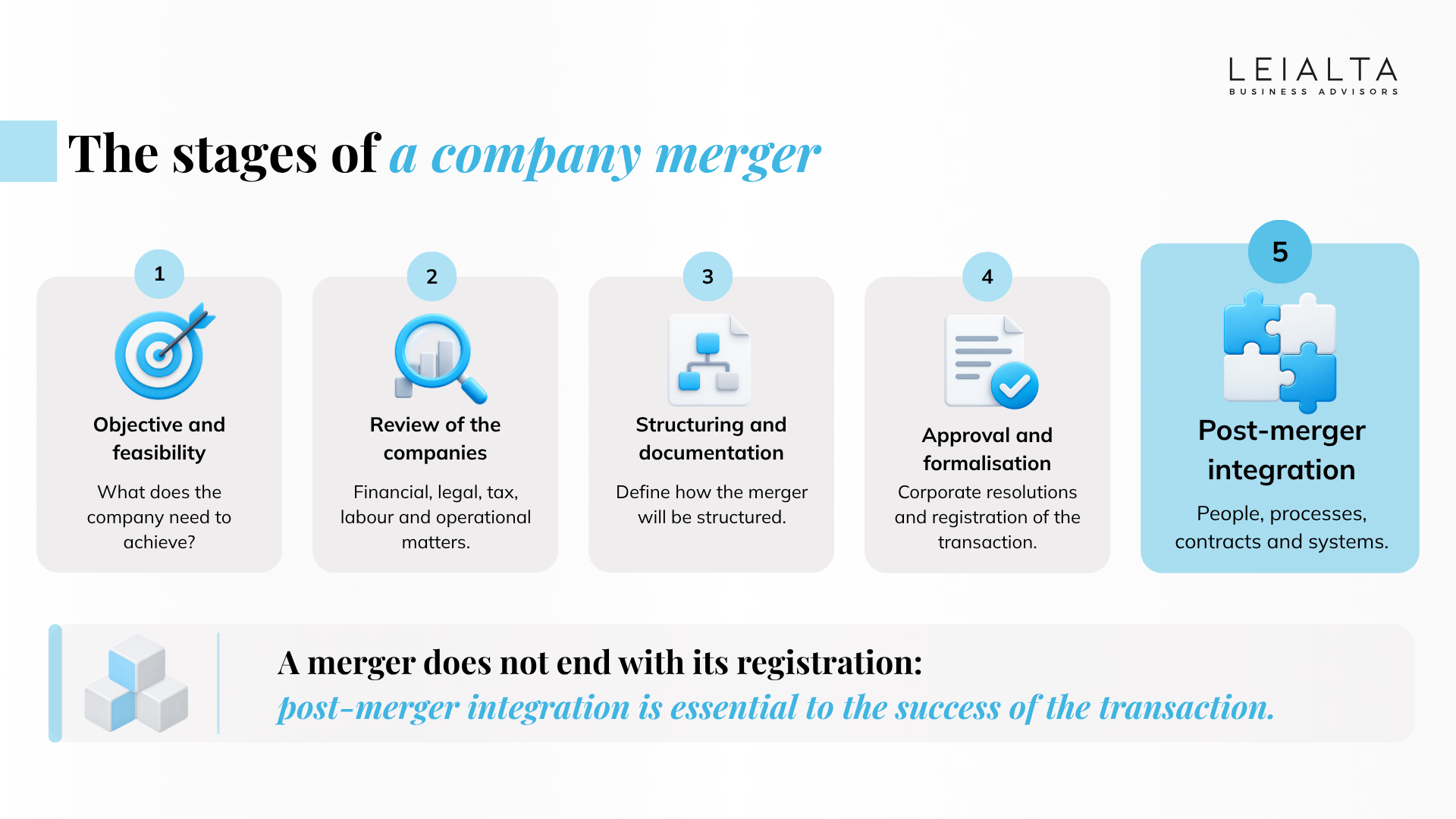
However, from a business perspective, the process can be understood in five main stages.
1. Determine whether a merger is the right transaction
The first step should not be to start preparing the legal documentation.
The company should first answer one question: what does the business need to achieve?
There may be different objectives: simplifying a group, integrating an acquisition, concentrating activities or supporting growth may each require different solutions.
At this stage, it is also important to assess whether a merger is the most appropriate option or whether another corporate transaction could achieve the objective more effectively.
2. Review the position of the participating companies
Before the transaction is structured, the assets, liabilities, obligations and potential risks of each participating company must be identified.
The scope of the review will depend on the circumstances, but it may include:
- Financial and accounting matters.
- Tax matters.
- Corporate and legal matters.
- Contracts.
- Employment matters.
- Operational issues.
The analysis should also identify debts, litigation, key contracts, guarantees, assets, outstanding obligations and other contingencies that could be transferred to the resulting company.
Not every merger requires the same type of due diligence.
However, carrying out a review adapted to the risks of the transaction can prevent significant issues from being discovered only after the merger has already been completed.
3. Structure the transaction and prepare the documentation
Once the position of the companies is understood, the merger structure must be defined.
The corporate documentation includes the common draft terms of merger, which must be prepared and signed by the directors of the participating companies.
The remaining documentation will depend on the characteristics of the transaction and any specific rules that apply.
At this stage, tax, accounting and labour implications should also be coordinated with the corporate structure of the merger.
4. Approve and formalise the merger
As a rule, the merger must be approved by the participating companies in accordance with the applicable legal procedure.
However, certain special cases may allow some requirements to be simplified.
The merger resolution is subsequently formalised in a public deed before a Spanish notary.
The merger becomes effective once the new company or the absorption is registered with the competent Spanish Commercial Registry.
Following registration, the corresponding entries relating to the companies that have ceased to exist are cancelled.
5. Integrate the companies after the transaction
Registration should not be seen as the end of the process.
Once the legal merger has been completed, it may still be necessary to integrate:
- Teams and responsibilities.
- Internal processes.
- Management systems.
- Accounting and reporting.
- Customer and supplier relationships.
- Contracts and day-to-day operations.
- Governance and decision-making processes.
A merger can be legally well executed and still create problems if the subsequent business integration has not been properly prepared.
For this reason, post-merger integration should form part of the planning process from the outset.
What should you consider before merging your company?
Before beginning the transaction, several factors should be reviewed because they may affect both the merger structure and how the resulting company will operate afterwards.
- Business objective. Define what the transaction is intended to achieve and confirm that a merger genuinely responds to that need.
- Assets and potential contingencies. Understand the assets, debts, contracts, guarantees and obligations that will be transferred to the resulting company.
- Tax impact. Analyse the Spanish tax consequences and whether the transaction may qualify for the tax-neutral corporate restructuring regime, commonly known as the FEAC regime. This regime covers qualifying mergers, demergers, contributions of assets and share-for-share exchanges. Where the relevant requirements are met, it may allow taxation of certain gains to be deferred, but it does not provide an automatic exemption or guaranteed tax saving. automatic exemption or guaranteed tax saving.
- Shareholders and ownership structure. Review how equity interests, shareholder rights and the governance of the resulting company will be structured.
- Employees and operational integration. Consider in advance how teams, responsibilities, processes and systems will be reorganised after the merger.
The preliminary analysis should therefore explain not only how the transaction can be implemented, but also what the business structure will look like afterwards.
Frequently asked questions about company mergers
What happens to debt when two companies merge?
Debt does not disappear simply because a merger takes place.
The transfer of assets and liabilities includes both rights and obligations.
In a merger by absorption, for example, the absorbing company acquires the assets and liabilities of the absorbed company through universal succession.
This is why existing obligations and potential contingencies should be identified before the transaction is completed.
Is an absorbed company liquidated?
In a merger by absorption, the absorbed company ceases to exist and transfers its assets and liabilities to the absorbing company.
It does not undergo an ordinary liquidation process in which assets are realised and the remaining value subsequently distributed.
The purpose of the merger is precisely to ensure that those assets and liabilities continue within the resulting company.
What is the difference between a merger and an absorption?
An absorption is one type of merger.
In a merger by absorption, an existing company integrates another company and continues to exist.
Alternatively, a merger may create a new company. In that case, the original companies cease to exist, and a new legal entity is formed.
Can a company merger reduce taxes?
Not necessarily.
Where the relevant requirements are satisfied, certain transactions may qualify for the FEAC regime.
This regime is intended to prevent taxation from becoming an obstacle to qualifying business reorganisations and generally allows taxation of certain gains to be deferred.
However, it is not an automatic tax exemption. Nor does it mean that every merger can be carried out without tax consequences.
The transaction structure, its business rationale and compliance with the applicable requirements must be reviewed in each case.
How long does a company merger take?
There is no single timeframe that applies to every merger.
The duration will depend on factors such as:
- Number and type of companies involved.
- Ownership structure.
- Available documentation.
- Need for reports or authorisations.
- Nature of the assets involved.
- Any specific characteristics of the transaction.
Therefore, before establishing a timetable, the company should first determine what type of merger will be carried out and which specific requirements apply.
How to approach a company merger
A company merger can help simplify a group, integrate activities or adapt the corporate structure to a new strategy.
However, its suitability should not be assessed solely by considering how many companies will disappear or whether the transaction could have a particular tax effect.
The key question is what the company needs to achieve and how the organisation will operate after the transaction.
For this reason, corporate, tax, accounting, labour and operational implications should be analysed together before a merger is implemented.
A decision affecting the entire business structure can rarely be assessed properly from a single perspective.
At LEIALTA, we support companies, SMEs and family-owned groups with business restructuring transactions, coordinating the different specialist areas involved throughout the process.
If you are considering integrating several companies, reorganising a corporate group or simplifying its structure, we can analyse the current situation and assess which alternative best supports your business objectives.