

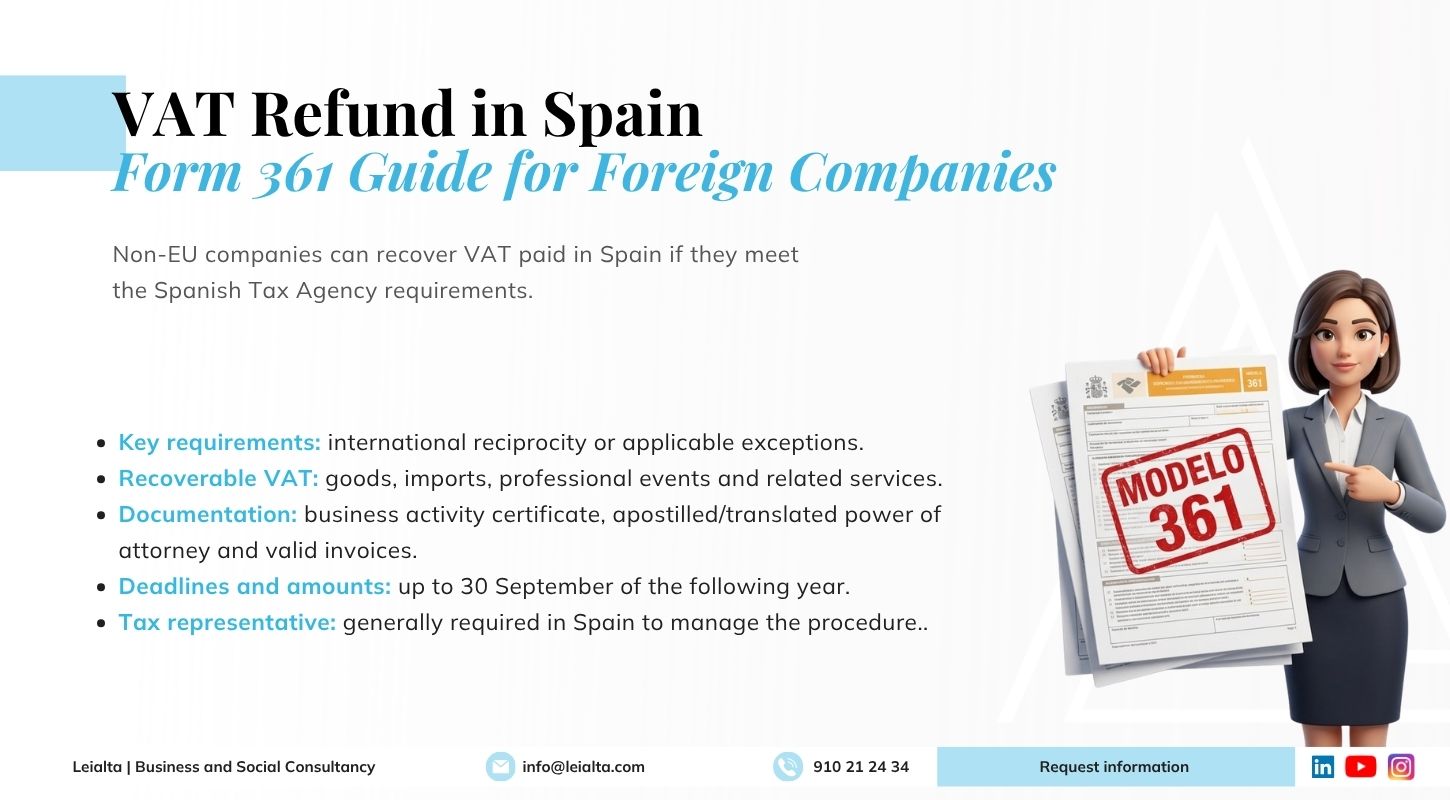
Has your company paid VAT in Spain for a trade fair, supplier, business trip, import or another transaction related to its business activity?
An invoice showing Spanish VAT does not automatically mean that the VAT can be refunded. In many cases, the most important work comes before filing the form: analysing the transaction, checking whether VAT was charged incorrectly, identifying the correct refund procedure and preparing consistent supporting documentation.
In this article, we explain how foreign companies can recover VAT paid in Spain through Form 361, what VAT may be refundable and how to prepare a claim with a realistic chance of success.
What is Form 361 in Spain?
Index of contents
Form 361 is the electronic application used by certain businesses and professionals established outside the European Union, the Canary Islands, Ceuta and Melilla to request a refund from the Spanish Tax Agency of VAT incurred or paid within the Spanish VAT territory, meaning mainland Spain and the Balearic Islands.
It is not a periodic VAT return and cannot be used to recover Canary Islands IGIC or Ceuta and Melilla IPSI. Nor is it an automatic refund mechanism. The procedure is governed by Articles 119 and 119 bis of the Spanish VAT Law and requires the Spanish VAT deduction rules to be reviewed.
Form 360 or Form 361: the key difference
Although Forms 360 and 361 are often confused because both relate to VAT refunds, they apply to different situations.
| Procedure | Who uses it | Where the tax was incurred |
|---|---|---|
| Form 360 | Businesses established in another EU Member State and, depending on the circumstances, in Spain, the Canary Islands, Ceuta or Melilla. | European or territorial VAT refund procedure. When a company established in another EU Member State seeks to recover Spanish VAT, the application is normally submitted through the portal of its country of establishment. |
| Form 361 | Businesses and professionals established outside the EU, the Canary Islands, Ceuta and Melilla. | VAT incurred in mainland Spain or the Balearic Islands, claimed directly from the Spanish Tax Agency. |
The Spanish Tax Agency expressly distinguishes between the procedures for Forms 360 and 361.
Form 361 is linked to applications for refunds of VAT incurred within the Spanish VAT territory by businesses or professionals established in third countries where reciprocity applies.
Practical rule: if the company is established in the EU, Form 361 is not the starting point. If it is established in a third country, the analysis should focus on Article 119 bis, reciprocity, applicable exceptions and any requirement to appoint a representative in Spain.
Which foreign companies can claim a VAT refund in Spain?
Eligibility does not depend solely on the country where the company is established. Several conditions must be met during the refund period.
1. The applicant must act as a business or professional
The applicant must carry out a genuine economic activity.
The VAT claimed must relate to goods or services used for that activity rather than private consumption.
The Spanish Tax Agency requires a certificate from the competent authority in the country of establishment confirming that the applicant carried out business or professional activities during the period covered by the claim.
2. The company must not be established in Spain for these purposes
The company must not have a head office or permanent establishment in mainland Spain or the Balearic Islands from which supplies of goods or services were made during the refund period.
Simply having some connection with Spain does not automatically prevent the company from using the procedure. The key issue is whether there is an establishment with sufficient human and technical resources and whether transactions are carried out from that establishment.
In fact, a company with a permanent establishment may still be treated as non-established for this procedure if no transactions were carried out from that establishment during the refund period.
This point should therefore be documented carefully.
3. The company must not carry out transactions in Spain that are incompatible with the regime
As a rule, the applicant must not have made supplies of goods or services subject to Spanish VAT.
There are exceptions, including certain transactions where the recipient becomes liable for VAT under the reverse charge mechanism, as well as certain exempt transport services and related services.
In addition, if the company receives transactions for which it becomes liable for VAT in Spain, it may need to register for VAT and recover the VAT through periodic returns instead of Form 361.
For this reason, the company’s overall activity in Spain should be reviewed rather than looking only at the invoices showing refundable VAT.
4. The expenditure must relate to transactions carrying a right to deduct
Goods and services acquired in Spain must be used for activities that give the company a right to deduct VAT in its country of establishment.
At the same time, the expenditure must also comply with the limitations on deductibility under Spanish VAT rules.
If the activity only gives rise to a partial right to deduct VAT, the refund will be reduced accordingly.
5. Reciprocity or an applicable exception must exist
As a general rule, the company must be established in a country that grants Spanish businesses an equivalent right to recover tax and whose reciprocity has been formally recognised by the Spanish Directorate-General for Taxes.
Reciprocity is a legal and formal requirement. It is not sufficient for the country simply to have a tax like VAT.
Countries with reciprocity for recovering VAT in Spain
Countries and territories commonly covered by reciprocity rulings and the practical application of Form 361 include:
- Canada.
- Israel.
- Japan.
- Monaco.
- Norway.
- Switzerland.
- United Kingdom.
However, the scope of reciprocity is not identical in every jurisdiction. Some rulings restrict specific categories of expenditure.
For example, the ruling applicable to the United Kingdom recognises reciprocity but contains several restrictions. These include limitations relating to goods and services intended for resale, recreational services, vehicle purchases and part of the VAT on vehicle leasing or hire.
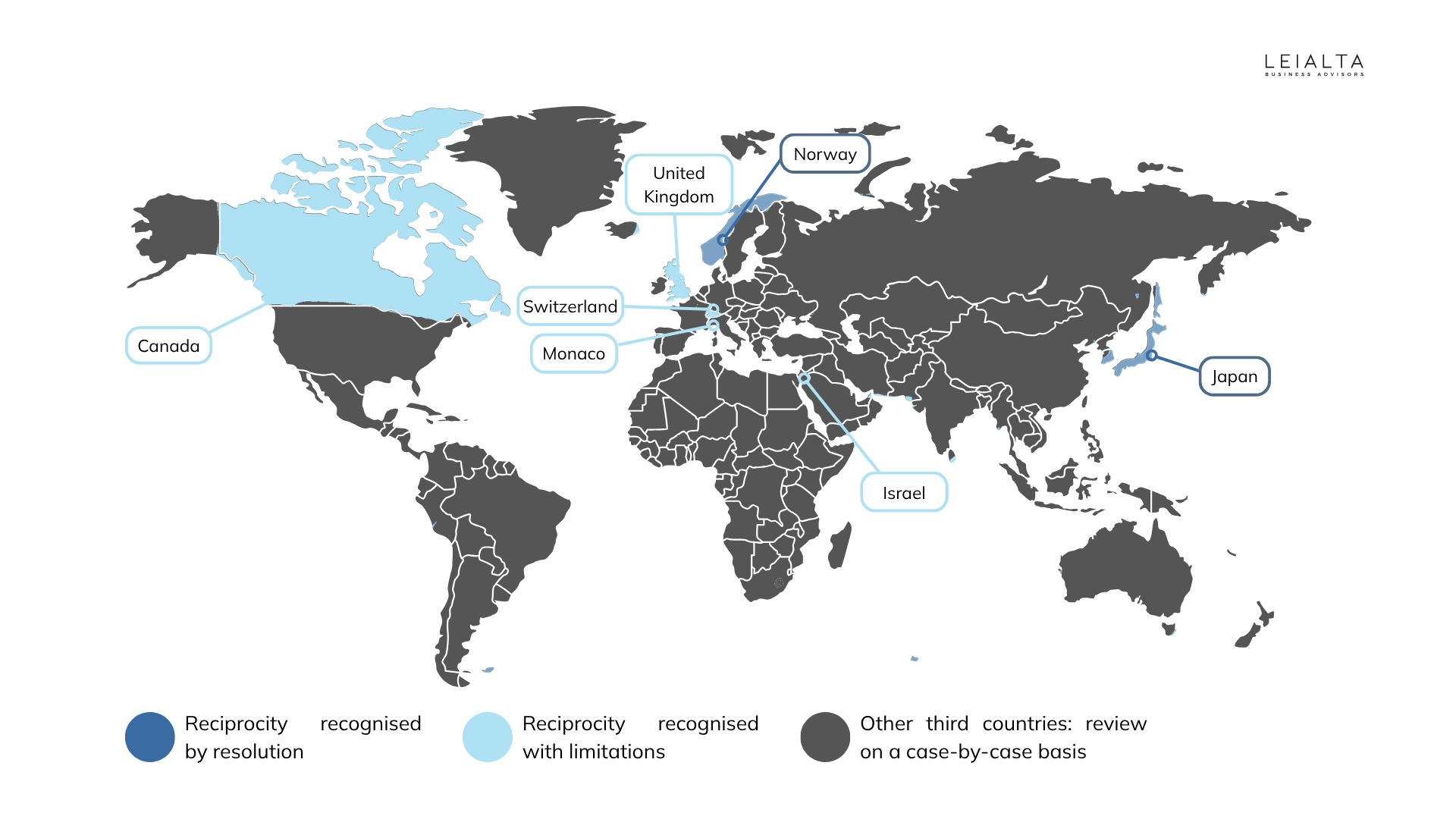
Therefore, a refund application should not be filed merely because the country appears on a list.
This information should be treated as an initial guide rather than a guarantee of repayment. Before submitting Form 361, three questions should be considered:
| Key question | Why it matters |
|---|---|
| Where is the company established? | Determines whether reciprocity or an applicable exception may exist. |
| What type of VAT does the company want to recover? | Not every expense carrying Spanish VAT is refundable. |
| Does the company have sufficient documentation? | Missing certificates, invoices or powers of attorney can prevent the claim from progressing. |
Exceptions: when VAT may be refunded even without reciprocity
Spanish VAT law allows any business or professional established in a third country to request a refund without recognised reciprocity for two specific categories of transactions.
1. Templates, moulds and equipment
These may qualify where they are acquired or imported into Spain and made available to a Spanish manufacturer.
The goods produced must then be dispatched outside the European Union to the non-established business. Once production ends, the templates, moulds or equipment must also be exported or destroyed.
2. Trade fairs, conferences and professional exhibitions
The exception may cover admission, accommodation, catering and transport services connected with attendance at commercial or professional fairs, conferences or exhibitions held in mainland Spain or the Balearic Islands.
Importantly, this exception does not make every hotel, meal or business travel expense refundable.
There must be a demonstrable connection with attendance at a qualifying trade fair, conference or professional exhibition.
Special case: companies using OSS
Where the VAT incurred relates exclusively to e-commerce transactions covered by a One-Stop Shop regime, Spanish law provides specific rules.
The refund is processed under Article 119 bis. However, reciprocity and the appointment of a representative are not required for those amounts.
If the company also carries out other transactions requiring VAT registration and periodic filings in Spain, the VAT may instead need to be deducted through those returns.
What VAT can be recovered and what should be reviewed first?
Form 361 may include VAT on acquisitions of goods, services and imports made in mainland Spain or the Balearic Islands.
However, the analysis should begin with the invoice itself.
If Spanish VAT was charged incorrectly, the correct solution is not to request a refund from the Spanish Tax Agency. Instead, the supplier should issue a corrective invoice and reimburse the VAT.
| Type of expense or transaction | Typical analysis |
|---|---|
| Goods acquired in Spain | May be recoverable if used for business purposes and the VAT is deductible. The subsequent destination of the goods and any Spanish registration requirements should be reviewed. |
| Imports | May qualify if the applicant appears as the importer, retains the customs documentation and uses the goods for activities giving a right to deduct. |
| Property and services located in Spain | Spanish VAT may have been correctly charged, but business use, deductibility and the possible existence of a permanent establishment must be considered. |
| Trade fairs and conferences | Admission and certain accommodation, catering and transport costs may be recoverable. The connection with the event must be properly documented. |
| Travel, hotels and restaurants | Not automatically recoverable. Spanish deduction restrictions apply and, outside the trade fair exception, the expense must also be directly linked to the business activity. |
| Vehicles and associated costs | Subject to business-use rules, deduction percentages and possible additional restrictions arising from reciprocity. |
| Client entertainment and recreational expenses | Generally excluded or restricted under Spanish VAT rules. |
| General B2B services | Many services supplied to a foreign business should not carry Spanish VAT under the place-of-supply rules. If VAT was charged incorrectly, the invoice should be corrected. |
The decisive question is not simply “Does the invoice show VAT?”. Instead, companies should ask: “Was Spanish VAT correctly charged, and would that VAT be deductible under Spanish rules?”.
Documentation required for Form 361
Documentation is one of the most sensitive aspects of the Form 361 procedure. A claim may be viable from a tax perspective but still be delayed or blocked if the company cannot properly evidence its business activity, representation or the transactions included.
Since 1 July 2024, the updated form has applied. Supporting documentation must be submitted through the electronic registry, and the registration number of each document must be included in the form. A properly prepared application will usually include:
- Certificate of business activity. This must be issued by the competent authority in the country of establishment and cover the period for which the refund is requested. It must confirm that the entity carries out activities subject to VAT or an equivalent tax.
- Power of attorney. This is required for the first application submitted through a representative or where the previous power is no longer valid. It must be granted before a public notary or equivalent authority, identify the parties and expressly authorise the electronic filing of Form 361. If the representative will receive the refund, the power must also state this expressly.
- Translation and legalisation of the power of attorney. The power must either be entirely in Spanish or translated into Spanish by a sworn translator. If it has been granted before a foreign notary or equivalent authority, it must include a Hague Apostille or, where the country is not a party to the Convention, the corresponding legalisation.
- Invoices and import documents. Electronic copies are mandatory when the taxable amount of each document exceeds €1,000, or €250 in the case of fuel. The Spanish Tax Agency may request additional documents, while the originals must be retained throughout the applicable limitation period.
- List of transactions. This should include the supplier, invoice number and date, taxable amount, VAT amount, nature of the expense, deductible percentage and any other codes required by the form.
- Bank details. These include the account holder and IBAN or, for non-IBAN accounts, the SWIFT-BIC. If the account belongs to the representative, the power of attorney must authorise them to receive the refund.
- Group structure, where applicable. If the applicant belongs to a tax group that uses a single identification number for all entities, the first application must include documentation of the group structure and the individual identification of each company.
It is important to note that the application is not considered filed until the business activity certificate and, where required, the power of attorney have been submitted. Filing the form without these documents does not protect the deadline.
Form 361 deadline, refund periods and minimum amounts
A Form 361 application may cover a period of no more than one calendar year and normally no less than three months.
A period shorter than three months is permitted when it covers the remainder of the calendar year.
| Aspect | General rule |
|---|---|
| Standard period | Between three months and one calendar year. |
| Period shorter than three months | Only where it covers the remainder of the calendar year. |
| Minimum refund for a period shorter than one year | €400. |
| Minimum refund for a full year or the remainder of the year | €50. |
| Deadline | 30 September of the year following the year in which the VAT was incurred. |
The filing period starts on the day following the end of the calendar quarter or calendar year covered by the application.
Although the final deadline is 30 September, it is advisable to begin preparing the claim well in advance.
Obtaining the required certificate, arranging an apostilled power of attorney and reviewing the invoices can take several weeks.
How to submit Form 361 to the Spanish Tax Agency
Form 361 must be submitted electronically to the Spanish Tax Agency. In general, it is advisable to follow a structured process:
- Eligibility assessment. Review the country of establishment, business activity, presence in Spain, transactions carried out, possible registration requirements and deductible percentage.
- Review of reciprocity or applicable exception. Identify the relevant reciprocity ruling, its limitations or the legal exception that allows the refund.
- Invoice audit. Separate VAT that was correctly charged and is deductible from invoices that need to be corrected or excluded.
- Document preparation. Prepare the business activity certificate, power of attorney, apostille or legalisation, sworn translation, bank details, import documentation and list of transactions.
- Electronic filing. The application is submitted by the representative resident in Spain, except where specific OSS rules apply, using the form available through the Spanish Tax Agency’s online portal.
- Follow-up. Notifications are monitored, requests for additional information are answered and, where the application is rejected in full or in part, the possibility of filing an appeal is assessed.
How long does the refund take?
As a general rule, the Spanish Tax Agency has four months from receipt of the application to issue a decision. If additional or further information is requested, the procedure may be extended to six months and, at most, eight months.
Requests for information must normally be answered within one month of receipt.
If the refund is approved, payment must be made within ten days following the end of the applicable decision period. If no express decision is issued within the maximum period, the application is deemed rejected for procedural purposes, without prejudice to the available appeal mechanisms.
Common mistakes when claiming a VAT refund in Spain
Form 361 can be a useful way to recover VAT incurred in Spain. Nevertheless, it is a demanding procedure, and many problems arise from insufficient analysis or incomplete documentation.
Common mistakes include:
- Claiming VAT that was incorrectly charged. The Spanish Tax Agency may reject VAT that should never have appeared on the invoice. A corrective invoice should first be requested from the supplier.
- Relying solely on a list of countries. Reciprocity may contain restrictions, while statutory exceptions only cover specific expenditure.
- Failing to review the company’s operations in Spain. A local sale, import, warehouse or reverse-charge transaction may change the correct recovery procedure.
- Including private, recreational or entertainment expenses. A business connection is not enough where Spanish law excludes the VAT deduction.
- Using invoices issued to employees or another group company. The recipient must match the applicant and the audit trail should be clear.
- Submitting an insufficient power of attorney or one without the required apostille, legalisation or translation. This is a common source of formal delays.
- Using a certificate that does not cover the relevant period. The company’s business activity must be evidenced throughout the refund period.
- Waiting until September to begin preparing the application. The form is not treated as filed if essential documentation is missing.
- Failing to respond to a request for information on time. This can lead to delays, a reduced refund or rejection of the application.
Frequently asked questions about Form 361
What is Form 361?
Form 361 is the application used by certain businesses or professionals established in third countries with recognised reciprocity to request a refund of VAT incurred in Spain, provided that the statutory requirements are met.
Who can submit Form 361?
Certain businesses and professionals not established in Spain, the European Union, the Canary Islands, Ceuta or Melilla may claim Spanish VAT incurred on expenditure connected with their business or professional activity.
Is Form 361 the same as Form 360?
No.
Form 361 is generally intended for businesses or professionals established in third countries where reciprocity applies.
Form 360 covers other VAT refund situations involving non-established businesses and should not be confused with Form 361.
Can every non-EU company submit Form 361?
No.
As a rule, recognised reciprocity is required.
However, businesses from any third country may request a refund for specific transactions involving templates, moulds and equipment or certain services related to trade fairs, conferences and exhibitions.
Special rules also apply to OSS.
Do I need a Spanish NIF?
The form allows applicants to be identified using their country and foreign TIN or VAT number, depending on the circumstances.
However, whether a Spanish tax identification number, NIF, is required should be reviewed considering the company’s overall activities.
Certain transactions may require VAT registration in Spain independently of the refund application.
Do I need a representative in Spain?
Yes, generally, a tax representative in Spain is required.
The representative must be resident within the Spanish VAT territory and may be jointly liable in cases involving an incorrect refund.
A representative is not required for VAT used exclusively for activities covered by OSS schemes, although one may be appointed voluntarily.
Can I recover VAT on hotels and meals?
Not automatically.
The expenditure must satisfy the Spanish rules on deductibility as well as any restrictions arising from reciprocity.
Where the services relate to attendance at a professional trade fair, conference or exhibition, Spanish law may allow the refund even without reciprocity, provided that the connection with the event can be demonstrated.
What happens if the invoice contains an error?
If essential information is missing or Spanish VAT has been charged incorrectly, a corrective invoice should normally be requested before Form 361 is filed.
The refund procedure before the Spanish Tax Agency does not replace the right to require the supplier to correct VAT that was incorrectly invoiced.
How LEIALTA can help
With Form 361, the real value does not lie in simply submitting a form. It lies in turning a collection of invoices into a well-supported VAT refund claim.
A preliminary review can prevent companies from spending time and resources on VAT that cannot be recovered. In addition, it helps identify from the outset which documents the Spanish Tax Agency is likely to require.
At LEIALTA, we support foreign companies and international groups throughout the entire process:
- Initial eligibility assessment and estimate of potentially recoverable VAT.
- Review of establishment, transactions in Spain, reciprocity, exceptions and OSS rules.
- Invoice-by-invoice audit to identify recoverable, restricted or incorrectly charged VAT.
- Preparation of certificates, powers of attorney, translations, apostilles or legalisation, and the transaction list.
- Acting as representative in Spain and electronically filing Form 361.
- Monitoring the application, responding to requests for information and assessing appeals where appropriate.
Has your company incurred VAT in Spain? We can review your invoices, confirm the appropriate recovery procedure and manage the application before the Spanish Tax Agency.
Learn more about our tax representation services in Spain.


