

In SMEs and family businesses, many of the decisions that ultimately shape their structure arise as a natural consequence of the company’s own development or simply through “inertia”.
This second scenario is what La Pastilla experienced. Founded in 2001 around the organisation of medication, 25 years later the company has its own manufacturing operations, several product lines and a presence in more than 20 countries.
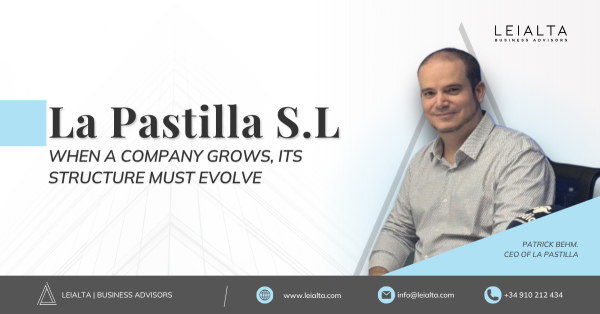
Its CEO, Patrick Behm, discussed the company’s evolution on A Media Sesión, on Radio Intereconomía, where he explained how years of growth brought La Pastilla to a point where it became necessary to stop, review what had been built and reorganise its structure. The aim was to bring greater order to its different business lines.
LEIALTA supported the company throughout this process through a business restructuring that included two spin-offs and the creation of a holding company structure.
We invite you to watch an extract from the interview featuring some of his most interesting comments:
From a specific need to a company with an international presence
La Pastilla began with a very specific need. As Patrick explains: “I think La Pastilla, like many projects, was born out of a need, which was to organise medication”.
Following a family situation, his mother began exploring the sector and quickly moved from looking for a simple pill organiser to importing other healthcare products and contacting potential customers.
Patrick joined the business to support his mother. In his own words: “I became involved almost from the very beginning to help my mother with the project. From there, we continued to grow and evolve, attending international trade fairs to discover more products and trying to find customers in other countries”.
New customers, products and needs gradually followed. The company evolved from solutions initially aimed at home use to working with care homes, adding medication trays and trolleys and, later, other clinical and hospital furniture solutions.
This growth also led to increasingly significant business decisions, including moving premises, expanding the team, changing suppliers and starting to manufacture certain products directly that had previously been imported.
When growth creates an increasingly complex structure
La Pastilla’s experience reflects a common situation among companies with a long track record. Each decision may make sense individually, but over time their accumulation can result in a business reality that is very different from the one that existed at the outset.
Changes of premises, for example, meant that the company gradually accumulated several industrial properties. Some were no longer used directly for the business and began generating rental income, while the core business continued to develop.
As a result, activities of a very different nature began to coexist within the same business structure: on the one hand, income generated by the commercial and manufacturing activities and, on the other, income derived from real estate assets.
Patrick sums up very clearly the moment when the need arose to review everything that had been built: “So, how could I organise all of this better?”.
The question may sound simple, but behind it was an important business decision. It was no longer simply a matter of managing day-to-day growth, but of assessing whether the structure that had developed over the years was still the right one for the company.
LEIALTA’s role: two spin-offs and a holding company structure
It was at this point that La Pastilla approached LEIALTA to analyse the situation and define a restructuring proposal.
The process ultimately included two spin-offs and the creation of a holding company structure, with the aim of organising the different activities within the group and separating the business operations from the activities related to property ownership and rental income.
Beyond the corporate transactions themselves, the key business objective was to create a structure that more accurately reflected what the company had become.
The reorganisation makes it easier to distinguish between the different business units, allocate the relevant income and expenses correctly and provide a clearer understanding of the structure, both for management and for the people working within the organisation.
This is precisely where a restructuring becomes more than a purely corporate matter. Organising the companies within a group can also improve how the business is managed and understood.
A structure also prepared for future investors
The reorganisation also has a particularly important future dimension.
During the interview, Patrick raised a very specific scenario: the potential introduction of external capital into certain areas of the company.
A prospective investor interested in the product distribution business or in furniture manufacturing may not necessarily be interested in a property-holding activity based on rental income.
Separating these different business realities properly means that future corporate decisions can be assessed within a much clearer structure.
As Patrick noted during the interview, this organisation is particularly relevant “with a view to future capital investment from investors who may wish to acquire an interest in the companies”.
For this reason, reviewing a corporate structure should not only be considered when a problem arises. It may also be necessary before bringing in investors, developing new business lines, carrying out corporate transactions or entering a new stage of growth.
Taking time to stop and review is also part of running a business
Business growth creates a day-to-day reality that rarely slows down. There are always customers, transactions, suppliers, teams and decisions requiring immediate attention.
Patrick explains it this way: “There will always be a new customer calling, a sales opportunity you need to work on and countless things you need to deal with every day, but you have to stop”.
And this is probably the main lesson that can be drawn from his experience: “You have to stop and think about how everything is organised, how it is structured and what you want to achieve over the next year”.
A company may know its market, its customers and its activity extremely well and still find that, over time, it has built a structure that no longer reflects its current circumstances.
Growth also means periodically reviewing whether the business structure is ready to support what the company wants to do next.
At LEIALTA, we support companies and corporate groups through business restructuring processes, analysing the corporate, tax, accounting and labour implications of each transaction in a coordinated way.
The objective is not to apply a holding company structure, a spin-off or any other solution automatically. The first step is to understand the company’s reality and then define a structure that responds to both its current and future needs. If you would like to review your business structure and explore possible ways to reorganise it, contact us.
La Pastilla is a good example first came the growth; then came the moment to organise what had been built to be better prepared for the next stage.

