

As the baby boomer generation gradually approaches retirement, one of the major challenges facing family businesses is coming into sharper focus: deciding what will happen to the company and the assets built up over decades.
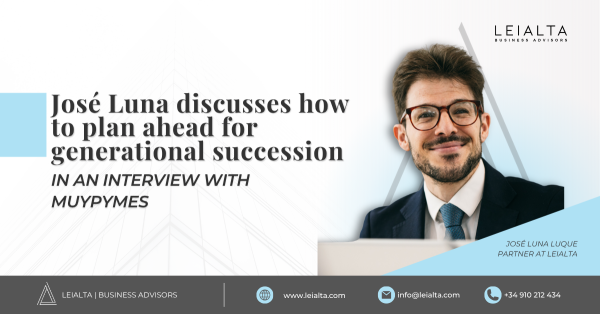
José Luna, Partner and Head of LEIALTA’s Corporate and Legal Department, discusses this issue in an interview published by MUY PYMES. He explains why corporate and asset planning should begin long before retirement becomes imminent.
The retirement of thousands of business owners over the coming years is accelerating a conversation that many families have postponed for too long: what should happen to the company when its founder or current owner steps away?
In a family business, several scenarios may arise. The next generation may take over, management may be professionalised or the business may ultimately be sold to a third party.
All of these options can be valid. The difference lies in having enough time to prepare for them properly.
In this context, MUY PYMES interviewed José Luna to explore how family businesses can prepare for generational succession. The interview also examines the role of corporate restructuring, asset protection and ownership planning throughout the process.
You can read the full MUY PYMES interview through this link.
Generational succession does not begin when retirement arrives
Preparing for business succession involves much more than deciding who will take over the management of the company.
It also requires a review of how ownership is organised, which assets have accumulated within the corporate structure and which companies form part of the group. In addition, it is important to assess whether the existing structure is still appropriate for the next stage.
After decades of activity, a company will often have evolved considerably from its original structure. New companies may have been incorporated, new business lines launched, property acquired or investments and surplus cash accumulated.
Therefore, before transferring the business, it is advisable to determine what should pass to the next generation. Companies should also assess which assets should remain with the current owner or family and how the group should be organised for the future.
Restructuring before succession can simplify the company’s future
A business restructuring allows the corporate structure to be adapted to a new reality.
Depending on the company’s circumstances, it may help separate activities with different risk profiles or distinguish business assets from operating activities. It can also organise ownership interests across several companies or simplify structures that have become unnecessarily complex over time.
In addition, restructuring may create opportunities for tax optimisation when the applicable requirements are met.
A well-organised structure makes it easier to understand which assets belong to the business and where the main risks are concentrated. It can also identify which assets could remain outside the operating activity.
At the same time, the next generation can gradually assume greater responsibility without inheriting a structure that is unnecessarily difficult to manage.
For this reason, corporate reorganisation can become a key tool in generational succession. It can prepare the business both for family continuity and for a future corporate transaction.
Holding companies: a particularly useful structure for business succession
Within these processes, creating or using a holding company is one of the alternatives that should be carefully considered.
A holding structure can centralise ownership interests in the different companies within a group. As a result, ownership becomes easier to organise and family assets can be more clearly separated from the operating companies.
It may also allow profits generated within the group to be reinvested in a more tax-efficient way, provided that the relevant statutory requirements are met.
From a succession perspective, a holding structure can also provide greater flexibility. The business owner may retain the holding company as the head of the family asset structure while the next generation gradually takes over the management or ownership of the operating companies.
This can prevent succession from automatically requiring the transfer of all the assets accumulated over many years.
In other cases, different corporate transactions may be more appropriate. For example, a spin-off can separate activities, business units or assets that need to follow different paths.
By contrast, a merger may be suitable when the objective is to integrate companies and simplify the overall structure.
The appropriate solution should always depend on the company’s objectives. It should also be assessed from a corporate, tax and asset-planning perspective.
Generational succession and a business sale: two ways to ensure continuity
One of the most interesting points raised in the interview is that business continuity should not be understood solely as keeping the company within the family.
Generational succession clearly has an emotional dimension. It allows the project to continue in the hands of children or other family members. For the business owner, this can mean seeing the results of many years of work continue as part of their legacy.
However, a well-planned sale can also represent an excellent conclusion to an entrepreneurial journey.
Selling the business to a third party may allow the company to continue operating and growing under new ownership. Meanwhile, the business owner converts the value created over many years into personal or family assets.
As José Luna explains in his interview with MUY PYMES, “the important thing is to prepare the company so that both options remain available.”
If the structure has been organised correctly, for example, the owner may sell the operating company while retaining a holding company. That holding could continue to own certain investments, properties or other income-generating assets after retirement.
Therefore, the real question is not simply whether to choose family succession or a sale. The aim should be to reach that point with enough flexibility to decide which option is more appropriate.
The emotional value of a business does not always match its market value
Business valuation is another particularly important aspect of succession planning.
It is common for an owner to assign a higher value to their company than the market would recognise. After many years of work, an emotional dimension will naturally influence that perception.
However, a profitable company is not necessarily easy to sell. Nor will it automatically achieve the valuation expected by its owner.
Preparing a potential transfer in advance provides a clearer view of the company’s actual market value. It also makes it possible to identify factors that could make the business more attractive to a buyer.
Based on that analysis, the family can decide whether a sale is genuinely viable or whether generational succession would be a more appropriate alternative.
Family assets should also be prepared before succession
Succession planning should not focus exclusively on the operating company.
Over the years, many family businesses accumulate property, investments, equity interests or other assets within the same companies that carry out the operating activity.
Consequently, a significant proportion of the wealth built up over decades may be exposed to ordinary business risks.
For this reason, it is advisable to assess in advance which assets should remain connected to the operating business, and which may require a separate structure.
Asset protection does not mean moving assets once financial difficulties or debts have already arisen. Instead, it involves organising assets, business activities and risks in advance.
The resulting structure should be consistent with both the family’s objectives and the future of the company.
Family protocols and shareholders’ agreements: setting the rules before conflicts arise
Succession also has an important family and corporate governance dimension.
Not every family member needs to play the same role. Some may wish to remain shareholders without becoming involved in management, while others may be ready to take on executive responsibilities.
In certain cases, bringing in external professionals may also be the most appropriate solution.
For this reason, clear rules should be established.
A family protocol and a shareholders’ agreement can regulate matters such as the involvement of family members in the company, decision-making processes and dividend policies. They can also address transfers of equity interests and the potential exit of a shareholder.
These agreements do not necessarily have to be formalised before the succession takes place. Nevertheless, it is advisable to address these matters before disagreements arise and make business continuity more difficult.
Business restructuring goes far beyond retirement
Generational succession is one of the situations in which the need to review a company’s structure becomes particularly clear. However, it is far from the only one.
Business growth, new lines of activity and the accumulation of assets within the operating company may also justify a reorganisation.
Other triggers include the entry or exit of shareholders, a future sale, the arrival of an investor or the need to separate different risk profiles.
A corporate structure that worked well ten or twenty years ago may no longer meet the company’s current needs.
Therefore, periodically reviewing how companies, assets and ownership interests are organised helps anticipate future issues. More importantly, it provides greater flexibility when making the decisions that will shape the company’s next stage.
You can read the full interview with José Luna, Partner and Head of LEIALTA’s Corporate and Legal Department, in MUY PYMES through this link.
At LEIALTA, we support family businesses and corporate groups in planning and implementing restructuring, generational succession and asset protection processes.
Our corporate and tax teams advise on holding company structures, mergers, spin-offs and other corporate reorganisations. We also assist with family protocols, shareholders’ agreements and the preparation of business succession or sale processes.
The objective is to design a structure tailored to each situation. This can help protect assets, organise ownership and facilitate the continuity of the business.
If you believe your company has reached the point where its structure should be reviewed, please contact us.

