

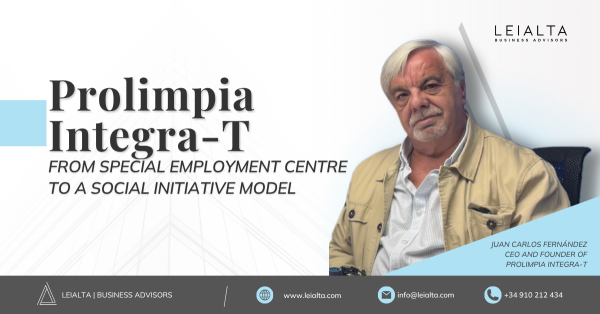
Juan Carlos Fernández, CEO and founder of Prolimpia Integra-T and the 3LIM2000 Group, took part in A Media Sesión on Radio Intereconomía to discuss the company’s journey, its employment inclusion model and its recent transition from a Special Employment Centre (CEE) to a Social Initiative Special Employment Centre (CEEIS).
Prolimpia Integra-T was founded in 2015 as a service company specialising, among other activities, in cleaning and concierge services in the Community of Madrid. From the outset, the project also had a social objective: to create employment opportunities for people with disabilities.
You can watch an extract from Juan Carlos Fernández’s interview on Radio Intereconomía, where he discusses the creation of the CEE and its subsequent transition to a CEEIS.
A Special Employment Centre also has to operate as a business
During the interview, Juan Carlos explained that this social purpose arose from his own experience in the sector and his direct contact with employees with disabilities.
In his own words: “My idea was to help. Beyond giving people jobs and opportunities, I had seen that people with disabilities were fully capable and could integrate into the workplace.”
One of the central themes of the interview was precisely the balance between the project’s social purpose and the demands of running any business.
Prolimpia operates in the market, provides services to clients and manages its teams in much the same way as any other company. The main difference lies in the support that must be provided to employees with disabilities.
As Juan Carlos explains: “The only difference we should have compared with an ordinary company is that we need a support unit, and we have to assess the disability of each employee joining the company so that we can provide the appropriate social and workplace support, including support in relation to their specific role.”
For Fernández, inclusion also means avoiding differences in employees’ working conditions. As he comments: “In practice, 100% of our employees have had permanent contracts, even back when permanent contracts were not as common. Their salaries have been the same as in an ordinary company. We have never made that distinction.”
From a Special Employment Centre to a Social Initiative Special Employment Centre
Prolimpia has recently taken another step in its development by becoming a Social Initiative Special Employment Centre (CEEIS) with the support of LEIALTA.
The decision involves more than simply changing its designation. Among other aspects, the social initiative model affects how the profits generated by the activity must be used and reinforces the project’s social purpose.
Juan Carlos Fernández explained that this philosophy was already part of Prolimpia before the formal transformation took place: “We do not distribute dividends. We have never distributed them in the 11 years that Integra-T has been operating. But now, what we do is ensure that all the money and profits generated by the Social Initiative Special Employment Centre are reinvested in employees or in initiatives with a social purpose.”
However, he also acknowledges that the evolution of the Special Employment Centre model is currently creating important decisions for companies in the sector: “There is a fairly complicated dilemma at the moment.”
During the conversation, he also highlighted the growing relevance that social initiative status can have in areas such as public procurement and the opportunities it may create for certain companies.
More than a decade of support from LEIALTA
The relationship between Prolimpia and LEIALTA dates back to the creation of the Special Employment Centre itself.
LEIALTA supported the company in setting up the Centre from scratch and has continued advising it throughout its development, including its recent transition to CEEIS, coordinating the different areas involved in projects of this kind: “We have been working with LEIALTA for 11 years. They handle all our labour, tax and accounting matters, as well as advising us on everything related to the Special Employment Centre.”
Fernández also emphasised the importance for a business owner of having a team that provides stability and allows change to be managed through an organised structure.
“Stability, having a team of advisers, in this case LEIALTA, that gives you peace of mind from an administrative point of view, knowing that everything is being handled properly and organised, together with a multidisciplinary team behind me that is motivated to move forward… I think that is how we get through these situations.”
This philosophy also reflects the way he approaches periods of business uncertainty: “The original company was founded during a crisis, and I believe crises create opportunities.”
LEIALTA social consulting services
At LEIALTA, we support companies and organisations in the creation, transformation and development of projects linked to the social economy, with particular experience in Special Employment Centres (CEE) and Social Initiative Special Employment Centres (CEEIS).
Our advice is not limited to the initial administrative process. We analyse each project from a comprehensive perspective and coordinate its corporate, labour, tax, accounting and administrative implications, both when the organisation is first established and during processes of transformation, professionalisation or adaptation to new requirements.
Our experience with projects such as Prolimpia enables us to support organisations with a practical, long-term perspective, helping them make decisions that combine business viability, regulatory compliance and social impact.
Subscribe to our alerts

