

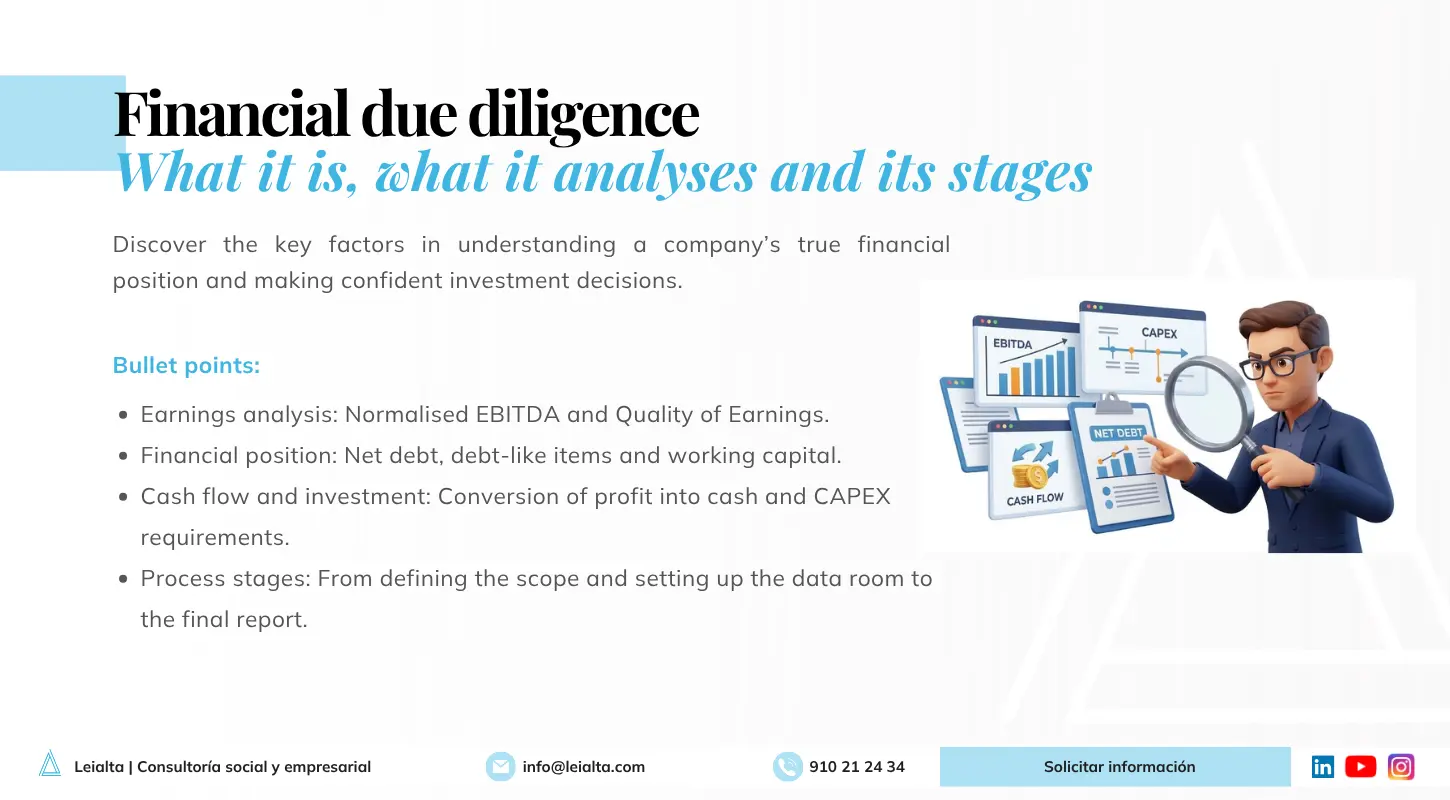
Financial due diligence is an analysis of a company’s financial position that makes it possible to assess the quality and sustainability of its results, understand its debt, working capital and cash generation, and identify issues that may affect an investment or M&A transaction.
Also known as financial due diligence or FDD, it is particularly common in company acquisitions, where the buyer needs to understand what really lies behind the figures presented before completing the transaction.
It should not be confused with a full review of the company. Legal, tax, labour or commercial matters may form part of a broader due diligence process, but they belong to different areas of analysis.
Below, we explain what financial due diligence is, what it is used for and what it analyses, among other key aspects.
What is financial due diligence?
Index of contents
Financial due diligence is a detailed review of a company’s economic and financial information to understand how it generates its results, the level of debt and working capital it maintains, how those results are converted into cash and which financial risks may be relevant to a transaction.
Its purpose is not simply to check whether the figures add up, but to understand what lies behind them.
For example, two companies may report a similar EBITDA and yet be in very different situations if one consistently converts its results into cash while the other needs to finance its operations continuously. Similarly, a year with strong results may have been influenced by exceptional income that will not recur after the acquisition.
For this reason, financial due diligence usually analyses both the company’s historical performance and the quality of its results, as well as certain assumptions about its future performance.
In short, financial due diligence analyses a company’s financial position and development to identify risks, normalise its results and understand the economic implications they may have for a transaction.
What is financial due diligence used for in an M&A transaction?
When considering the acquisition of a company, the annual accounts and information provided by the seller are an important starting point. However, they are not always sufficient to understand how the business works financially.
Financial due diligence allows the buyer to examine that information in greater depth and answer questions such as:
- Are the reported results recurring?
- Does EBITDA accurately reflect the company’s ordinary business activity?
- How have revenue and margins evolved?
- Is there any debt that should be considered in the transaction?
- What level of working capital does the company need?
- Are profits converted into cash?
- What investment does the business require to maintain its activity?
- Are future forecasts consistent with historical performance?
This review may confirm the assumptions used during the negotiations or reveal factors that make it necessary to reconsider them.
For example, a company may report profits and a high EBITDA while also generating little cash, requiring significant working capital or having postponed necessary investments for several years.
Financial due diligence therefore helps move beyond simply looking at the figures to understanding their quality, sustainability and implications for the transaction.
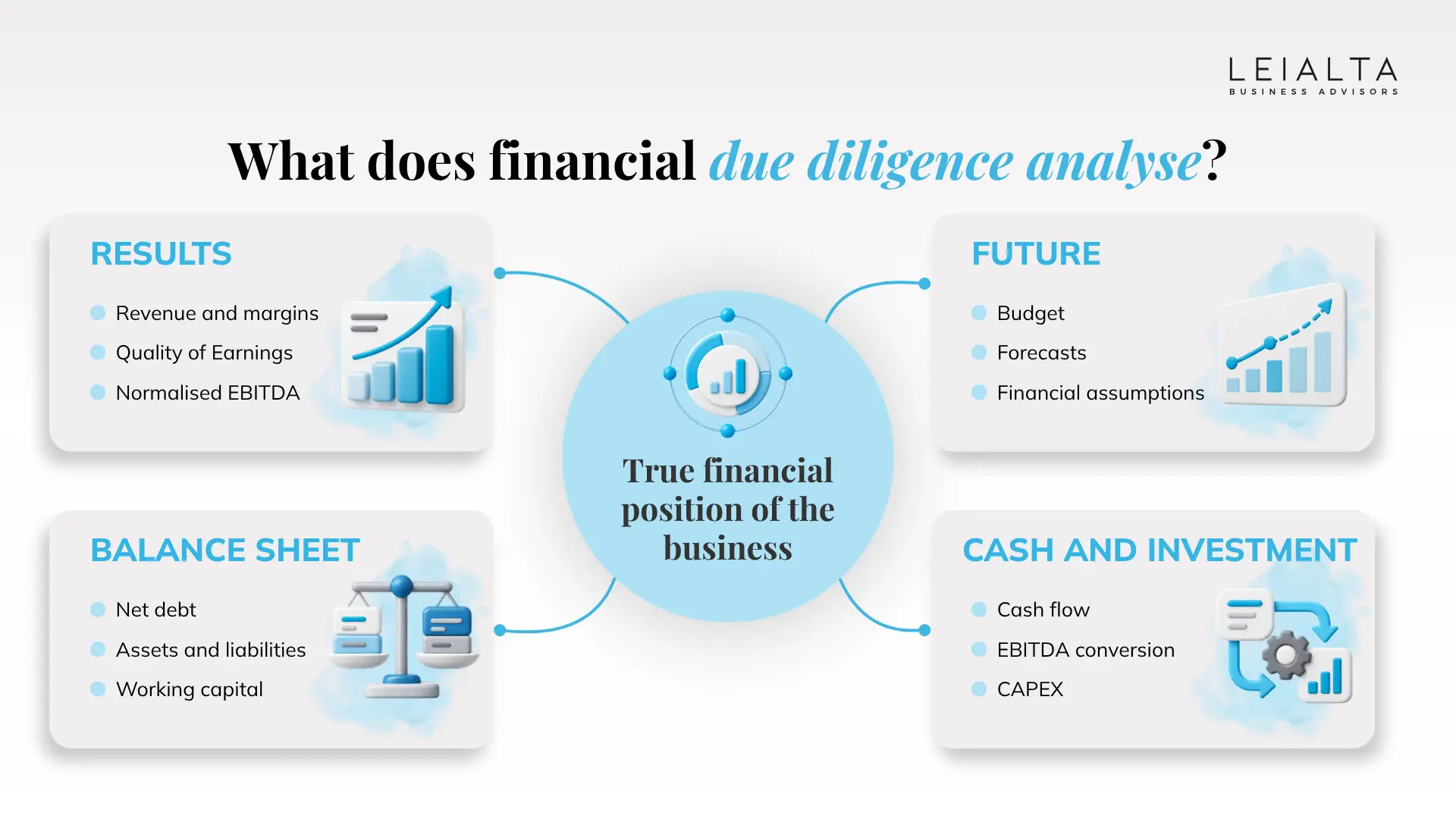
What does financial due diligence analyse?
The specific scope will depend on the company and the transaction. Nevertheless, certain areas are particularly relevant because they help explain how the business operates financially and highlight any differences between the information initially presented and its underlying economic reality.
Quality of Earnings and normalised EBITDA
One of the main objectives of financial due diligence is to analyse the quality of earnings.
It is not enough to know how much profit or EBITDA the company has generated. It is also important to understand where those results come from and to what extent they can be considered recurring.
The analysis may identify exceptional income or expenses, one-off effects or items that distort the company’s normal operating performance. Examples may include:
- exceptional income;
- compensation payments;
- one-off restructuring costs;
- extraordinary expenses;
- transactions that do not form part of the company’s ordinary activity;
- certain items whose future behaviour may differ from their historical performance.
The objective is to understand what the company’s results would look like under normal operating conditions.
This is where the concept of normalised EBITDA becomes relevant. Normalised EBITDA starts with reported EBITDA and considers which adjustments may be necessary to provide a more accurate representation of the recurring profitability of the business.
This does not mean that every extraordinary expense should automatically be removed. Each adjustment must be justified and analysed in the context of the transaction.
If you would like to explore this metric in greater depth, at LEIALTA we explain specifically what EBITDA is, how it is calculated and what normalised EBITDA means.
Revenue, costs and margins
Financial due diligence also analyses how the company’s revenue and costs have evolved over recent years.
Among other areas, the review may consider sales trends, revenue growth or decline, seasonality, the breakdown by business line and significant changes between periods. The aim is to understand the factors driving the company’s results.
For example, an increase in sales accompanied by a gradual decline in margins may indicate that the business needs to sell increasingly more to generate the same level of profit.
Financial debt and net debt
Understanding a company’s debt position is another central part of financial due diligence. The analysis may include bank loans, credit facilities and other financial obligations.
Based on this information, the company’s net financial debt can be determined. In simplified terms:
Net debt = financial debt – cash and cash equivalents
In a real transaction, however, this calculation can be more complex. The parties may agree that certain obligations should be treated as debt-equivalent items, commonly referred to as debt-like items.
There is no universal list of debt-like items. Their treatment depends on the nature of each item, the company itself and the way in which the transaction has been structured.
One of the objectives of due diligence is therefore to identify these items and allow the buyer and seller to determine how they should be treated during negotiations.
Working capital
Working capital represents the resources a company needs to carry out its ordinary business activities.
Financial due diligence usually focuses particularly on operating working capital. However, knowing the company’s working capital at a specific date is not always enough. Its historical development and factors such as inventory turnover may also need to be analysed to estimate a normalised working capital level.
Imagine that a company normally requires €800,000 of working capital to operate but reaches completion of the transaction with only €500,000 because it has temporarily delayed supplier payments or accelerated customer collections.
The position on that specific date may not represent the company’s normal operating requirements. Therefore, depending on how the acquisition has been negotiated, differences from the normalised level of working capital may have economic consequences for the transaction.
Cash flow and EBITDA-to-cash conversion
A profitable company does not necessarily generate cash at the same rate. For this reason, another fundamental question in financial due diligence is:
Do the company’s reported results convert into cash?
To answer this question, the analysis may cover operating cash flows, changes in cash balances, working capital requirements, recurring investments, financing needs and differences between EBITDA and cash generation.
This analysis is particularly important because EBITDA, although widely used, does not represent a company’s cash flow.
For example, a company may generate a high EBITDA while using a significant proportion of its resources to finance inventory, maintain substantial customer receivables or make recurring investments.
For this reason, EBITDA and cash generation should be analysed together.
Assets and liabilities
The balance sheet provides insight into how the company is financially structured. The purpose is not simply to verify accounting balances, but also to assess their evolution and understand what lies behind certain items.
For example, a high level of trade receivables may initially appear positive because it represents sales already made. However, if a significant proportion of those invoices has remained unpaid for many months, the financial interpretation changes.
The same applies to high levels of inventory where part of the stock moves slowly or has lost economic value.
The objective is to understand the quality of the different balance sheet items and their effect on the company’s financial position.
Investments and CAPEX
CAPEX (capital expenditure) refers to the investments a company makes in assets required for its operations or growth.
This analysis can reveal situations that are not always apparent in the profit and loss account. For example, a company may have reported strong results over recent years while significantly reducing its investment levels.
If this lower level of investment means that machinery, facilities or other assets will need to be replaced shortly after the acquisition, the buyer needs to be aware of it.
Therefore, it is not only important to understand how much the company has invested, but also whether that level of investment is sustainable enough to maintain the business under normal operating conditions.
Financial projections
Future forecasts may also form part of financial due diligence. The analysis can include:
- budgets;
- business plans;
- revenue forecasts;
- expected cost developments;
- margins;
- cash generation;
- investments;
- financing requirements.
The aim is not to certify that the forecasts will be achieved, but rather to assess whether the assumptions used are reasonable and consistent with the company’s historical performance, current position and recent development.
For example, a forecast showing a significant increase in sales while keeping associated costs unchanged may require further explanation. The same applies where a business plan assumes substantial growth without incorporating the investment or working capital requirements needed to support it.
Documentation required for financial due diligence
There is no identical list of documents for every company, as the information required will depend on its size, business activity, the scope of the analysis and the transaction itself.
Nevertheless, financial due diligence generally requires sufficient information to reconstruct and understand the company’s financial development.
| Area | Typical documentation | What it helps analyse |
|---|---|---|
| Historical financial information | Annual accounts, balance sheets, P&L statements, monthly closings. | Financial performance and results. |
| Management accounts | Trial balances, general ledger, internal reporting. | Cross-checking and reconciliation of information. |
| Revenue | Sales by period, customer, product or business line. | Growth, mix, recurrence and concentration. |
| Costs and margins | Breakdown of costs and margins. | Profitability and business drivers. |
| Working capital | Customer/supplier ageing reports, inventory. | Working capital and operating requirements. |
| Financing | Details of debt, repayment schedules, cash. | Net debt and financing requirements. |
| Cash | Cash flow and cash position. | Conversion of results into cash. |
| Investments | Fixed assets and historical CAPEX. | Investment requirements. |
| Forecasts | Budgets and business plan. | Reasonableness of projections. |
Additional information may also be requested as the analysis progresses. For example, if differences arise between internal reporting and the annual accounts, it will be necessary to understand their origin before reaching a conclusion.
A company preparing for a transaction can also anticipate this process by organising in advance the information that a prospective buyer is likely to request.
Stages of financial due diligence
Financial due diligence should follow a structured process that moves from gathering information to identifying conclusions that are useful for the transaction.
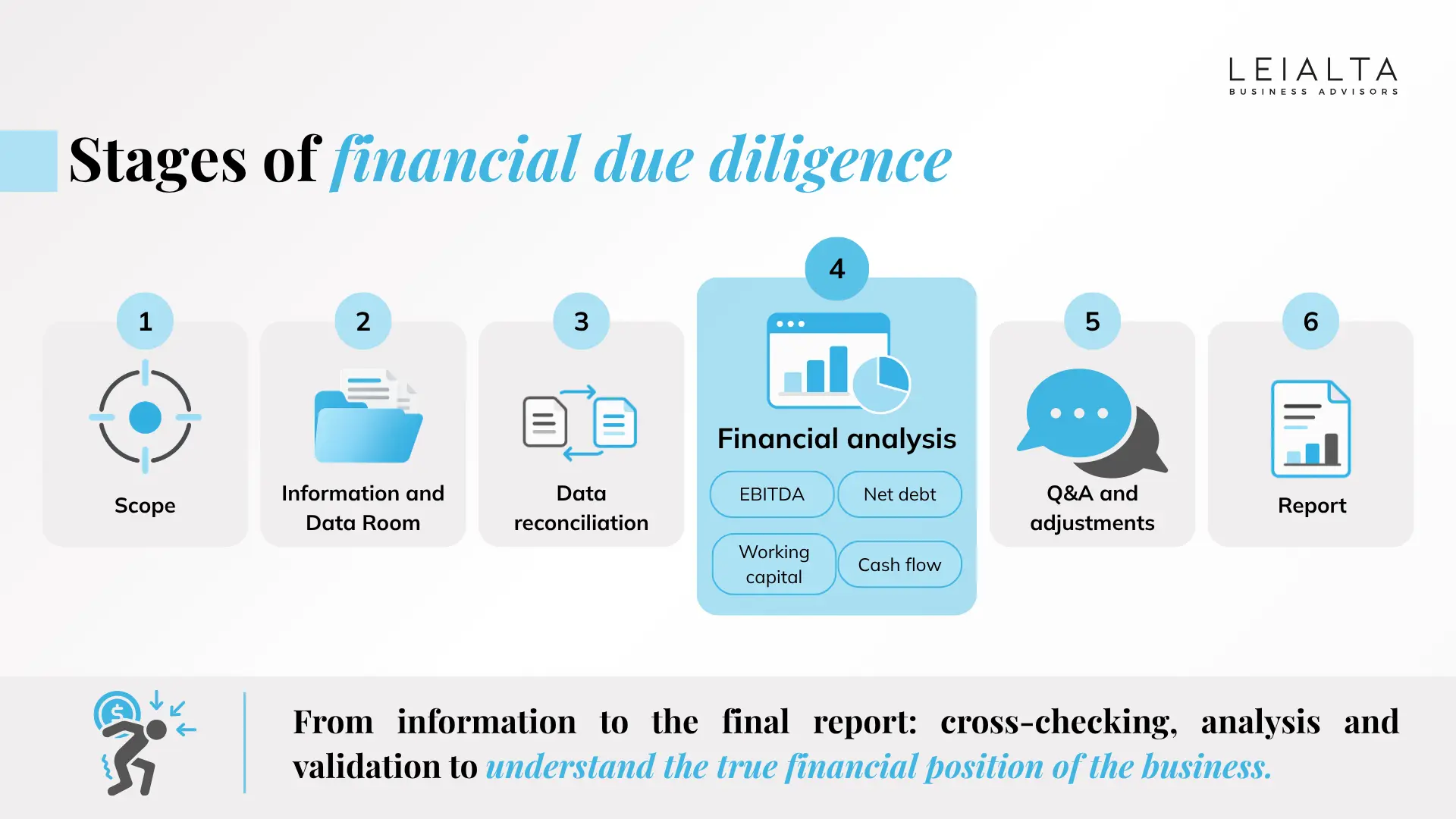
1. Defining the scope
The first step is to define precisely what needs to be analysed and how far the review should go. This requires an initial understanding of the transaction, the company’s structure, the entities included, the relevant historical period and the main financial assumptions underlying the transaction.
Based on this information, the areas requiring more detailed analysis are identified. For example, in an industrial company it may be particularly important to analyse CAPEX, inventory or working capital requirements, while in a service company greater emphasis may be placed on margin trends, recurring revenue or the conversion of results into cash.
The aim of this first stage is therefore not to request all available financial information, but to determine which areas may genuinely be relevant to understanding the business and assessing the transaction correctly.
2. Requesting and organising information
Once the scope has been defined, a request list is prepared containing the documentation needed for the analysis.
This information is usually made available to the teams involved in the transaction through a data room, where annual accounts, balance sheets, management information, sales details, debt, working capital, investments and other required financial documentation are organised.
The quality of the information is particularly important at this stage. Data should be sufficiently well organised, clearly identify the periods to which it relates and make it possible to determine which version of each document is current.
The greater the consistency between the accounting records, annual accounts and internal reporting, the easier it will be to move on to analysing the figures. Conversely, fragmented or incomplete documentation, or multiple versions of the same information, may require a significant part of the process to be spent understanding and reconstructing the data before any meaningful analysis can begin.
3. Reviewing and reconciling the data
Once the documentation is available, a particularly important stage begins checking that the data used as the basis for the analysis is consistent.
This may require reconciling annual accounts with trial balances, monthly reporting, management accounts or the data used in budgets and forecasts. The team also checks whether changes in the different financial metrics can be explained consistently based on the information provided.
For example, if internal reporting shows revenue figures that differ from those subsequently recorded in the accounting records, the source of that difference must be identified before conclusions can be drawn about the company’s growth.
This stage helps establish a reliable financial basis for the rest of the due diligence. Analysing trends or adjusting loses much of its value if the underlying information has not first been properly reconciled.
4. Financial analysis and normalisation
Once the information has been cross-checked, the technical core of the financial due diligence begins. This stage analyses the company’s performance and focuses on the financial metrics that may be particularly relevant to the transaction.
Revenue, costs and margins are reviewed to understand how the results have been generated and whether significant trends exist. At the same time, the quality of those results is assessed through the Quality of Earnings, identifying possible extraordinary or non-recurring items that may affect normalised EBITDA.
The analysis also covers net debt, working capital and cash generation, as these metrics provide a clearer picture of the company’s true financial position and may directly influence certain economic terms of the transaction.
Historical investments and CAPEX requirements are also reviewed, together with financial forecasts where these form part of the agreed scope. In this way, the analysis does not merely explain what happened in previous years but also helps assess whether the assumptions used to project future performance are consistent with the company’s historical behaviour and current financial reality.
5. Q&A and meetings with management
As the analysis progresses, questions often arise that cannot be resolved solely from the available documentation. For this reason, a Q&A (questions and answers) process is usually carried out to request clarifications or additional information.
For example, it may be necessary to understand why margins have fallen, what explains an exceptional increase in trade receivables or why certain planned investments were not ultimately made. Further information may also be needed to understand a proposed EBITDA adjustment or the assumptions underlying certain forecasts.
Where necessary, these matters can also be discussed directly with management or the company’s finance team. This allows the data to be placed in context and properly challenged before a conclusion is reached.
6. Identifying findings and preparing the report
The final stage consists of organising and prioritising the main findings identified during the review. At this point, the objective is no longer to continue accumulating information, but to determine which issues are genuinely relevant to the transaction and explain why.
Some findings may simply involve minor differences requiring clarification, while others may affect the interpretation of EBITDA, net debt, normalised working capital, cash generation or future investment requirements.
The financial due diligence report should therefore present the conclusions in a structured way, distinguishing the most important adjustments, risks and red flags, and explaining their potential implications for the transaction.
In this way, a process that began with a request for documentation ultimately transforms a large amount of financial information into conclusions that can be used to assess the transaction more effectively, negotiate its terms and make decisions based on a better understanding of the business’s economic reality.
Example of financial due diligence
Imagine that a buyer is considering acquiring a company that reports EBITDA of €1.2 million. During the financial due diligence, three issues are identified:
- €150,000 of the EBITDA consists of exceptional income that is not expected to recur.
- An obligation of €100,000 is identified whose potential treatment as a debt-like item needs to be considered during negotiations.
- Working capital at the date analysed is €80,000 below its historical normal level due to a temporary situation.
| Initial information | Finding | Potential consequence |
|---|---|---|
| Reported EBITDA: €1,200,000 | €150,000 relates to non-recurring income. | Consider a normalised EBITDA different from the reported figure. |
| Net debt position initially reported | An additional obligation is identified that may potentially be treated as debt. | Review the net debt used in the transaction. |
| Available working capital | €80,000 below its normalised level. | Assess whether a working capital adjustment applies under the agreed terms. |
This does not mean that the purchase price should automatically be reduced by €330,000. Each element works differently.
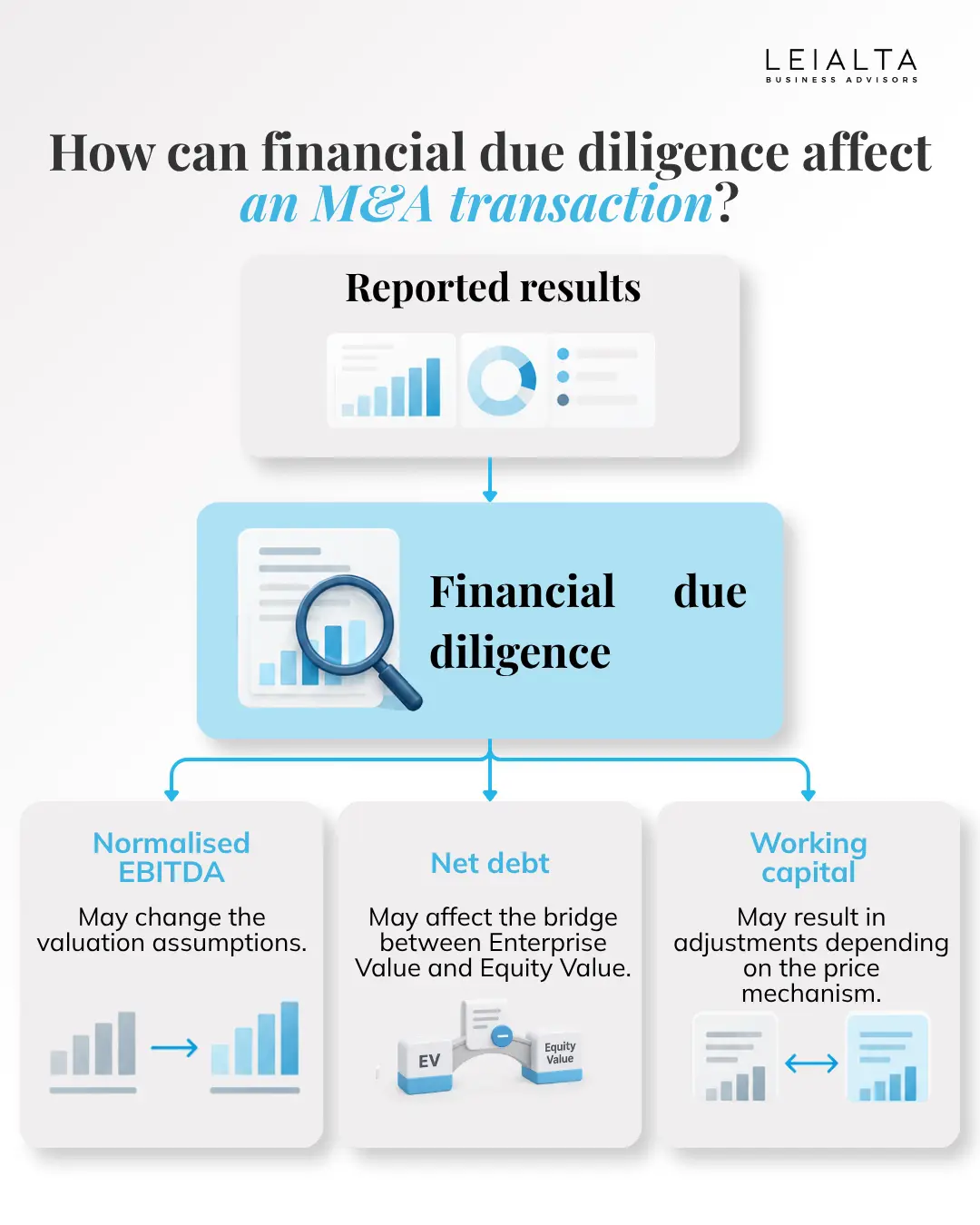
A change in EBITDA may affect the assumptions used to value the business. A debt-like item may influence the net debt calculation, while working capital may be subject to a specific adjustment mechanism.
The purpose of due diligence is to provide this information so that the parties can properly understand the transaction and negotiate on a more robust financial basis.
Main financial red flags
A financial red flag is a finding that requires particular attention because it may change the interpretation of the company’s results, financial position or economic requirements. Common examples may include:
- High EBITDA driven by extraordinary or non-recurring items.
- Progressive deterioration in margins despite continued sales growth.
- Significant differences between profit and cash generation.
- Old trade receivables or doubts regarding their recoverability.
- Accumulation of inventory or slow-moving stock.
- Higher debt than initially identified.
- Potential debt-like items.
- Abnormally low working capital close to completion.
- Recurring financing requirements needed to maintain operations.
- Insufficient CAPEX over several years compared with the actual needs of the business.
- Financial forecasts significantly above historical performance without sufficiently supported assumptions.
- Reliance on recurring adjustments to present a normalised EBITDA significantly higher than reported EBITDA.
A red flag does not necessarily mean that the acquisition should be abandoned. The important point is to understand its scale, recurrence and impact on the financial rationale of the transaction.
How can financial due diligence affect the purchase price?
One of the main questions in an M&A transaction is whether findings identified during due diligence can change the price.
The answer is yes. They can influence the price and other economic terms, although not every finding automatically results in a direct adjustment. The impact will depend on how the company has been valued and on the agreed price mechanism.
Normalised EBITDA and valuation
In some transactions, valuation may use EBITDA multiples as one of the main methods or reference points.
For example, if an EBITDA of €1 million was initially used and due diligence concludes that part of that result comes from non-recurring items, the valuation assumptions may need to be reviewed.
Imagine:
- Reported EBITDA: €1,000,000
- Normalisation adjustments: -€100,000
- Normalised EBITDA analysed: €900,000
If EBITDA is an important variable in the valuation, the difference may be significant. However, adjustments should not be applied mechanically.
The key question is which EBITDA best represents the recurring earnings capacity of the business.
Net debt: from Enterprise Value to Equity Value
Many M&A transactions distinguish between:
- Enterprise Value (EV): the value of the business before taking certain financing items into account.
- Equity Value: the value attributable to shareholders after applying the relevant adjustments.
A simplified structure may follow this logic:
Equity Value = Enterprise Value – net debt ± other agreed adjustments
Determining net debt correctly is therefore particularly important.
If due diligence identifies additional debt or items that may need to be treated as debt-like items, the amount ultimately attributable to shareholders may differ from the amount initially estimated.
The exact formula will always depend on the terms agreed between the parties.
Working capital adjustments
Working capital may also have an economic impact on an acquisition.
Certain price structures establish a target or normalised level of working capital. If the company delivers significantly less or more working capital than this level at completion, adjustments may arise in accordance with the agreed mechanism.
The logic is straightforward: the buyer should receive a business with the operating resources required to continue functioning under normal conditions.
What does a financial due diligence report contain?
A financial due diligence report sets out the main analyses performed, the findings identified and their potential implications for the transaction.
There is no single standard format. Its structure will depend on the company, the agreed scope and the needs of the buyer or investor. However, it will commonly include the following sections:
- Executive summary: main conclusions, risks and matters requiring particular attention.
- Scope and limitations: periods and entities analysed, information received, work performed and any limitations affecting the analysis.
- Historical financial performance: revenue, costs, margins, results, balance sheet and key trends.
- Quality of Earnings and normalised EBITDA: analysis of earnings quality and potential adjustments to reported EBITDA.
- Working capital: historical trends, seasonality, composition and determination of a potential normalised working capital level.
- Net debt and potential debt-like items: details of debt, cash and other items that may be relevant to the transaction.
- Cash flow and CAPEX: cash generation capacity and historical or future investment requirements.
- Financial projections: review of the business plan and key assumptions used, where included within the scope.
- Red flags and implications for the transaction: key risks identified and their potential impact on valuation, negotiations, price adjustments or specific terms of the acquisition.
The value of the report does not lie in accumulating financial information, but in explaining what the figures and findings mean for the decision the buyer needs to make. Texto pegado
Financial due diligence vs financial audit
Financial due diligence and a financial audit may both examine financial information, but they do not have the same purpose or scope.
A financial audit is a regulated activity whose general objective is to review and verify certain financial information in order to issue an audit opinion.
Financial due diligence, by contrast, is designed specifically around a transaction and the questions that the buyer or investor needs to answer.
| Aspect | Financial due diligence | Financial audit |
|---|---|---|
| Purpose | Analyse a transaction and its financial risks. | Express an opinion on financial information. |
| Scope | Tailored to the transaction. | Determined by the applicable auditing framework. |
| Focus | QoE, EBITDA, net debt, working capital, cash and forecasts. | Financial information subject to audit. |
| Perspective | Transaction-focused. | Reliability of audited financial information. |
| Outcome | Findings and implications for the transaction. | Audit report. |
Therefore, having audited accounts does not remove the value of carrying out financial due diligence before an acquisition.
Audited accounts can provide highly valuable information and improve the buyer’s understanding of the company. However, due diligence addresses different questions: what is the recurring EBITDA, what level of working capital does the business require, what is its net debt position and how effectively does it convert results into cash?
Frequently asked questions about financial due diligence
Who carries out financial due diligence?
Financial due diligence is normally carried out by professionals specialising in financial analysis and business transactions.
Depending on the transaction, economists, financial experts, accountants and other specialists may be involved to analyse specific areas. Some findings may also require coordination with legal, tax or labour professionals.
How long does financial due diligence take?
There is no standard timeframe.
The duration depends on the size and complexity of the company, the number of entities being analysed, the period under review, the quality of the information available and how quickly questions arising during the process are resolved.
In M&A transactions, the process may take several weeks, although the timetable should always be determined according to the specific characteristics of each transaction.
What is normalised EBITDA in due diligence?
Normalised EBITDA seeks to represent the recurring operating performance of the business by removing or adjusting certain items that distort its normal operations.
Each adjustment must be justified individually. The objective is not to produce the highest possible EBITDA, but rather a figure that helps provide a better understanding of the company’s recurring earnings capacity.
What is net debt in financial due diligence?
Net debt generally starts with financial debt and deducts cash or certain cash equivalents.
In a transaction, other items may also exist whose treatment needs to be negotiated. Therefore, determining net debt does not always simply involve subtracting two figures from the balance sheet.
What does working capital mean in an M&A transaction?
Working capital represents the resources the business needs to carry out its ordinary activities.
During an acquisition, its normal historical level may be analysed and compared with the level existing at the time of the transaction. Depending on the agreed price mechanism, differences may result in adjustments
Can financial due diligence change the purchase price?
Yes. Its conclusions may influence price negotiations or the mechanisms used to adjust the price.
For example, differences may arise in normalised EBITDA, net debt or working capital. However, a financial finding does not automatically result in an equivalent reduction in the purchase price. Its effect will depend on how the company has been valued and, on the terms, agreed between the parties.
Is financial due diligence the same as a business valuation?
No.
A valuation seeks to estimate the economic value of a company using specific methodologies, assumptions and financial information.
Financial due diligence analyses and challenges that information to understand the quality of earnings, debt, working capital, cash generation and other relevant factors.
The two processes are closely related, but they have different objectives.
Is financial due diligence necessary if the accounts have already been audited?
It may still be advisable.
Financial audits and financial due diligence serve different purposes. A company may have audited accounts, and the buyer may still need to analyse normalised EBITDA, net debt, working capital, cash conversion, CAPEX or forecasts before completing the acquisition.
How can LEIALTA help with financial due diligence?
Financial due diligence should go beyond reviewing annual accounts or checking balances. Its purpose is to understand how the business works economically and what implications that financial reality may have for a corporate transaction.
At LEIALTA, we support companies, buyers, sellers and investors in company acquisitions and M&A transactions, combining financial analysis and business insight with coordination across the different specialist areas that may be involved in a transaction.


