

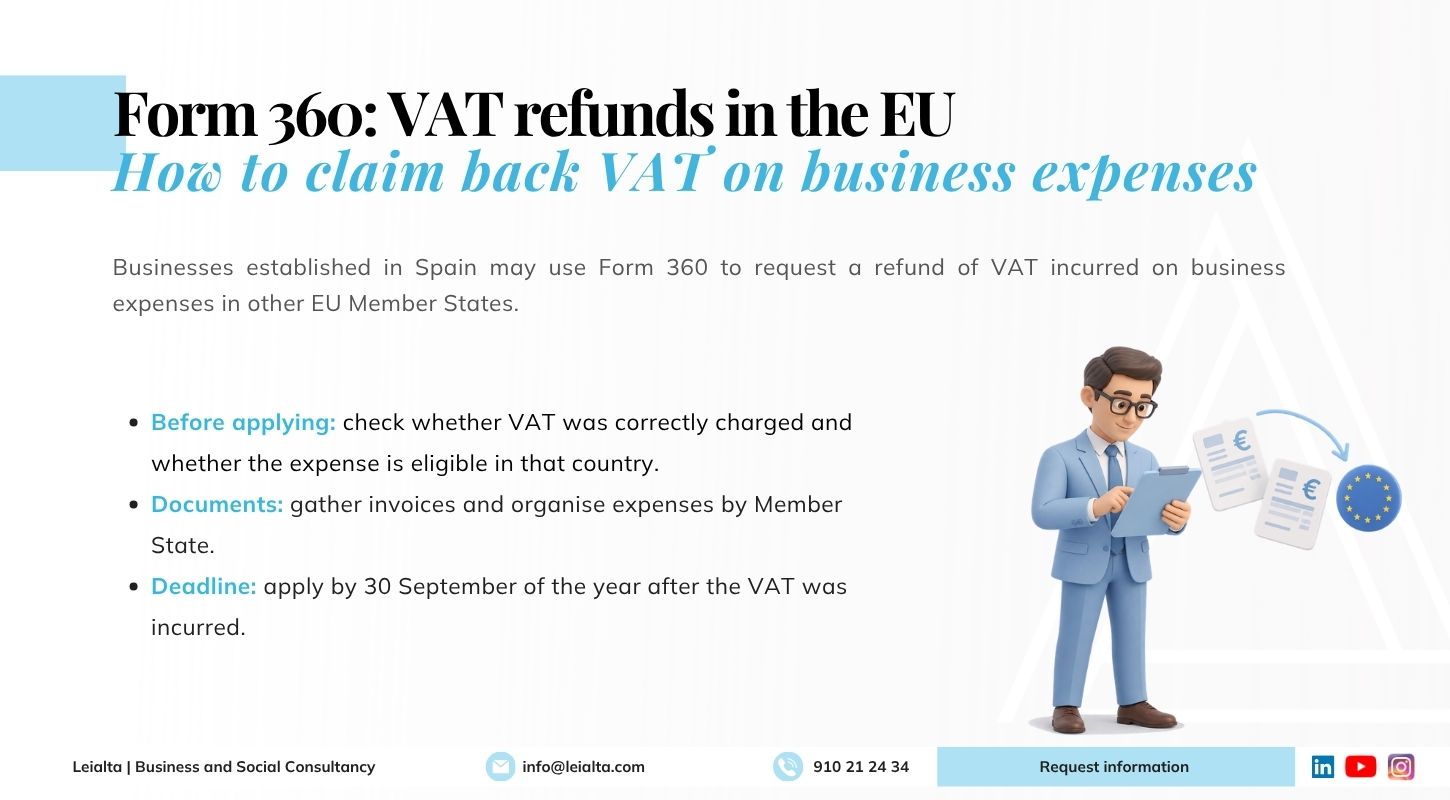
Form 360 allows businesses and professionals to apply, through the Spanish Tax Agency, for a refund of certain amounts of VAT incurred in other European Union countries. This article explains the general procedure for applicants established in mainland Spain or the Balearic Islands who meet the requirements to recover VAT as non-established businesses in the country of refund.
An international trade fair, a client visit or a business trip can generate invoices that include foreign VAT. However, that VAT is not recovered automatically. The expense, the company’s circumstances and the conditions applicable in the country where the VAT was incurred must first be reviewed.
What is Form 360 and what is it used for?
Index of contents
Form 360 is a VAT refund application. It is not a periodic self-assessment return or a form that all companies are required to submit. In the situation covered in this article, it is used to apply for the recovery of certain amounts of VAT incurred in other EU Member States.
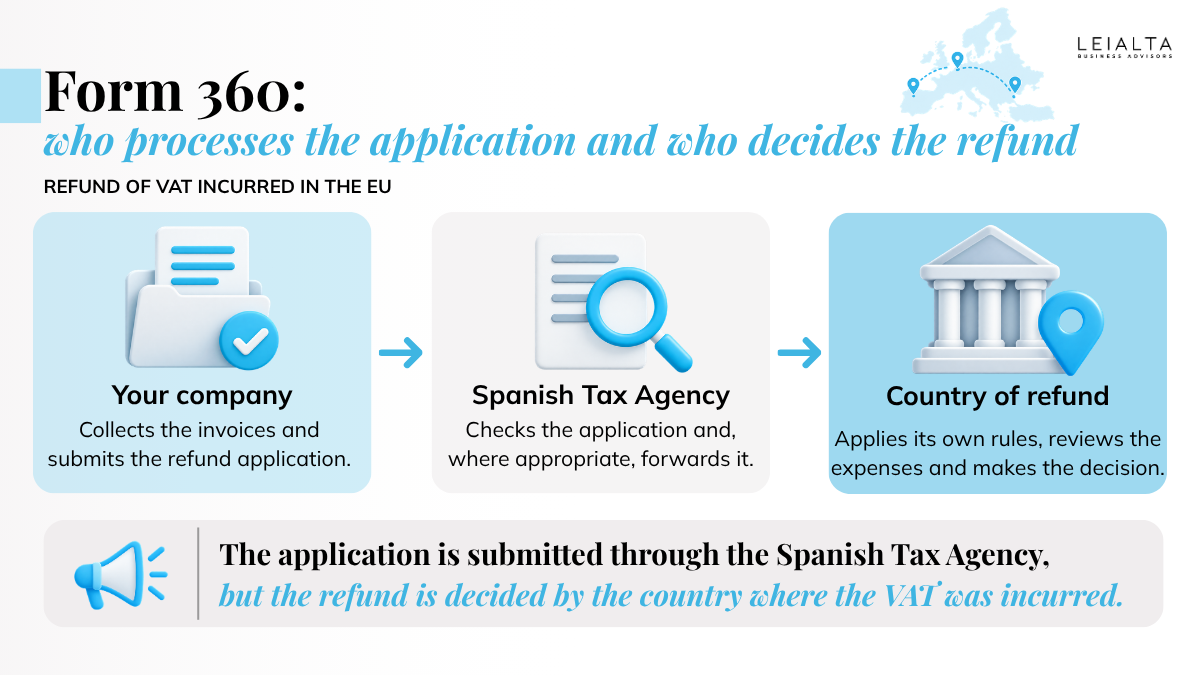
The Spanish Tax Agency receives the application and checks whether it should be forwarded. The tax authority in the country of refund then reviews the expenses and decides whether the amount claimed should be refunded. Therefore, submitting the form in Spain does not mean that the Spanish Tax Agency approves the refund of foreign VAT.
This procedure should not be confused with the refund of Spanish VAT to businesses established in third countries through Form 361. The country in which the business is established and the territory where the VAT was incurred determine which procedure needs to be considered.
Who can submit Form 360?
Businesses and professionals established in Spain
The most common situation is that of a business or professional established in mainland Spain or the Balearic Islands that incurs VAT in another EU Member State. For example, a company based in Bilbao may incur expenses during a business visit to Germany.
Businesses established in the Canary Islands, Ceuta or Melilla require a specific analysis of the applicable procedure and the conditions imposed by the country of refund. The general rules explained in this article should not automatically be applied to those cases.
Conditions for requesting a refund in another country
Under the general European procedure, three main issues need to be checked:
- The company’s activity. It must act as a business or professional and carry out transactions that give rise to a right of deduction in Spain.
- Its presence in the country of refund. During the period covered by the application, it must not have the seat of its economic activity there or a permanent establishment from which it has carried out business transactions. If it has neither a seat nor a permanent establishment there, it must also not have its domicile or habitual residence in that country.
- The transactions carried out in that country. As a rule, during the period covered by the application, the company must not have made supplies of goods or services deemed, for VAT purposes, to take place in that country. However, there are exceptions that allow a refund to be claimed even where certain transactions have been carried out there.
These exceptions include certain exempt transport services and related services, as well as transactions in which the recipient must account for VAT under the reverse charge mechanism. It is therefore incorrect to say that carrying out any sale or service in the country automatically prevents the company from applying for a refund.
Having a VAT identification number in the country of refund does not mean that the company has a permanent establishment there. To determine whether this procedure can be used, its actual presence and the transactions carried out in that territory must be reviewed.
Businesses that carry out exclusively exempt transactions that do not give rise to a right of deduction cannot use this procedure to recover VAT relating to those transactions. There are also restrictions connected with certain tax regimes. The Spanish VAT Regulations prevent certain applications from being forwarded, including those submitted by businesses operating exclusively under the equivalence surcharge scheme or the special scheme for agriculture, livestock farming and fishing.
Difference between Form 360 and Form 361
Both forms relate to VAT refunds for non-established businesses, but they apply to different situations. The following table summarises the key distinction for a Spanish company incurring expenses in other European countries.
| Form | Who it applies to in the situation explained | VAT that can be recovered |
|---|---|---|
| Form 360 | Businesses and professionals established in Spain. The Canary Islands, Ceuta and Melilla are subject to the specific considerations explained above. | VAT incurred in other EU Member States, in accordance with the applicable procedure. |
| Form 361 | Certain businesses and professionals established outside the EU, the Canary Islands, Ceuta or Melilla. | VAT incurred in mainland Spain and the Balearic Islands, subject to reciprocity or an applicable exception and the other requirements. |
Spanish Form 361 cannot be used to recover VAT incurred by a Spanish company in countries outside the EU. In those cases, the procedure available in the country where the tax was incurred must be analysed. The specific conditions of the other procedure are explained in our article on the requirements for Form 361.
Form 360 is also used to apply for refunds of VAT incurred in mainland Spain and the Balearic Islands by businesses established in the Canary Islands, Ceuta or Melilla. That situation falls outside the scope of this article.
What expenses may qualify for a refund of VAT incurred in the EU?
Trade fairs, events and business travel
The categories used to identify expenses include admission to trade fairs, accommodation, transport, fuel and restaurant expenses. They may also include purchases of goods, other services and imports related to the business activity. However, the fact that a category appears on the form does not mean that the VAT is deductible in every country.
Imagine a Spanish company attending a trade fair in Germany. On its return, it gathers the invoices for admission, accommodation and travel. The review should not simply consist of adding up all the VAT amounts.
- First, the different types of expense should be separated.
- The company should then check which services have correctly been charged German VAT and which of those amounts are eligible for refund.
The business purpose of the trip is relevant, but it does not replace this analysis.
Accommodation, transport and other business-related expenses
Each Member State applies its own restrictions within the European framework. An expense that is recoverable in one country may receive different treatment in another. This is particularly relevant for categories such as vehicles, fuel, restaurant expenses or business entertainment.
France provides one example. Its tax guidance generally excludes VAT on expenses incurred to provide free accommodation to employees or directors. Unless an applicable exception applies, VAT on accommodation provided to an employee travelling for work is therefore also non-deductible on that basis.
For this reason, where a company regularly incurs expenses in different countries, it can be useful to classify them both by territory and by type. An internal expenses policy can help organise this information, although deductibility must always be checked against the applicable rules.
European invoices containing VAT that should not have been charged
There is one check that comes before all the others: whether the supplier should have charged that VAT in the first place. The European VAT refund procedure excludes amounts that have been incorrectly invoiced.
The fact that an invoice has been issued by a European company is not enough. The VAT treatment of the transaction may be incorrect. In that case, the supplier should be asked to correct the invoice, and the amount incorrectly charged should be recovered through the appropriate procedure.
Three situations should be distinguished:
- VAT correctly charged and recoverable, either fully or partially, under the applicable rules.
- VAT correctly charged but not recoverable because of restrictions in the country of refund or because it relates to transactions that do not give rise to a right of deduction.
- VAT incorrectly charged, which should be recovered through correction of the invoice and the corresponding procedure.
The procedure also excludes VAT charged on certain supplies of goods that are or may be exempt as intra-Community supplies or exports in some circumstances. Therefore, where goods are transported to another country, the VAT treatment of the supply should be checked before including the amount in the refund application.
Consequently, the fact that an invoice correctly includes foreign VAT does not necessarily mean that the full amount can be claimed as a refund.
Documentation required to submit Form 360
Before accessing the form, it is advisable to organise the information into four groups:
- Company details: tax identification number, registered address, activity, electronic contact details and bank account information, including IBAN and BIC.
- Transaction documents: invoices and, where applicable, import documents.
- Details of each expense: supplier, tax identification details where applicable, date, document number, taxable amount, VAT amount and the nature of the goods or services.
- Application details: country of refund, period, currency and amount of VAT for which a refund is requested.
The VAT shown on an invoice and the amount that can be recovered do not necessarily coincide. The application distinguishes between VAT incurred and deductible VAT and, where applicable, includes the relevant deduction percentage.
To substantiate the right to a refund, valid invoices or import documents must be available in accordance with the applicable legislation. It is advisable to request invoices in the company’s name, including its full tax details, and to check the requirements of the relevant country, including any rules governing simplified invoices. Proof of payment alone does not replace this documentation.
Supporting documents demonstrating the connection between the expense and the business activity should also be retained, such as trade fair registration documents or evidence of the business trip.
Coordination with LEIALTA’s tax and accounting team can help prepare an organised list, identify missing documents and avoid duplication before the application is submitted.
When should copies of invoices be attached?
The Directive allows the country of refund to require electronic copies where the taxable amount reaches certain thresholds: €1,000 in general and €250 for fuel, or the equivalent amount in national currency. These thresholds apply where the amount is equal to or above those limits.
These thresholds refer to the taxable amount, not the VAT, and they do not mean that every country requires the same supporting documents. The requirements of the relevant Member State should be checked. The thresholds are assessed for each invoice or import document individually, and documents may also be requested below those amounts in the cases provided for by law.
Deadline for submitting Form 360
The filing period begins on the day following the end of the period covered by the application and ends on 30 September of the year following the year in which the VAT was incurred.
- For VAT incurred in 2025, the general filing deadline is 30 September 2026.
It is advisable not to wait until the final day. The application must contain all mandatory information to be treated as duly submitted. Having the documents ready is not the same as having completed the filing procedure.
What periods and amounts can be included?
As a rule, the refund period must cover between three months and one calendar year. A period shorter than three months is permitted where it corresponds to the remaining part of the calendar year.
| Period covered by the application | Minimum amount of VAT claimed |
|---|---|
| At least three months and less than one calendar year, except for the remaining part of the year | €400 |
| Full calendar year or remaining part of the year | €50 |
These thresholds refer to the amount of VAT claimed, not the total value of the invoices. Where relevant, the equivalent in national currency applies.
For example, €180 of recoverable VAT from the first quarter would not meet the minimum threshold for a quarterly application. However, it could potentially be included in the annual application, provided the other conditions are met.
To determine the period in which a transaction should be included, both the date on which the invoice was issued and the date on which VAT became chargeable must be considered. Generally, both events must have occurred before the VAT can be included in the application. If they fall in different periods, the VAT should be included in the period in which the later of those two conditions is met. For imports, the relevant period is the one in which the import took place. The payment date alone does not determine the refund period.
If an application for a particular period has already been submitted and invoices that were not included are identified later, the Spanish Tax Agency indicates that they should be included in a new annual application for the relevant year. The filing deadline must still be observed, and the company should check that those amounts have not already been claimed.
How to submit Form 360 to the Spanish Tax Agency
The application must be submitted electronically and may be filed either by the applicant or by an authorised third party acting on its behalf. Before starting, the company should check its NIF, tax registration status and access to an accepted electronic certificate.
The process can be organised into three stages:
- Check access and notifications. Review the electronic identification method, registration for the relevant service and, where a third party is involved, their powers to act.
- Prepare the application by country and period. Include the company’s activity, bank details, transactions and any required attachments.
- Review, sign and submit. Check the amounts and retain the filing receipt and supporting documentation.
There is an important practical distinction to keep in mind: being authorised to submit the application does not necessarily mean being authorised to receive notifications. Where the person submitting the application will also receive notifications, the Spanish Tax Agency requires the corresponding power of attorney.
Attention should also be paid to the preferences of the country of refund, including expense codes, additional information and accepted languages. The form incorporates information linked to these national requirements.
Who decides the application and how long can it take?
For applications relating to VAT incurred in another EU Member State, the decision is made by the tax authority of that country. The Spanish Tax Agency checks whether the application should be forwarded and confirms its receipt.
The general deadline for notifying the decision is four months from the date the country of refund receives the application. If additional information is requested, special procedural deadlines apply and the process may take up to eight months where further information is requested. These decision deadlines do not amount to a guarantee that the refund will be paid within four months.
If the refund is approved, the relevant country must pay the approved amount no later than ten working days after the applicable decision period has ended. This payment deadline does not necessarily run from the date on which the favourable decision is notified.
During the process, communications may be received directly from the country of refund. In addition, the European procedure provides a period of one month to supply any additional information requested, calculated from receipt of the request. For this reason, monitoring the procedure does not end once the form has been submitted.
If the country of refund rejects the application in full or in part, it must state the reasons. The decision may be appealed before the competent authorities in that country in accordance with its procedures and deadlines. If the Spanish Tax Agency decides not to forward the application, that decision must be challenged in Spain through the corresponding procedures.
Common mistakes when applying for a refund of VAT incurred in the EU
When applying for a refund of foreign VAT, errors do not always arise when completing the form itself. They may also occur when selecting the procedure, preparing the documentation or dealing with subsequent communications. These are the main points that should be reviewed to avoid problems.
- Eligibility errors. Claiming VAT that was incorrectly invoiced or using the procedure without first reviewing the company’s transactions may result in rejection. It is also important to distinguish when Form 361 applies rather than transferring its requirements to Form 360.
- Documentation and completion errors. Incomplete supplier details may prevent the application from being submitted correctly. The Spanish Tax Agency requires the supplier’s name and address and, for purchases of goods or services, the corresponding tax identification number. The currency, bank account and amount claimed should also be checked.
- Follow-up errors. Filing after the deadline or failing to respond to requests for information may jeopardise the application. It is advisable to assign a person to monitor communications, particularly where the company, its adviser and a foreign tax authority are all involved.
Frequently asked questions about Form 360
Can I deduct foreign VAT on Form 303?
Foreign VAT cannot be deducted as Spanish VAT on Form 303. VAT incurred in another country must be considered under the relevant refund procedure. This is different from Spanish VAT that may need to be reported in connection with an intra-Community acquisition or a transaction subject to the reverse charge mechanism.
Do I have to submit Form 360 every quarter?
No. Form 360 is an application used to exercise a right to a refund, not a general quarterly filing obligation. The permitted periods and minimum amounts determine when an application can be submitted, always within the applicable deadline.
Can I include expenses from several countries in a single application?
VAT incurred in different Member States should not be combined in a single refund application. Each application relates to one specific country. For example, French and German VAT must be organised into separate applications.
What happens if my company can only deduct part of its VAT?
The amount claimed must be adjusted to the applicable deductible proportion. Where a pro rata deduction applies, this reflects the percentage of VAT that can be deducted. The full amount of VAT shown on the invoices cannot simply be transferred to the form.
Does submitting Form 360 guarantee that I will recover the full amount claimed?
No. The tax authority in the country of refund may approve only part of the amount claimed or reject the application. First, it must be determined which amount of VAT is recoverable under the rules of the country of refund. Where applicable, that amount is then adjusted by the deductible proportion corresponding to the applicant’s activity in Spain.
If the final deduction percentage differs from the percentage initially applied on a provisional basis, the amount claimed or already refunded must be adjusted. The correction is communicated in accordance with the procedure during the calendar year following the refund period, and the form provides for notification of the final pro rata percentage.
How LEIALTA can help recover VAT incurred in other EU countries
Recovering foreign VAT requires coordination between the tax review and the underlying accounting documentation. Before submitting Form 360, companies should understand which expenses they have incurred, where they were incurred and the transactions to which they relate.
At LEIALTA, we support companies and corporate groups through coordinated tax and accounting advice. Our tax advisory services allow these issues to be addressed as part of a broader view of the company’s business activity.
The aim is to identify potentially recoverable VAT, detect possible issues and prepare the documentation before the procedure begins, without assuming that the refund will necessarily be granted.


