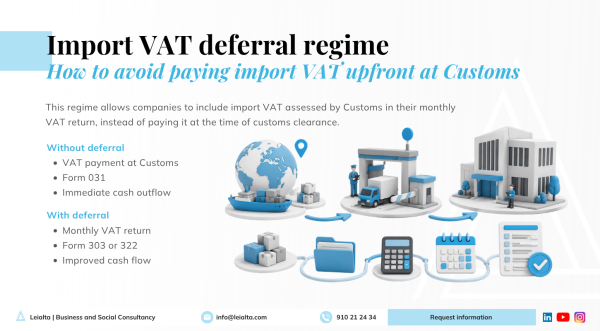
The import VAT deferral regime allows certain companies and professionals to avoid paying import VAT at the time of customs clearance. Instead, the amount is included later in their monthly VAT return.
This option can be particularly useful for importing companies, businesses engaged in international trade and foreign companies operating in Spain that need to optimise their cash flow.
In this article, we explain how the import VAT deferral regime works, when it applies, which requirements must be met, how to opt into it and which obligations companies should review to avoid errors in their VAT returns.
What is the import VAT deferral regime?
Index of contents
The import VAT deferral regime allows businesses to defer payment of the VAT assessed by Spanish Customs until the corresponding monthly VAT return is filed.
As a rule, when a company imports goods from a third country, meaning a country outside the European Union, import VAT must be paid at the time of customs clearance. This can have a significant financial impact because the company has to advance the tax before being able to deduct it in its periodic VAT return, provided it is entitled to deduct it.
Under the deferral regime, the importer does not pay import VAT through Form 031 at the time of customs clearance. Instead, the amount assessed by Customs is included in the monthly VAT return, normally through Form 303 or, where applicable, Form 322.
Therefore, this regime does not provide an exemption or eliminate VAT. It simply defers the timing of payment and allows the amount to be managed through the relevant monthly VAT return.
Why can it be useful for importing companies?
The main advantage of import VAT deferral is improved cash flow.
Without this regime, the company must pay import VAT to Customs and then wait until its periodic VAT return to deduct it, provided it is entitled to do so. With deferral, however, the amount is included in the monthly VAT return, reducing the immediate financial impact of the import.
This can be particularly relevant for companies that:
- Import goods regularly.
- Carry out a high volume of international transactions.
- Need to optimise cash flow.
- Operate with tight margins or long collection cycles.
- Operate in Spain as part of an international structure.
In practice, the regime helps prevent import VAT from generating an immediate cash outflow with each customs clearance.
When does import VAT deferral apply?
Import VAT deferral applies to imports of goods from countries outside the European Union.
In these transactions, the importing company may have to pay different amounts at Customs, including customs duties, other charges and import VAT.
The deferral regime applies specifically to import VAT. Therefore, it should not be confused with an exemption from customs duties or the elimination of other customs obligations.
Without this regime, the usual procedure is for the company to pay VAT when the customs declaration, or DUA, is accepted or when customs clearance takes place. It may then deduct the amount in its periodic VAT return, provided the general deduction requirements are met.
With deferral, payment of the VAT is transferred to the relevant monthly VAT return, avoiding the need to advance the amount at Customs.
Differences between applying and not applying import VAT deferral.
| Aspect | Without VAT deferral | With VAT deferral |
|---|---|---|
| When VAT is paid | At customs clearance. | Through the monthly VAT return. |
| Usual form | Form 031. | Form 303 or Form 322. |
| Cash-flow impact | Greater immediate cash outflow. | Improved liquidity. |
| Specific requirements | General import regime. | Monthly VAT settlement period and census election. |
| Subsequent treatment | Deduction through the periodic VAT return, where applicable. | VAT assessed by Customs is included in the monthly return. |
| Main risk | Financial cost of advancing the VAT. | Errors or omissions when reporting the amounts in the VAT return. |
What requirements must be met?
Certain requirements must be met to apply the import VAT deferral regime.
The main requirement is that the importer must be a business or professional whose VAT settlement period corresponds to the calendar month.
This is important because carrying out imports is not sufficient on its own. The company must file monthly VAT returns.
In practice, entities that may have a monthly VAT settlement period include:
- Large companies, meaning those with an annual turnover exceeding €6,010,121.04.
- Companies registered in the Monthly VAT Refund Register, REDEME.
- Entities applying the special VAT group regime, where applicable.
In addition, the company must:
- Exercise the option for VAT deferral within the applicable deadline and in the required form.
- Submit the relevant census declaration correctly.
- Include the import VAT assessed by Customs in its monthly VAT return.
- Continue to comply with the applicable tax and customs obligations.
Therefore, the key requirement is not that the reporting period coincides with the calendar year, but that the VAT settlement period is monthly.
How can import VAT deferral be requested?
The option to defer import VAT is exercised by filing the corresponding census declaration with the Spanish Tax Agency, using Form 036.
Generally, the application must be submitted during November of the year preceding the calendar year in which the regime is intended to take effect.
For example, if a company wants to apply the deferral regime from the following year, it must exercise the option during November of the previous year.
Once the option has been exercised, the regime applies to all import transactions carried out during the calendar year. It is also automatically extended to subsequent years unless the company renounces the regime or is excluded from it.
When Customs accepts the DUA, the system checks whether the importer has exercised the VAT deferral option. If the option has been correctly registered, the company will not have to pay import VAT using Form 031.
How is deferred import VAT reported in Form 303?
Once the deferral regime applies, the importing company must include the import VAT amounts assessed by Customs in the corresponding monthly VAT return.
As a rule, these amounts are reported in Form 303 or, where applicable, Form 322, for the period in which the assessment was notified.
In an import transaction, this notification normally takes place on the date the goods are released by Customs.
Form 303 includes a specific box for import VAT assessed by Customs and still pending payment. For this reason, companies should carefully review all amounts notified during each period before filing their VAT return.
The Spanish Tax Agency also provides a specific online service called “Consulta del IVA importación con diferimiento de pago”, which allows businesses to check the amounts corresponding to each period and their current status.
This tool can be particularly useful for preventing reporting errors, duplicate entries or omissions in the monthly return.
What happens if the amounts are not reported correctly?
Import VAT deferral requires strict control over the amounts assessed by Customs.
If the importer fails to include all import VAT amounts notified during a particular month in the corresponding VAT return, the omitted amounts may move directly into the enforcement collection period.
In addition, failing to report, incorrectly reporting or incompletely reporting tax amounts relating to import transactions assessed by the authorities may constitute a tax infringement and result in penalties.
Companies applying this regime should therefore review each month:
- Customs declarations processed.
- Import VAT amounts assessed by Customs.
- The date of release or notification.
- Information available through the Spanish Tax Agency’s online portal.
- Correct reporting of the amounts in Form 303 or Form 322.
An error at this stage can turn a cash-flow advantage into a tax compliance issue.
Can a company opt out of the regime or be excluded?
Yes. A company can opt out of the import VAT deferral regime.
The renunciation must be made by filing the corresponding census declaration with the Spanish Tax Agency, normally during November of the year preceding the calendar year in which it is intended to take effect.
Once submitted, the renunciation remains effective for a minimum period of three years.
A company may also be excluded from the regime if it no longer meets the requirements, particularly if its VAT settlement period ceases to be monthly.
For this reason, companies should review each year whether they continue to meet the conditions for applying the regime and whether it remains appropriate for their business operations.
When may import VAT deferral be worthwhile?
The import VAT deferral regime can be particularly useful for companies that import goods regularly and are entitled to deduct input VAT.
It may be worth considering in cases such as:
- Importing companies with frequent transactions.
- Companies purchasing large volumes of goods from outside the European Union.
- Businesses seeking to reduce cash-flow pressure.
- Foreign companies operating in Spain and carrying out imports.
- Corporate groups with international activities and VAT obligations in Spain.
However, before opting into the regime, it is important to analyse the company’s specific circumstances, VAT settlement frequency, right to deduct VAT, administrative capacity and expected import volumes.
How LEIALTA can help
The import VAT deferral regime can be a useful tool for improving the cash flow of importing companies. However, it also requires precise tax management and appropriate monitoring of the amounts assessed by Customs.
At LEIALTA, we can help you assess whether your company meets the requirements to apply the regime and whether it is suitable for your international operations, import volumes and tax obligations in Spain.
If your company carries out imports or is considering starting business operations in Spain, contact us.
Specialist advice can help ensure that the regime is applied correctly, prevent errors in monthly VAT returns and optimise the tax management of imports.