

Payroll outsourcing in Spain allows businesses to delegate payslip preparation and certain recurring employment administration tasks to a specialist provider. It can make ongoing payroll management more efficient, provide access to local expertise and create a better-structured process, while allowing the employer to retain oversight.
For any company employing staff in Spain, running payroll involves more than calculating salaries. Every month, payroll teams must incorporate employee changes, check pay components, apply relevant collective bargaining agreements and coordinate obligations with the Spanish Social Security and tax authorities.
Outsourcing this work is therefore not simply a matter of transferring administrative tasks. A well-managed arrangement defines what the payroll provider does, what the employer checks and how both parties coordinate their work.
What is payroll outsourcing in Spain and how does it work?
Index of contents
Payroll outsourcing, also known as outsourced payroll management, means engaging a specialist firm to prepare and administer employee payroll on a recurring basis, either in full or in part.
The service may focus solely on salary calculations or extend to broader employment administration. Under a more comprehensive arrangement, it can include processing employee changes, coordinate Social Security contributions and tax withholding, and preparing reports for Human Resources. The precise scope depends on the agreed services.
For example, a business with 40 employees in Spain might retain responsibility for annual leave, absences and working-time changes, while an external labour adviser calculates monthly payroll and prepares the relevant Social Security documentation.
In this model, the company’s HR team supplies the information, checks the calculations and approves the payroll before salaries are paid.
However, outsourcing payroll operations does not transfer all employment-related legal responsibilities to the provider. The company remains the employer and must maintain appropriate controls over the information supplied and its statutory obligations.
What services does payroll outsourcing in Spain include?
The scope of a payroll outsourcing service depends on the company’s requirements and its agreement with the provider. There are three main areas worth reviewing before entering into a contract.
Salary calculations, collective agreements and employee changes
Preparing payroll requires accurate calculation of each employee’s remuneration, taking account of contractual terms, the applicable collective bargaining agreement and any changes occurring during the pay period.
Typical items include:
- Basic salary, pay supplements and additional salary payments.
- Variable remuneration, bonuses and overtime, where applicable.
- Absences, leave, periods of temporary incapacity for work and changes to working hours.
- New starters, leavers and amendments to employment terms.
- Salary increases and other changes required under the applicable collective bargaining agreement.
The payroll adviser needs accurate, up-to-date information, but does not always have direct access to all the changes taking place within the business.
For example, if an employee earns a monthly bonus or changes their working hours, HR must communicate that information through the agreed process. The provider then includes the change in the payroll calculation and checks how it should be treated.
Some payments require additional assessment, such as reimbursed travel expenses and subsistence allowances. Their treatment for payroll, tax and Social Security purposes depends on the nature of the payment and the applicable Spanish requirements.
The quality of payroll outsourcing therefore depends not only on accurate calculations, but also on receiving complete information at the right time.
Social Security contributions and payroll tax withholding
Payroll processing is connected to several employment and tax obligations that employers in Spain must meet on a recurring basis.
In relation to Spanish Social Security, the provider may prepare and submit contribution settlements, process employee data changes and make other communications through the Sistema RED electronic platform, provided that these tasks are included in the agreement and the necessary authorisations are in place.
For tax purposes, payroll calculations include the personal income tax (IRPF) withholding applicable to each employee. Depending on the agreed scope, the provider may also prepare or file the associated returns, such as Spanish tax form 111 and the annual summary form 190. This makes it essential to distinguish between the following:
- The employer’s legal obligations.
- The administrative work that an external payroll adviser can carry out on the employer’s behalf.
Appointing an external provider does not remove the employer’s responsibilities for wages, Social Security contributions or compliance with Spanish employment legislation.
Before outsourcing these activities, the parties should therefore agree who prepares the documentation, who submits the returns and how the amounts are reviewed and approved.
Payroll reporting and communication with HR and finance teams
An outsourced payroll provider should do more than issue payslips at the end of each month. The employer also needs reliable information to review the results and monitor its employment costs.
Depending on the contract, deliverables may include payroll summaries, employment-cost reports, Social Security documentation, outstanding-issue logs and other information required by HR or the finance department.
These reports help a business track salary cost, identify differences from previous periods and prepare internal forecasts. To make the process effective, it is advisable to agree a timetable for submitting information, clear review dates and named points of contact.
The parties should also decide how to report changes discovered after payroll has closed and who will resolve them. This allows the provider to carry out the contracted work while the employer maintains visibility over its Spanish payroll obligations.
Benefits and risks of outsourcing payroll in Spain
Payroll outsourcing can bring operational and organisational benefits, but the results depend on the company’s size, the complexity of its workforce and the quality of the service it receives.
Before making a decision, management should assess the potential advantages alongside the risks that need to be controlled.
Main benefits for employers 1.
- Less internal administration. The HR and administration teams may have more time to focus on workforce planning, employee development and other responsibilities when recurring payroll calculations are handled externally. 2.
- Access to specialist knowledge. An experienced payroll team can provide technical support with complex pay calculations, collective agreements and changes to Spanish employment requirements. 3.
- Greater service continuity. If payroll depends on a single in-house employee, leave or staff turnover can disrupt the monthly process. A suitably resourced provider can help maintain continuity through documented procedures and cover arrangements. 4.
- Support with employment compliance. Specialist oversight may help detect inconsistencies, review calculation criteria and adapt processes to applicable requirements, although outsourcing does not guarantee that errors or penalties will never arise. 5.
- Flexibility as the business grows. As headcount or the number of workplaces increases, the provider may be able to adapt the service without the company needing to perform all additional administration in-house.
Potential risks when outsourcing payroll
Outsourcing can also create difficulties if the service is not properly organised. The main areas to consider are provider dependency, unclear responsibilities and the protection of employees’ personal information.
- Provider dependency. If procedures are not documented or communication channels are unclear, an unexpected issue may affect the monthly payroll timetable.
- Unclear responsibilities. If nobody is explicitly responsible for checking and approving payroll, errors, disagreements or delays may go unresolved.
- Confidentiality. Payroll involves personal and financial data, so access rights, secure data transfers and processing arrangements must be carefully managed.
These risks can be mitigated through a clearly defined service agreement, documented communication procedures, access controls and regular checks. The benefit of outsourced payroll depends on how the service is set up and monitored, rather than on outsourcing alone.
In-house, outsourced or hybrid payroll: which model suits your company?
Not every organisation needs to outsource the same range of payroll functions. Some have established internal teams, while others rely on an external adviser for the full payroll cycle. A third option is a hybrid arrangement that combines internal resources with specialist external support.
| Criterion | In-house | Outsourced | Hybrid |
|---|---|---|---|
| Operational control | The internal team performs and supervises payroll. | The provider carries out agreed tasks; the employer checks the results. | Operational tasks are shared between the teams. |
| Administrative workload | Mostly handled by the company. | Less execution of delegated tasks in-house. | Shared according to the agreed responsibilities. |
| Specialist expertise | Depends on the skills of internal staff. | Access to the provider’s payroll expertise. | Combines internal knowledge with external advice. |
| Scalability | May require more people or systems. | Depends on the provider’s capacity and terms. | Can adapt the split of work as the business grows. |
| HR / finance | Direct internal coordination. | Requires data exchange and approval. | Clear division of responsibilities. |
The most suitable approach depends on the organisation’s structure and resources:
- A company with an experienced internal payroll team may prefer to manage the process in-house.
- A business that needs ongoing specialist support may choose to delegate much of the day-to-day work.
- A hybrid model may be appropriate where the company wants to retain some administrative tasks while outsourcing others.
Whichever model is chosen, the employer still needs reliable information, internal oversight and compliance with its statutory employment obligations.
When should a business consider outsourcing payroll in Spain?
The decision does not depend on headcount alone. A company’s structure, frequency of payroll changes and availability of skilled internal resources also influence whether external support would be worthwhile.
Several situations may justify reviewing the current payroll model:
- Workforce growth: more employees mean additional payroll calculations, employment changes and administrative communications.
- Multiple workplaces or collective agreements: different employees may be subject to different pay scales and employment conditions.
- Frequent payroll issues: recurring adjustments, corrections and delays can occupy substantial HR and finance resources.
- Limited in-house expertise: an administration team may be handling specialist payroll matters without sufficient time or technical support.
A review may also be appropriate if management receives insufficient information about employment costs or cannot easily track the status of recurring payroll tasks.
These situations do not necessarily require a fully outsourced service. In some cases, reorganising responsibilities or obtaining specialist support for selected tasks may be enough.
What should a company check before appointing or changing a payroll provider?
Choosing a payroll provider in Spain should involve more than comparing monthly fees. The business also needs to understand how the service will work in practice and what will happen if an issue arises.
Before signing an agreement, it should assess the proposed scope, the transition arrangements and the handling of employee information. These matters become particularly important when an international parent company is involved.
Three areas deserve particular attention:
Scope, responsibilities, deadlines and controls
The service agreement should specify which activities the provider will perform, and which responsibilities will remain with the employer.
It should be clear who supplies variable-pay information, who prepares the payslips, who reviews the calculations and who authorises the monthly payroll close.
The parties should also agree delivery dates, procedures for correcting issues and communication channels for HR and finance contacts in Spain or abroad.
Pricing is another point to check. Some providers charge according to employee numbers, while exceptional tasks or specialist advice may be billed separately.
A clear understanding of the recurring fee and any additional charges will help the company assess the overall service rather than comparing headline prices alone.
Data migration and historical employment records
Changing providers involves more than handing over an up-to-date employee list. The incoming adviser needs enough historical information to continue payroll processing accurately.
The employer should therefore coordinate a structured handover and establish which information the outgoing provider will deliver, in what format and by which date.
Relevant records may include employment contracts, employee details, remuneration arrangements, applicable collective agreements, previous payroll calculations, Social Security and withholding information, and any unresolved issues.
The right time to change provider depends on whether the company can organise a reliable handover, obtain the necessary historical records and ensure that no outstanding obligation is missed.
Before agreeing a start date, the company should review payroll and contribution deadlines, assign responsibility for each reporting period and arrange checks on the first payrolls completed by the new provider.
Data protection and access to sensitive information
Payroll records contain personal and salary information and, in some circumstances, particularly sensitive employee data. Appropriate confidentiality and security measures are therefore essential.
Where a payroll provider processes personal data on the employer’s behalf, the relationship must be formalised in accordance with applicable data protection requirements, including the EU General Data Protection Regulation (GDPR).
Generally, the employer is the data controller and the provider acts as a data processor for activities carried out under the employer’s instructions. The precise allocation of roles should be checked against the activities involved.
The relevant agreement should address the purposes of processing, instructions, security measures and access arrangements, among other requirements. It is also advisable to define how records will be returned or handled when the service ends.
How do the employer and payroll adviser manage the monthly cycle?
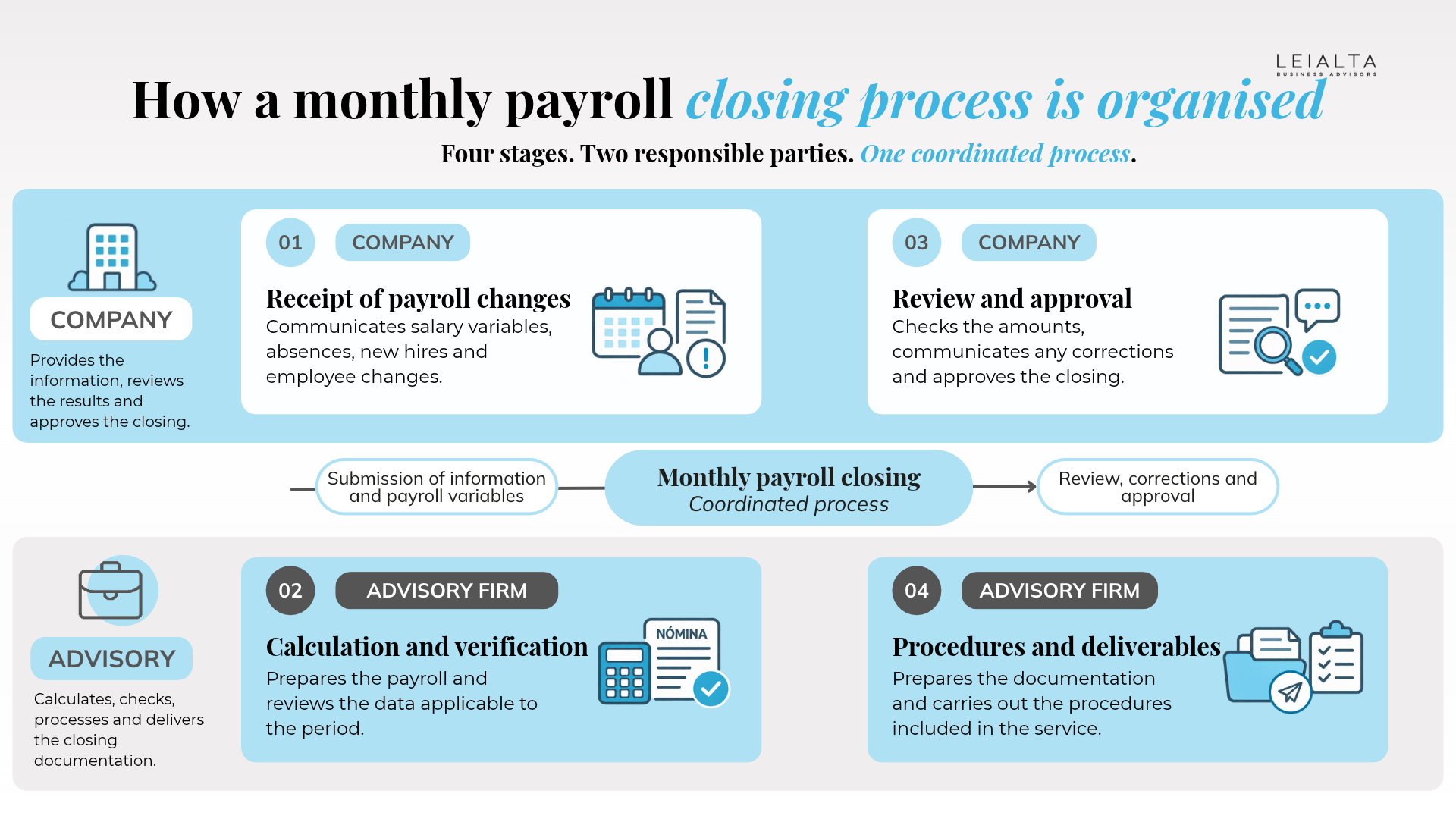
An outsourced payroll service requires coordination throughout the month, even though many activities are concentrated in the days leading up to payroll close.
The employer communicates changes affecting employees, while the payroll adviser prepares the calculations and carries out the checks included in the agreed service.
Before finalisation, both parties need a process for resolving discrepancies and approving the results. Final documentation is then issued, and any agreed submissions or other administrative tasks are completed.
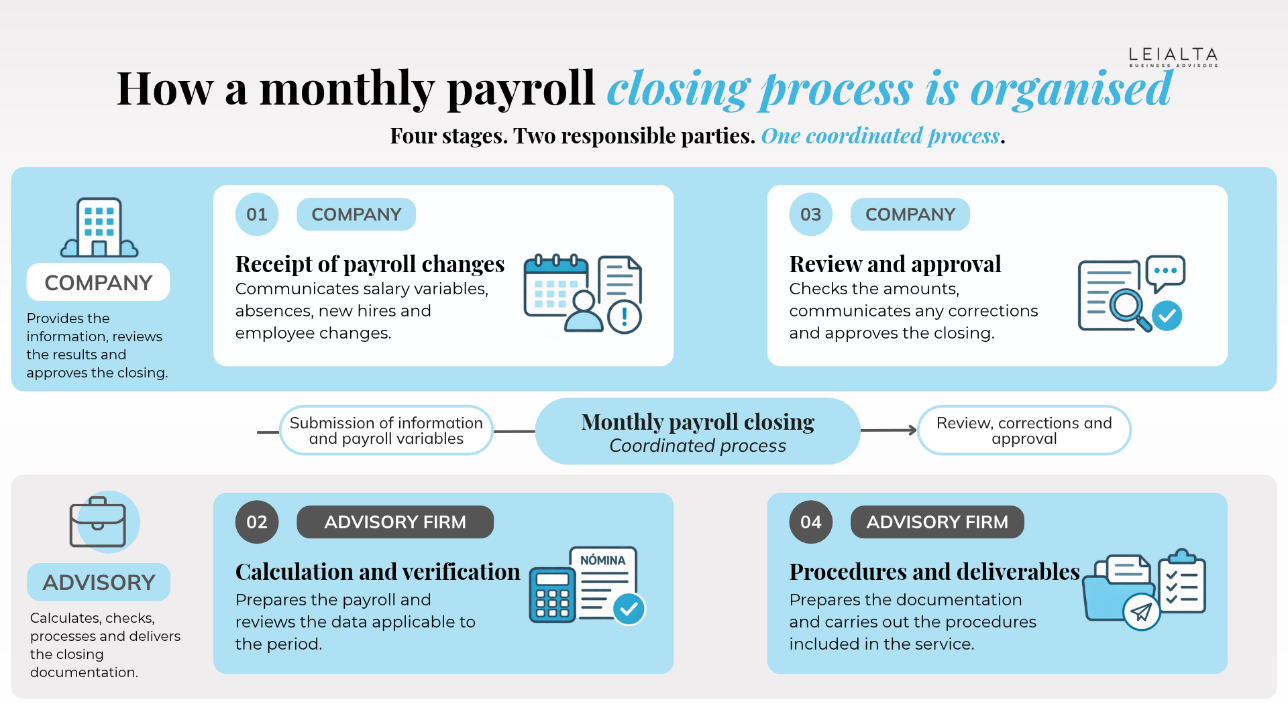
The precise timetable will depend on the business’s internal procedures and the scope of the agreement with the payroll provider.
For instance, there may be agreed deadlines for communicating changes, delivering draft payroll and approving results before final payslips are issued. It is also useful to specify how changes reported after the deadline will be handled.
The aim is for everyone to know what information they must provide, when they need to act and which checks they are responsible for. This makes payroll outsourcing a coordinated process rather than a simple monthly exchange of documents.
Payroll outsourcing for Spanish subsidiaries of international groups
International businesses with employees in Spain may face additional coordination requirements. In practice, payroll often involves three different teams:
- The parent company’s HR department.
- Local management or the Spanish subsidiary’s HR team.
- A local payroll adviser familiar with Spanish employment rules.
Even where a group uses common remuneration policies and corporate procedures, payroll for employees subject to Spanish employment law must follow the requirements applicable in Spain.
These include the relevant collective bargaining agreements, Social Security contributions, payroll tax withholding and other features of the Spanish employment framework.
The parent company may also require periodic reports on employment costs, headcount movements and differences from budget, often in a standard format used across several countries.
A local labour advisory firm can coordinate these requirements, support communication across jurisdictions and prepare the agreed payroll information for the international HR and finance teams.
For example, a Spanish subsidiary may need to complete payroll according to local deadlines while supplying a consolidated salary-cost report to its international headquarters for group financial reporting.
The challenge is to align those two reporting processes while continuing to meet the employer’s obligations in Spain.
How can LEIALTA support payroll outsourcing in Spain?
At LEIALTA, we support Spanish and international businesses with recurring payroll administration and specialist employment advice. Our approach combines day-to-day execution with an understanding of the wider needs of the company.
Our labour advisory services cover the full payroll cycle, as well as employment contracts, Spanish Social Security, remuneration policies and other employment matters relevant to businesses operating in Spain.
One example of this approach is our work with Evercom, a Spanish communications and digital strategy consultancy.
In that engagement, LEIALTA reviewed the applicable collective bargaining agreement, the company’s workforce structure and its remuneration policies. Our team also carried out an employment-law review of payroll, contracts and the treatment of personal income tax withholding.
Following the review, the team prepared a report outlining its findings and recommended measures. The work helped improve the application of remuneration policies and establish a more structured process for communication and coordination with the company.
If your company is considering outsourcing payroll in Spain or reviewing its current arrangements, our labour advisory team can help you assess the scope of the service and the coordination required.
Frequently asked questions about payroll outsourcing in Spain
Which payroll-related tasks can the employer keep in-house?
The employer may retain responsibility for managing annual leave, recording and communicating employee changes, making hiring or remuneration decisions and approving payroll before payment.
The precise division of tasks will depend on the service model. Even if much of the operational work is outsourced, the company remains responsible for the oversight and statutory duties that apply to it as an employer.
Can a company change payroll providers during the year?
Yes. A business can change payroll provider during the year, provided it plans the handover carefully and follows the relevant contractual terms.
The essential steps are transferring payroll records, assigning responsibility for each pay period and coordinating any outstanding returns.
What information does a provider need to process payroll in Spain?
Usually, the provider needs employee details, contracts, salary terms, the relevant collective agreement and information needed for tax withholding and Social Security contributions.
Each month, it will also need changes affecting pay, such as absences, changes to working hours or variable remuneration.
Requirements vary with the service and the workforce. All information should be handled in line with data protection principles.
How much does payroll outsourcing in Spain cost?
Pricing depends on workforce size, payroll complexity, applicable collective agreements and the services included. Providers may charge per employee or offer a tailored monthly fee. Before signing, check which services are included and which carry additional charges.
Who is responsible if an outsourced payroll calculation is incorrect?
The employer retains its statutory duties, while the provider may have contractual or professional responsibilities. Clear approval and correction procedures help both parties address errors.
Does outsourced payroll include paying employees’ salaries?
Not automatically. The provider normally prepares payroll calculations and documents; the employer authorises and pays salaries. Payment administration must be agreed separately.

