A legal due diligence is a legal review of a company, business or certain assets that makes it possible to identify risks, obligations and contingencies before a company sale or purchase, investment or other corporate transaction.
Also known as legal due diligence, it analyses aspects such as the company’s corporate position, its contracts, potential litigation, employment relationships, intellectual property rights, licences and regulatory compliance.
It forms part of a broader due diligence process when the transaction also requires financial, tax, commercial or other matters to be reviewed. Its specific purpose is to determine what legal risks exist and how they may affect the decision, negotiation or completion of the transaction.
What is legal due diligence?
Index of contents
Legal due diligence is an analysis of a company’s legal position to verify its rights, obligations, contracts and potential contingencies before a business transaction.
In other words, it is not simply a matter of checking that certain documents exist. It is also necessary to understand:
- What effects they have.
- Whether they have been properly formalised.
- Whether they contain obligations, restrictions or risks that the buyer should be aware of.
For example, a company may have one of its main contracts properly signed, but that contract may contain a change-of-control clause allowing the other party to terminate it if the company is sold.
The document exists and is valid, but its content may be decisive for the transaction.
Legal due diligence therefore aims to move from legal documentation to a practical assessment of the risk that the buyer or investor may assume in acquiring or investing in the company.
When is legal due diligence carried out?
Legal due diligence is usually carried out once a transaction has progressed far enough for the potential buyer or investor to access sensitive documentation, but before the risks are definitively assumed and the transaction is completed.
It is particularly common in company sale and purchase transactions, although it can also be relevant in other transactions such as the entry of an investor, certain mergers, joint ventures or acquisitions of businesses or assets.
The legal scope will also depend on how the transaction has been structured. Acquiring equity interests or shares in a company is not the same as purchasing only certain assets or a business unit.
- In the first case, the buyer takes control of a company that retains its existing rights and obligations.
- In the second, it is necessary to define very precisely which assets, contracts, rights or obligations form part of the transfer.
What is analysed in legal due diligence?
There is no single scope that applies to every company.
The sector, corporate structure, type of activity, principal assets and the transaction itself determine which legal areas require a more in-depth review.
However, several areas are usually of particular importance.
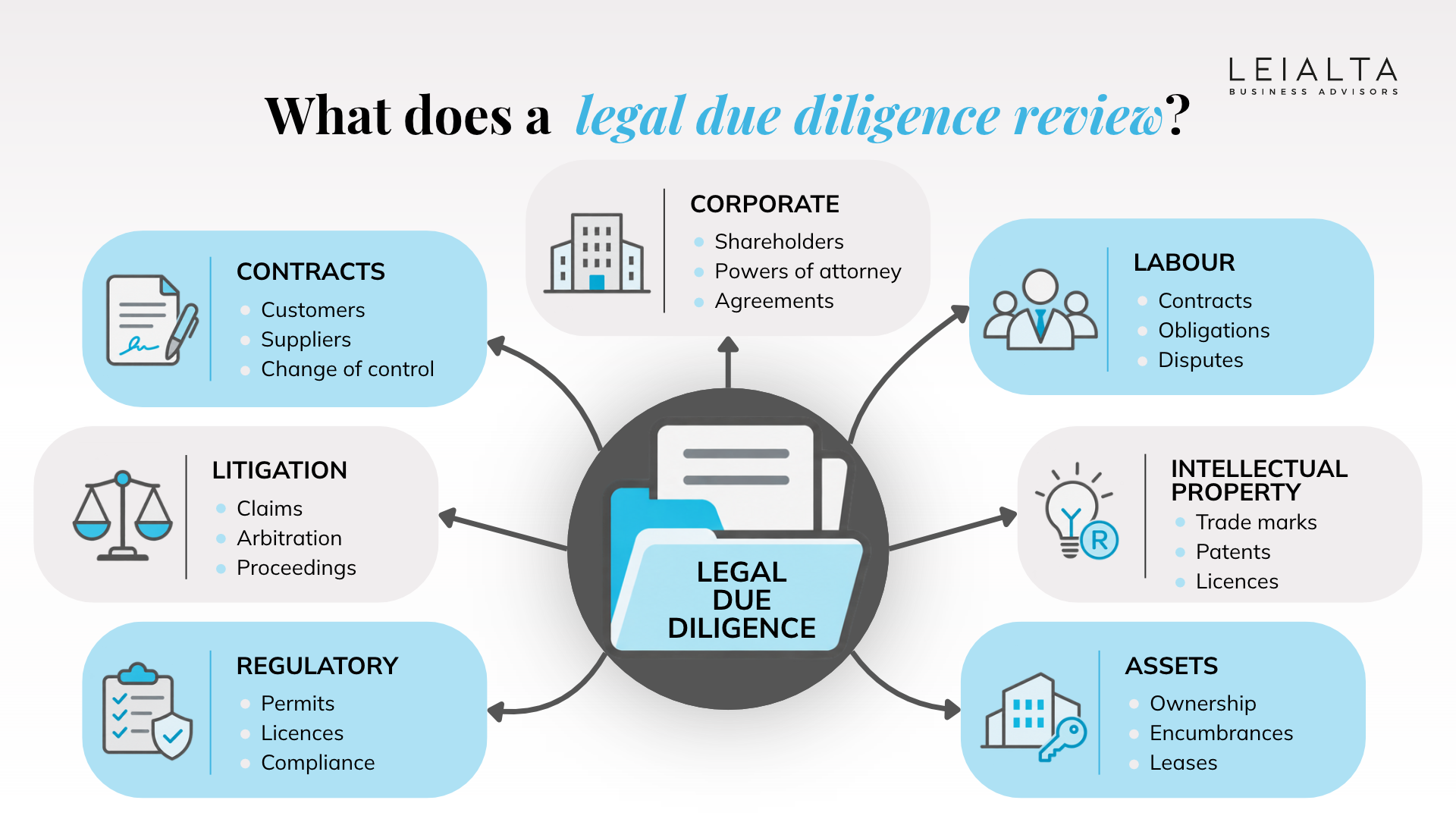
Corporate and commercial position
One of the first objectives is to determine whether the company’s corporate structure is properly documented and whether there are circumstances that could hinder or affect the transaction.
This may involve reviewing matters such as the company’s incorporation, current articles of association, shareholder structure, capital increases or reductions, management bodies, powers of attorney granted and certain relevant corporate resolutions.
It is also important to review the corporate books, any shareholders’ agreements and any restrictions on the transfer of equity interests or shares.
For example, the articles of association or a shareholders’ agreement may contain pre-emption rights, tag-along rights or other provisions that must be considered before completing a company sale.
The objective is to verify that the company’s actual corporate position is consistent with the existing documentation and that there are no restrictions or issues relevant to the transaction.
Contracts with customers and suppliers
Contracts can be one of the main areas of risk in legal due diligence.
They do not all need to be reviewed to the same level of detail. Particular attention is normally paid to those that are essential to the continuity or value of the business.
Depending on the company, contracts with customers, strategic suppliers, distributors, landlords, lenders, business partners or other third parties may be reviewed.
Imagine that one of the company’s main contracts allows the other party to terminate the agreement if the shareholder controlling the company changes. If that contract represents a significant part of the business, the buyer will need to understand the risk and determine how to address it before closing.
A contract review therefore involves more than checking which contracts have been signed. It also requires understanding what may happen to them as a result of the transaction itself.
Employment relationships
From a legal due diligence perspective, the review may cover employment contracts, relationships with directors or key employees, collective bargaining agreements, special arrangements, employment disputes or certain obligations that could transfer risks to the buyer.
However, its scope should be distinguished from a specialist employment review.
Legal due diligence aims to identify legal rights, obligations and contingencies that may affect the transaction. Where an in-depth analysis of salary costs, Social Security contributions, remuneration structures or other specifically employment-related matters is required, the work should be coordinated with specialists in that area.
This distinction is particularly important for companies with large workforces or complex employment situations.
Litigation and proceedings
A company may be involved in court proceedings, arbitration, claims or administrative proceedings that could give rise to future obligations.
Legal due diligence analyses which proceedings exist, their current status and the consequences they could have.
However, identifying that litigation exists is not enough. It is necessary to understand what is being claimed, the stage of the proceedings, the arguments put forward by the parties and the company’s potential exposure.
The aim is to enable the buyer to assess whether contingencies could materialise after the acquisition and determine which mechanisms can be used to manage them.
Intellectual and industrial property
For many companies, particularly those whose value depends on a brand, technology, software or certain intangible assets, intellectual and industrial property is an essential part of the review.
The review may include, among other elements:
- trade marks;
- patents;
- designs;
- domain names;
- software rights;
- licence agreements;
- assignments of rights;
- certain copyrights, where relevant.
The objective is to verify that the company holds the rights required to use and exploit those assets.
For example, a technology company may depend on software developed by third parties or former collaborators. If the assignment of rights to the company has not been properly documented, the buyer could acquire a company whose main technology asset is not legally protected as expected.
The review must therefore consider both the existence of the rights and their ownership and terms of exploitation.
Licences and regulatory compliance
Certain business activities require permits, licences or authorisations in order to operate.
In these cases, legal due diligence should verify which permits, licences or authorisations are required, whether they remain valid and whether they may be affected by the transaction.
A company operating in a highly regulated sector may require a much more extensive legal review than a company whose activities are not subject to the same level of administrative authorisation.
The key question is whether the company can continue operating after the transaction on the intended terms and whether there are any breaches that could give rise to liabilities.
Assets and relevant transactions
Legal due diligence may also analyse the company’s rights over certain assets that are important to the business. From a legal perspective, it is relevant to verify ownership, contracts governing their use, leases, possible encumbrances, security interests and other restrictions.
However, this analysis must be distinguished from financial due diligence.
The legal review examines what rights the company has over the asset and what obligations are associated with it. By contrast, its valuation, recoverability or accounting treatment fall within the financial analysis.
Where a transaction mainly involves real estate, the review may need to be extended to specific matters such as registered title, encumbrances, leases, licences or planning status. However, this type of analysis corresponds to specific real estate due diligence and is not the main purpose of corporate legal due diligence.
What documentation is required for legal due diligence?
The documentation required will depend on the type of company, its sector, the complexity of the transaction and the risks initially identified.
There is therefore no universal request list that can be applied in the same way to every company. Even so, certain groups of documents are commonly requested:
| Area | Typical documentation | What it allows you to verify |
|---|---|---|
| Corporate and commercial | Deeds, articles of association, corporate resolutions, powers of attorney, corporate books and shareholders’ agreements. | Company structure, governance, ownership and potential restrictions. |
| Contracts | Relevant contracts, appendices, amendments and communications. | Obligations, term, termination, warranties and change-of-control clauses. |
| Employment | Employment contracts and legally relevant employment documentation. | Obligations, special employment relationships, disputes and potential contingencies. |
| Litigation | Claims, legal proceedings, arbitration, administrative proceedings and agreements. | Status of proceedings and legal exposure. |
| Intellectual and industrial property | Registrations, licences, assignments and agreements. | Ownership and rights of use or exploitation. |
| Regulatory | Licences, permits, authorisations and compliance documentation. | Ability to carry out the activity and potential non-compliance. |
| Assets | Title documents, agreements for use, leases and guarantees. | Ownership, availability, encumbrances and restrictions. |
The initial request should not be treated as a closed list either.
As the review progresses, documents may emerge that require clarification or further checks. A contract may refer to another agreement that was not initially provided, litigation may require additional documentation, or a previous corporate transaction may lead to the review of further background documents.
Documentation is therefore the starting point, but legal due diligence evolves as the company’s legal position becomes better understood.
Stages of legal due diligence
Legal due diligence requires an orderly process that moves from defining the initial scope to identifying risks and then translating those findings into the negotiation of the transaction.
1. Defining the legal scope
The first step is to understand what is being acquired or the transaction in which the parties are participating and, from there, define which matters require a more in-depth review.
This involves analysing the company’s structure, the companies included in the scope, the main assets and contracts, the sector and the characteristics of the transaction.
A company with a simple corporate structure and few strategic contracts may require a different scope from a group with several companies, sector-specific licences, significant intellectual property and international operations.
The initial objective is therefore not to request all the company’s legal documentation indiscriminately, but to focus the analysis on matters that may have a real impact on the transaction.
2. Requesting and organising documentation
Once the scope has been defined, a request list is prepared setting out the documentation that the company must provide.
The information is usually organised in a data room that can be accessed by the teams involved in the transaction. For the review to be efficient, it is important for the documentation to be properly classified, for the current versions to be identifiable and for the different documents to be consistent with one another.
This phase also makes it possible to identify important omissions. If, for example, a principal contract has been provided but several appendices that amend its terms are missing, they will need to be obtained before a conclusion can be reached.
The quality and organisation of the information directly affect the team’s ability to focus on the legal analysis rather than simply reconstructing the available documentation.
3. Legal review and cross-checking of information
Once the documentation is available, the analysis begins.
The review should not necessarily be carried out document by document in isolation. It is often necessary to cross-check different sources in order to understand the actual legal position.
For example, reviewing the corporate structure may require comparing deeds, articles of association, shareholders’ agreements, corporate resolutions and Commercial Registry documentation.
Likewise, the position under a contract may depend not only on the original document, but also on its appendices, renewals, amendments and subsequent communications.
This phase makes it possible to identify inconsistencies, outstanding obligations, restrictions and other matters requiring further analysis.
4. Q&A and additional documentation
As the review progresses, questions arise that cannot always be answered solely based on the available documents.
It is therefore common to conduct a Q&A process through which the advisers request clarifications or additional information from the company and its advisers.
It may be necessary to establish, for example, whether a particular claim remains active, why a strategic contract has not been signed, whether a pending authorisation has been applied for, or the status of a licence that is close to expiry.
Where necessary, these matters may also be addressed in meetings with management or those responsible for areas.
This means that, before a circumstance is classified as a risk, an effort is made to obtain sufficient context to understand its scope properly.
5. Identifying and classifying risks
Once the information has been analysed, the findings should be classified according to their importance to the transaction.
Not all documentary defects have the same significance.
A formal issue that can easily be remedied may require only corrective action, whereas the possibility of losing an essential contract, lacking a necessary licence or facing significant litigation may directly affect the acquisition.
At this stage, it is therefore essential to determine what has happened, what risk it creates, what its potential impact may be and what alternatives are available to mitigate it.
In this way, the legal review moves beyond a simple description of the documentation and becomes a decision-making tool.
6. Reporting and reflecting the findings in the transaction
Finally, the conclusions are incorporated into the legal due diligence report and carried through into the negotiations.
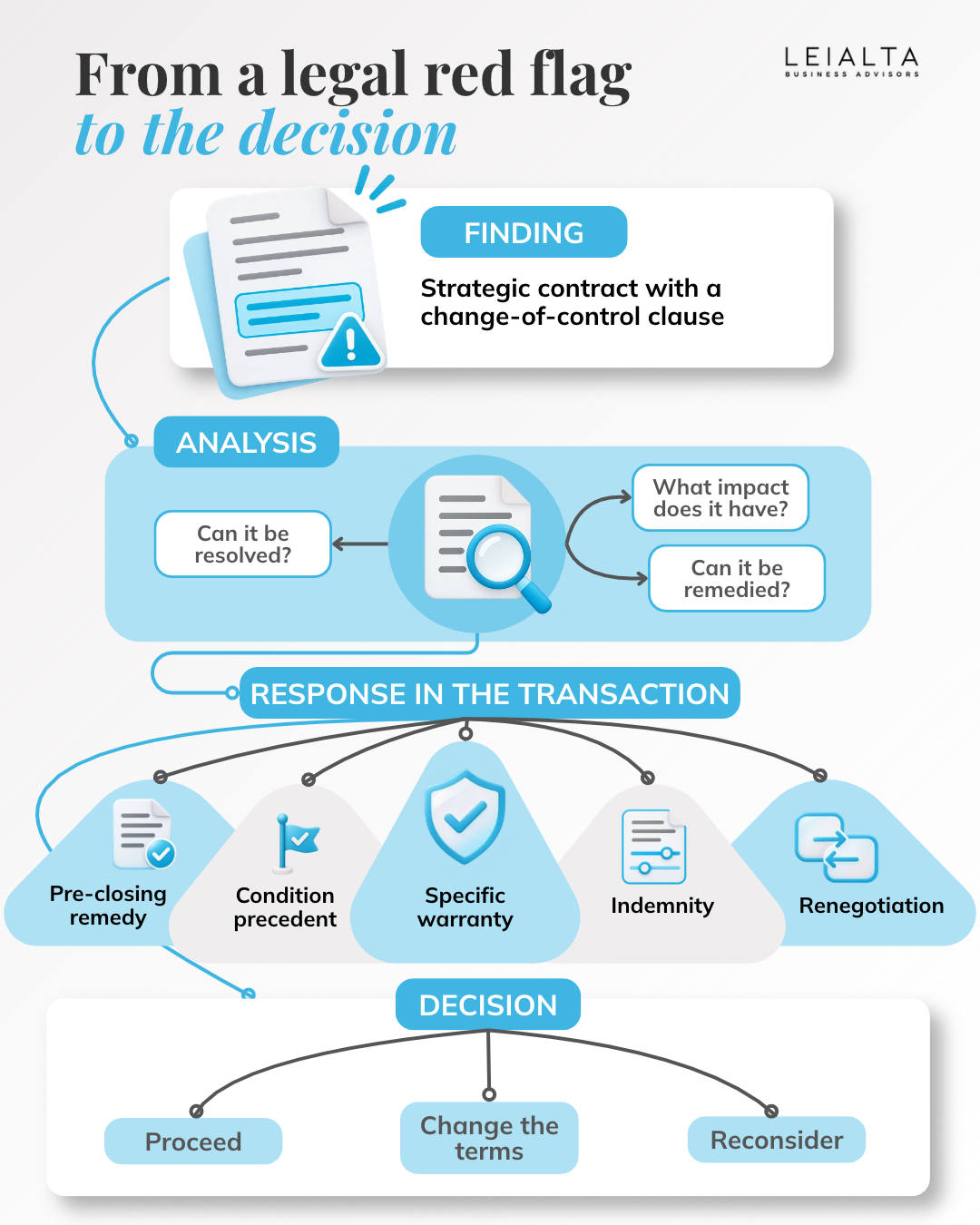
A finding may lead to different responses depending on its nature.
In some cases, it will be sufficient to remedy the situation before closing. In others, it may be necessary to establish a condition precedent, include a specific representation or warranty, agree an indemnity or introduce other protections into the sale and purchase agreement.
Where the risk affects an essential element of the business and cannot reasonably be remedied or mitigated, it may even be necessary to reconsider the terms of the transaction.
Legal due diligence therefore does not end when a risk is identified. Its real value emerges when that finding is translated into a decision or a specific protection within the transaction.
Main legal risks or red flags
Legal red flags are findings that require particular attention because they may affect the rights acquired, obligations assumed or the company’s ability to continue operating after the transaction.
Risks that may arise during legal due diligence include:
- Corporate irregularities or relevant resolutions that are insufficiently documented.
- Insufficient or outdated powers of attorney for certain actions.
- Restrictions on the transfer of equity interests or shares.
- Change-of-control clauses in strategic contracts.
- Essential contracts approaching expiry or subject to significant termination rights.
- Contractual breaches that may give rise to claims.
- Litigation or proceedings with a potential impact on the company.
- Intellectual or industrial property rights that are insufficiently protected or documented.
- Missing, expired or conditional essential licences or authorisations.
- Regulatory breaches relevant to the business.
- Key assets whose ownership or legal availability has not been sufficiently evidenced.
- Guarantees, sureties, commitments or other obligations that may continue to have effect after the transaction.
However, a red flag does not automatically mean that the sale and purchase transaction should be abandoned. Its significance will depend on the nature of the risk, its potential impact and the alternatives available to remedy it, limit it or allocate it contractually.
What does a legal due diligence report contain?
A legal due diligence report sets out the main analyses carried out, the risks identified and their potential implications for the transaction.
There is no single standard format, as the report must be adapted to the scope of the work and the characteristics of the company. However, it will typically include:
- Executive summary: main findings and matters requiring particular attention.
- Scope and limitations: companies, legal areas and documentation reviewed, as well as any limitations on the work.
- Corporate and commercial position: conclusions regarding structure, governance, resolutions, powers of attorney and potential restrictions.
- Contracts: key obligations, risks and clauses that may affect the transaction.
- Employment relationships: legal contingencies identified within the scope of the review.
- Litigation and proceedings: status of claims and proceedings and potential exposure.
- Intellectual and industrial property: ownership and terms governing the use of relevant rights.
- Licences and regulation: permits, authorisations and key compliance matters.
- Red flags and implications: priority risks and possible actions for managing them within the transaction.
The value of the report lies not in accumulating legal documentation, but in explaining what the findings mean and how they may affect the buyer’s decision.
Legal due diligence in a company sale and purchase transaction
In a company sale and purchase transaction, identifying a risk is only one part of the work.
The next step is to decide what to do about it.
This is precisely why the conclusions of the legal due diligence can subsequently be reflected in the negotiation of the agreement and in the conditions required to complete the transaction.
Remediation before closing
Some issues can be resolved before the transaction is completed.
For example, it may be necessary to formalise an outstanding corporate resolution, update certain powers of attorney, renew a licence or properly document a right.
Resolving these matters before closing allows the buyer to acquire the company in a different legal position from that initially identified.
Conditions precedent to closing
In other cases, a particular circumstance may become a condition that must be satisfied before the transaction can be completed.
The parties may therefore agree that the transaction will only close once an authorisation or contractual consent has been obtained, or another action considered essential has been completed.
Representations and warranties
The sale and purchase agreement may include representations and warranties from the seller regarding certain circumstances relating to the company.
These clauses help allocate risks between the parties and establish the information the seller represents regarding the company being transferred.
The due diligence findings are important in determining which matters require specific provisions in the agreement.
Protection against known risks
Where a specific contingency has been identified, specific mechanisms may also be established to regulate what will happen if it ultimately materialises.
The appropriate solution will depend on the risk and how the transaction is negotiated.
Therefore, not every issue identified needs to be resolved in the same way or necessarily through a price reduction.
Practical example of how legal due diligence is applied
Imagine that, during the review, it is identified that a contract representing a significant part of the business contains a change-of-control clause.
The acquisition of the company could allow the customer to terminate that contract.
The buyer therefore needs to assess how dependent the business is on that relationship and what options are available to protect itself.
One option could be to obtain the customer’s consent before closing. The parties could also agree that obtaining that consent is a condition for completing the transaction or include specific protections in the sale and purchase agreement.
If the contract is essential and there is no reasonable solution, the buyer may even reconsider the transaction.
This example shows why legal due diligence is not merely about identifying legal issues, but about determining how they should be addressed before they are assumed.
Differences between legal and financial due diligence
Legal and financial due diligence may be carried out as part of the same transaction, but they address different questions.
Legal due diligence primarily analyses legal rights, obligations and risks, while financial due diligence examines the financial position and quality of the business.
| Aspect | Legal due diligence | Financial due diligence |
|---|---|---|
| Focus | Legal rights, obligations and contingencies. | Financial position and quality. |
| What it analyses | Company, contracts, litigation, employment relationships, licences, intellectual property and assets. | EBITDA, revenue, margins, debt, working capital, cash, CAPEX and forecasts. |
| Main findings | Restrictions, breaches, contingencies and legal risks. | Adjustments, trends and financial risks. |
| Potential impact | Remediation, warranties, conditions and contractual negotiation. | Valuation, debt, financial adjustments and negotiation. |
For example, a material contract may be analysed from both perspectives.
Legal due diligence may examine whether the contract contains a clause allowing it to be terminated in the event of a change of control. Financial due diligence, by contrast, may assess how much revenue and margin that customer generates and what impact losing the contract would have. The two reviews therefore complement one another rather than replace each other.
If you would like to learn more about financial due diligence: what it is, what it analyses and its stages.
Frequently asked questions about legal due diligence
Who carries out legal due diligence?
The review is usually carried out by lawyers specialising in corporate and commercial law and business transactions.
Depending on the risks identified, it may be necessary to coordinate the analysis with professionals from other areas, such as labour, tax, finance, data protection or sector-specific regulation.
How long does legal due diligence take?
There is no standard timeframe.
The time required will depend on the size of the company, the number of companies included in the review, the volume and quality of the documentation, the number of material contracts, existing litigation, the sector and how quickly the questions arising during the process can be resolved.
Is legal due diligence mandatory?
There is no general legal requirement to carry out legal due diligence before every acquisition or sale of a company.
However, acquiring a company without first reviewing its legal position may mean assuming rights, obligations and contingencies that the buyer was unaware of.
Its suitability should therefore be assessed according to the characteristics of each transaction.
Which contracts are reviewed during legal due diligence?
Priority is normally given to contracts that are material to the business or the transaction.
These may include contracts with key customers and suppliers, financing agreements, distribution agreements, leases, licences or other arrangements that give rise to significant obligations.
The selection will depend on the company and the scope defined at the beginning of the review.
What is a change-of-control clause?
A change-of-control clause is a contractual provision that establishes certain consequences when the party controlling a company changes.
Depending on how it is drafted, it may require the other party to be notified, its consent to be obtained or even allow the contract to be amended or terminated.
These clauses can therefore become particularly important when a company is being acquired.
What happens if legal risks are identified during due diligence?
The first step is to assess the significance of the risk and its potential consequences.
Depending on the circumstances, the issue may be remedied before closing, incorporated as a condition to the transaction, addressed through warranties or contractual protections, or dealt with by renegotiating certain terms. Where the risk is particularly significant and cannot be mitigated, it may even lead the buyer to reconsider the acquisition.
Does legal due diligence also review labour matters?
It may review certain labour matters from a legal perspective, particularly employment contracts, material obligations, special employment relationships, litigation and potential contingencies.
However, where the analysis requires a more detailed review of specifically labour-related matters, it is advisable to involve specialists in that area.
What is the difference between legal and financial due diligence?
Legal due diligence analyses the company’s legal rights, obligations and contingencies.
Financial due diligence examines matters such as quality of earnings, EBITDA, net debt, working capital, cash and CAPEX.
Both may be carried out as part of the same transaction, and their conclusions should be coordinated where a finding affects more than one area.
How LEIALTA can help with legal due diligence
Legal due diligence should provide an understanding of the legal risks that exist and the implications they may have for the transaction, rather than simply reviewing documents.
At LEIALTA, our Legal and Corporate Advisory team specialises in corporate law, commercial contracts and business transactions.
As part of a legal due diligence process, depending on the scope of each transaction, we can analyse matters including the corporate structure, material contracts, litigation, licences, intellectual property, assets and other legal contingencies.
In addition, where findings have financial, tax or labour implications, we can coordinate the analysis with LEIALTA’s different specialist teams to provide an integrated view of the transaction.