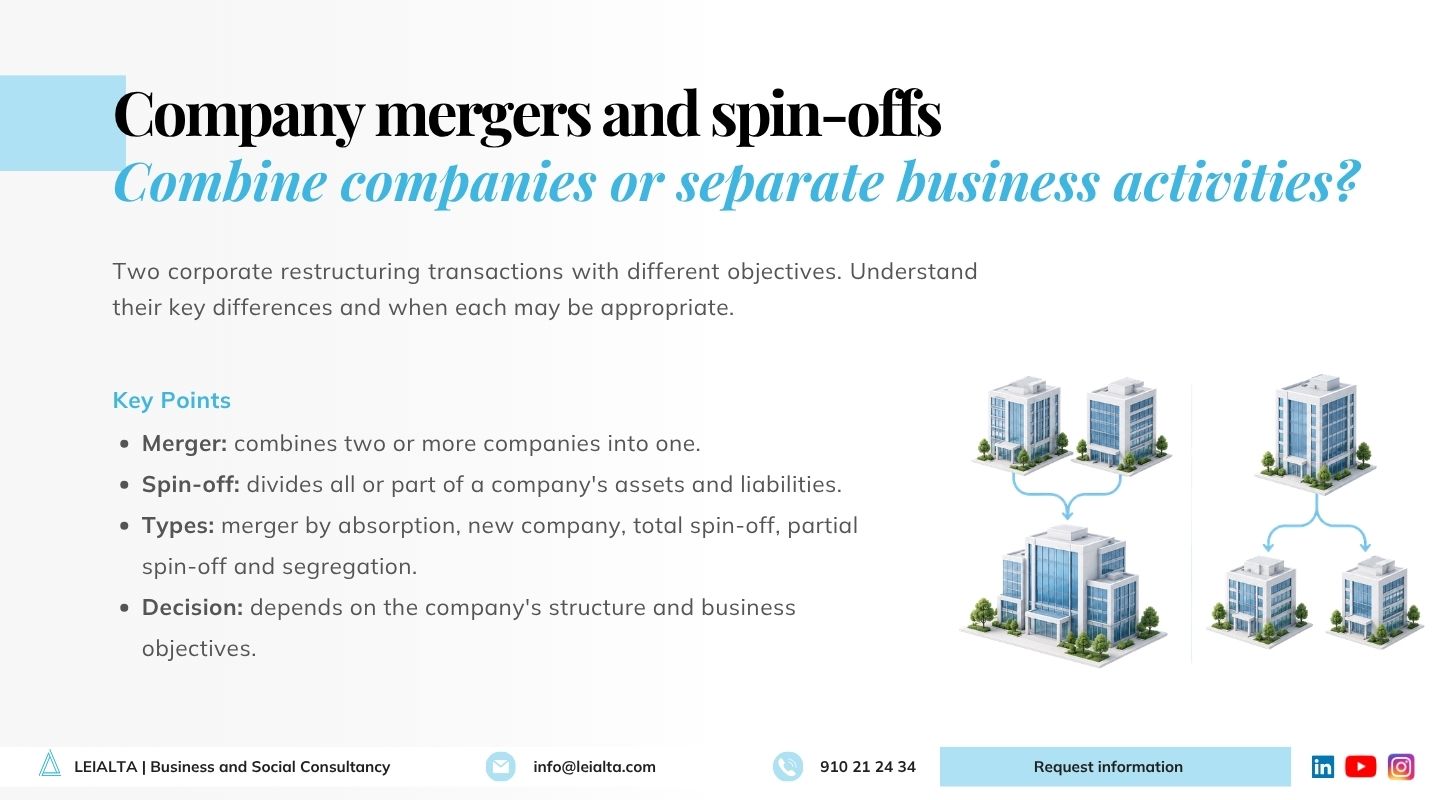
Company mergers and spin-offs are two transactions that allow a corporate structure to be reorganised, but they produce different results. While a merger combines two or more companies into a single entity, a spin-off allows all or part of a company’s assets and liabilities to be divided among several companies.
Both can be used to adapt a business structure to new needs. However, choosing between one and the other requires an analysis of the activities involved, the assets and liabilities, the shareholders and the company’s objectives. At LEIALTA, we explain their differences, the different types available and when a merger or spin-off may be appropriate.
What is a company merger?
Index of contents
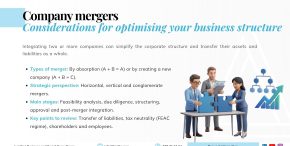
A company merger is a transaction through which two or more commercial companies are combined into a single company. Their assets and liabilities are transferred and the companies incorporated into the resulting entity cease to exist.
This transfer takes place by universal succession, meaning that it includes both the assets and rights and the obligations of the companies that cease to exist.
A merger may result in the creation of a new company or allow one of the participating companies to absorb the others.
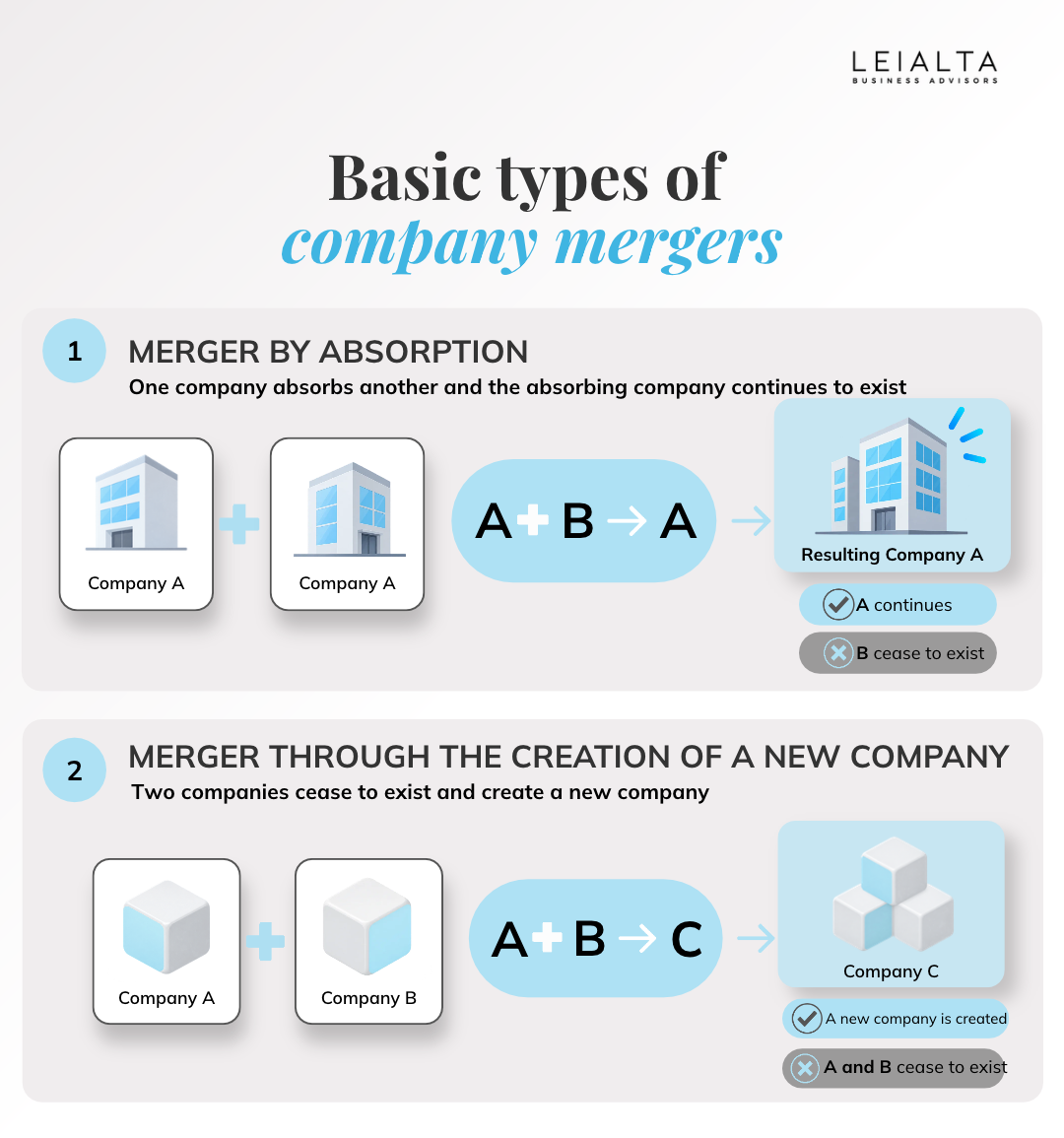
Merger by absorption and merger through the creation of a new company
There are two main types:
- Merger by absorption: an existing company incorporates the assets and liabilities of one or more other companies, which cease to exist. For example, Company A absorbs Company B and continues operating with the combined assets and liabilities.
- Merger through the creation of a new company: two or more companies transfer their assets and liabilities to a newly incorporated entity. The original companies cease to exist and the resulting company begins operating.
In both cases, the shareholders of the companies that cease to exist generally receive equity interests or shares in the resulting company, subject to the specific rules applicable to certain transactions.
You can find further information in our guide on company mergers: what they are, types, examples and when to consider one.
What is a company spin-off?
A company spin-off is a corporate restructuring transaction through which a company divides and transfers all or part of its assets and liabilities to other companies, which may be newly created or already existing.
Unlike a merger, which results in the integration of companies, a spin-off allows activities or assets to be distributed among different entities. Depending on the type of transaction, the original company may continue carrying out part of its activity or may cease to exist.
The transfer takes place by universal succession and includes the assets, rights and obligations corresponding to the part of the business being transferred.
Therefore, spinning off a company is not simply a matter of transferring assets or separating accounting records.
In addition, where part of the assets and liabilities is transferred through a partial spin-off or segregation, it must constitute an economic unit in accordance with the applicable legal requirements.
For a more detailed explanation, you can read our article on company spin-offs: types, advantages, taxation and process.
What types of spin-off are there?
Spanish legislation distinguishes between three types of company spin-off: total spin-off, partial spin-off and segregation.
The main differences concern how much of the company’s assets and liabilities are transferred, whether the original company continues to exist and who receives the equity interests or shares in the beneficiary companies.
Total spin-off
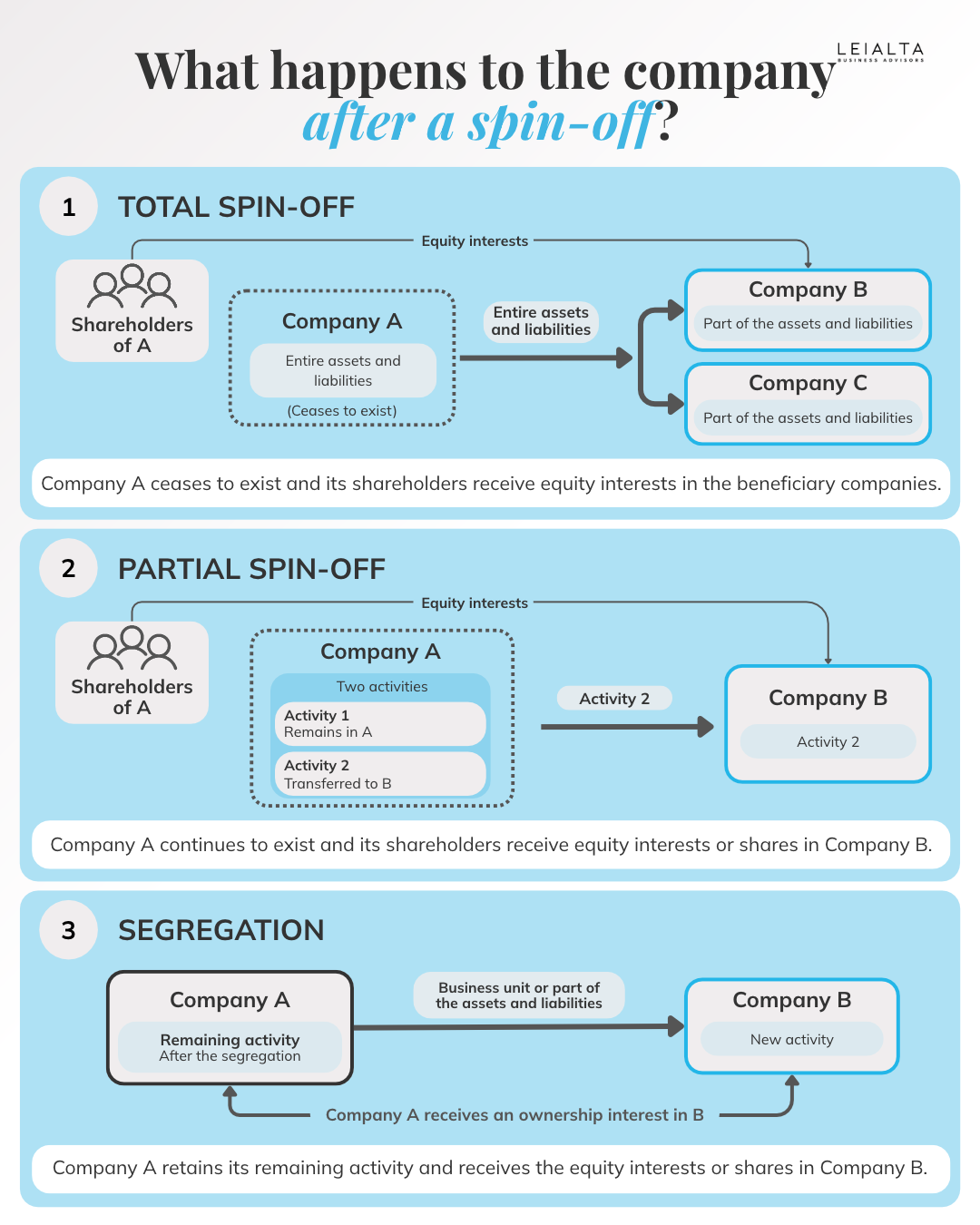
In a total spin-off, the original company divides all of its assets and liabilities into two or more parts and transfers them to different beneficiary companies.
As a result, the company being spun off ceases to exist. Its assets and liabilities pass to the beneficiary companies and its shareholders receive equity interests or shares in those companies in accordance with the applicable rules.
For example, a company carrying out both manufacturing and distribution activities could divide all its business between two companies. One would take over the manufacturing activity and the other the distribution activity.
The original company would cease to exist, while its shareholders would become shareholders in the beneficiary companies.
Partial spin-off
A partial spin-off allows a company to transfer one or more parts of its assets and liabilities, if they constitute economic units, while retaining the remainder.
In this case, the original company does not disappear. It continues operating with the activity or assets that remain within it.
The key feature is that the shareholders of the company being spun off directly receive the equity interests or shares in the beneficiary companies, in accordance with the legally established criteria.
For example, a company engaged in both the sale and maintenance of machinery could transfer its maintenance business unit to another company while retaining its commercial activity.
After the transaction, the two activities would operate through separate companies, and the shareholders would hold interests in both.
Segregation
A segregation also allows one or more economic units to be transferred to other companies without the original company ceasing to exist.
However, there is one fundamental difference compared with a partial spin-off: the equity interests or shares in the beneficiary companies are received by the company transferring the assets and liabilities, rather than directly by its shareholders.
Imagine a company deciding to transfer its technology division to a newly incorporated company. Through a segregation, the original company would receive the equity interests or shares in the beneficiary company.
This would allow it to organise its activities through different entities while retaining an ownership interest in the beneficiary company.
Therefore, although both a partial spin-off and a segregation allow the original company to continue to exist, they do not produce the same ownership structure.
Differences between company mergers and spin-offs
The main difference between a merger and a spin-off lies in the outcome of the reorganisation: a merger combines companies, while a spin-off distributes assets, liabilities or activities among different entities.
However, there are also differences regarding the continuity of the original companies, the transfer of rights and obligations and the allocation of equity interests or shares.
| ASPECT | MERGER | SPIN-OFF |
|---|---|---|
| Typical objective | Integrate companies. | Separate assets, liabilities or activities. |
| Assets and liabilities transferred | Assets and liabilities of the companies that cease to exist. | All or part of the original company’s assets and liabilities. |
| Original company | The absorbing company remains or a new company is created. | May continue to exist or cease to exist. |
| Equity interests / shares | Generally received by the shareholders of the companies that cease to exist, subject to exceptions. | Received by shareholders in total or partial spin-offs; by the transferring company in segregations. |
| Example | Two operating companies are combined into one. | A company separates two business lines. |
It is important to remember that neither transaction automatically produces a more favourable economic outcome. Their effects will depend on the corporate structure, financial position and purpose of the reorganisation. For this reason, specialist support such as that provided by LEIALTA is essential to carry out these transactions with greater certainty.
Examples of company mergers and spin-offs
These transactions are easier to understand when applied to common business situations.
The following hypothetical scenarios illustrate their differences and how each type of corporate restructuring transaction may work.
Example of a merger between two companies within the same group
Imagine a family-owned corporate group made up of two companies:
- One specialising in industrial installations.
- Another specialising in maintaining those installations.
Both companies have their own administrative structure but share customers and some management processes.
The shareholders conclude that maintaining two separate companies no longer meets their needs and therefore consider a merger by absorption.
Under the transaction, the installations company absorbs the maintenance company. The latter ceases to exist, and all its assets, rights and obligations pass to the absorbing company.
What is the result? The group begins carrying out both activities through a single company.
This reorganisation could facilitate coordination and reduce certain duplicated functions. However, it would still be necessary to assess whether the integration generates genuine benefits and what costs it entails.
Example of a spin-off involving a company with two activities
Now imagine a family business carrying out two different activities: a chain of food shops and a corporate catering service.
Both operate within the same company but have different resources, customers and management requirements.
The shareholders want to organise each business independently without abandoning either activity. They therefore consider a partial spin-off.
The original company would retain the food shops and transfer the catering economic unit to a beneficiary company.
What would happen to the shareholders? If two family members own 60% and 40% of the original company respectively, they could retain those same direct ownership percentages in both companies following a proportional spin-off.
The original company would continue to exist, and the two activities would be organised through separate entities.
However, before carrying out the transaction, it would be necessary to confirm that the transferred activity constitutes an economic unit and that the other legal, accounting and tax requirements are met.
When might a merger be appropriate and when might a spin-off be preferable?
The decision to merge or spin off companies should begin with a specific business need, rather than solely with the characteristics of each transaction.
One company may need to integrate activities that currently operate separately.
Another may face the opposite situation: several different businesses may operate through the same company and need to be managed independently.
Situations where a merger may be considered
A merger may be considered where two or more companies carry out complementary activities, share resources or maintain structures that would benefit from being analysed together.
Common situations include integrating companies within the same group, reorganising a business following an acquisition or consolidating activities currently carried out through different entities.
A merger may also support growth or simplify the corporate structure.
Depending on the relationship between the businesses, different configurations may be considered, including horizontal and vertical mergers.
In addition, certain transactions between related companies are subject to specific rules and legal simplifications, as is the case with some special mergers.
In all cases, any potential cost savings or efficiency improvements should be assessed before a decision is made.
Situations where a spin-off may be considered
A spin-off may be considered where a company carries out several activities and believes it would be more appropriate to organise them through separate companies.
It may also form part of the reorganisation of a corporate group, facilitate the separate management of economic units or prepare the company for changes to its ownership structure.
For example, a business may wish to manage an industrial activity separately from a service activity. However, it must first be confirmed that the transaction allows this separation to be carried out in accordance with the applicable legal requirements.
Nor should it be assumed that dividing assets and liabilities automatically eliminates previous responsibilities or resolves disagreements between shareholders.
In both cases, mergers and spin-offs are tools that can form part of a broader business restructuring process. The choice should reflect the objectives and characteristics of each business, which is why an initial analysis by specialist professionals is advisable.
What stages are involved in a merger or spin-off?
In Spain, mergers and spin-offs of commercial companies are primarily governed by Royal Decree-Law 5/2023 of 28 June, which regulates structural modifications.
Although the specific requirements may vary depending on the transaction, the process can generally be organised into five stages:
- Analysis of the business situation. The participating companies, their activities, assets and liabilities, obligations and the objectives behind the reorganisation are reviewed.
- Structuring the transaction. It is determined which companies will remain, which will cease to exist, which assets and liabilities will be transferred and how the shareholders’ ownership will be structured.
- Preparing the documentation. The relevant merger or spin-off plan is prepared and the need for balance sheets, reports and other legal documentation is assessed. Some transactions may qualify for simplified procedures.
- Approval and formalisation. Corporate resolutions, information and publication requirements and the legally required protection measures are completed. The transaction is then formalised by public deed and registered with the relevant Commercial Registry.
- Implementing the new structure. The accounting, tax, labour and administrative effects are coordinated so that the companies can adapt their operations to the resulting structure.
Not every merger or spin-off requires the same documentation or steps. The ownership structure, the characteristics of the participating companies and the availability of simplified procedures may affect the process.
For this reason, the transaction should be properly defined and the applicable requirements confirmed before formal procedures begin.
What should you review before planning?
Before carrying out a company merger or spin-off, the first step is to identify the problem that needs to be solved and the structure the business wants to achieve.
Integrating two companies carrying out similar activities is not the same as separating business units so that they can be managed independently.
Based on that objective, several issues should be reviewed:
- Shareholder and ownership structure. A merger or spin-off may change existing ownership interests and the way control over the companies is exercised.
- Assets and liabilities to be transferred. This includes real estate, machinery, rights, contracts, obligations and debts.
- Employees. Where the transaction involves a transfer of undertaking, the corresponding employment rights and obligations must be respected in accordance with the applicable legislation.
- Tax and accounting implications of the transaction.
Separating activities does not automatically eliminate debts or guarantee tax benefits. Before deciding, the assets and liabilities, obligations and overall effects of the transaction need to be reviewed.
At LEIALTA, a business and social consulting firm, we support SMEs, family businesses and corporate groups through business restructuring processes, coordinating the legal, corporate, tax, accounting and labour aspects involved.
Our approach begins with an analysis of the existing structure and the company’s needs to assess which alternatives may be most appropriate, anticipate their implications and plan the reorganisation from a comprehensive perspective.