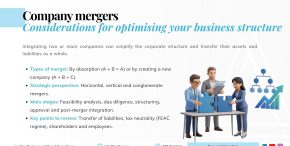
Companies may need to reorganise for many different reasons: to increase their size, reduce duplication, enter new markets, integrate an acquisition or gain greater control over certain stages of their activity.
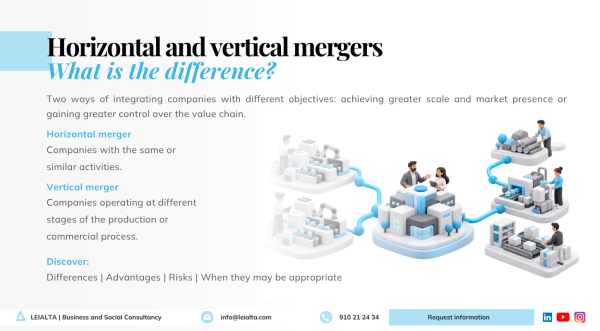
Within these transactions, it is common to distinguish between horizontal mergers and vertical mergers. The difference between them depends on the relationship between the activities carried out by the companies involved in the transaction.
These terms help explain the business objective behind the transaction, although they do not represent different legal forms of merger. From a corporate perspective, a merger may be carried out, for example, through a merger by absorption or through the creation of a new company.
In this article, we explain the differences between horizontal and vertical mergers, their advantages and risks, and when each type may make sense.
What is a horizontal merger?
Index of contents
A horizontal merger takes place when companies carrying out the same or similar activities and operating at the same level of the value chain are combined.
These are generally companies that compete in the same market or whose products and services are very similar.
For example, imagine two industrial maintenance companies:
- One operates mainly in Madrid and Castilla-La Mancha.
- The other has an established customer base in Castilla y León.
If the two companies merge, they can combine their teams, customers, resources and corporate structure under a single company. The transaction would be considered horizontal because both companies essentially carry out the same activity.
What can a horizontal merger be used for?
This type of merger may be considered when a company wants to:
- Increase its scale.
- Expand its geographical presence.
- Gain new customers or sales channels.
- Eliminate duplicated structures.
- Benefit from economies of scale.
- Strengthen its financial position and negotiating capacity.
- Fully integrate a company that was previously acquired.
It can also be used within a corporate group where two companies have gradually come to perform almost identical activities and maintaining both structures separately no longer makes sense.
In fact, simplifying structures, integrating companies and improving efficiency are common objectives of mergers carried out as part of broader business restructuring processes.
Advantages of horizontal mergers
A horizontal merger can create significant operational and strategic advantages. However, these benefits do not arise automatically simply because the merger has been completed. The subsequent integration of teams, processes, systems and corporate cultures is an essential part of the transaction.
Greater scale
By combining two similar businesses, the resulting company may have a larger customer base, more resources and a structure with greater capacity to undertake projects.
Elimination of duplication
The merger may make it possible to centralise administrative departments, facilities, systems, purchasing functions or other activities that were previously duplicated across the two companies.
Expansion into new markets
A company can strengthen its presence in a geographical area where it previously had limited activity by integrating another business that already has customers, local market knowledge and an established structure.
Greater negotiating capacity
A larger organisation may have a stronger position when dealing with suppliers, financial institutions or certain customers.
Risks of a horizontal merger
A horizontal transaction can also create difficulties. Some examples include:
- Overlapping roles or teams.
- Differences in corporate culture.
- Systems and procedures that are difficult to integrate.
- Loss of customers during the reorganisation.
- Difficulties reaching agreements between shareholders or management teams.
- Higher integration costs than initially expected.
In addition, where the transaction is sufficiently significant, its impact on competition must also be assessed.
The Spanish National Markets and Competition Commission (CNMC) reviews certain business combinations where the applicable market share or turnover thresholds are reached. A transaction may be authorised, authorised subject to commitments or conditions or, in exceptional cases, prohibited if it creates problems for effective competition.
Increasing market share may therefore be one of the business objectives of the transaction, but reducing competition should not be considered an advantage.
When might a horizontal merger make sense?
A horizontal merger may be particularly worth considering where:
- Two companies carry out very similar activities.
- There are duplicated administrative structures.
- A company wants to expand its geographical presence.
- A business has previously been acquired and is now to be fully integrated.
- Several companies within the same group have gradually come to perform almost identical functions.
- The objective is to gain scale for a new stage of growth.
In these situations, a merger may help simplify the structure and concentrate the activity within a single company.
What is a vertical merger?
A vertical merger takes place when companies operating at different stages of the same value chain are combined.
They are not necessarily competitors. One company may supply the other, carry out an earlier stage of production or be involved in distributing and marketing the final product.
The usual objective is to gain greater control over stages of the process that are considered strategically important.
For example, a furniture manufacturer could merge with a company specialising in the treatment and supply of timber, or with another company responsible for distributing and delivering the furniture to the end customer.
Backward vertical merger
In a backward vertical merger, a company integrates an earlier stage of its value chain.
For example, a food manufacturer may merge with one of its raw material suppliers. The objective may be to secure supply, gain greater control over quality, reduce dependence on third parties or improve coordination between production and procurement.
Another example relevant to an SME would be a furniture manufacturer that merges with another company within the same group specialising in the treatment of the timber used in its production process.
Forward vertical merger
In a forward vertical merger, a company integrates a later stage of the process.
For example, a manufacturer may merge with a company that distributes and sells its products.
This can give the business greater control over its relationship with the end customer, distribution, commercial margins and information about demand.
A food producer, for instance, could integrate a company that had previously been responsible for distributing its products to retail outlets.
Advantages of vertical mergers
Vertical integration can be particularly useful where one stage of the value chain is critical to the operation of the business.
Potential advantages include:
- Greater control over supply.
- Less dependence on specific suppliers or distributors.
- Greater quality control.
- Better coordination between different stages of the process.
- Reduced intermediary costs in certain areas.
- Greater ability to respond to changes in demand.
- Direct access to customers or commercial information.
However, bringing a stage of the process in-house also means taking on its structure, costs, workforce and risks.
Risks of a vertical merger
A company may gain greater control over its value chain while at the same time increasing its complexity.
Some risks that should be considered include:
- Higher fixed costs.
- The need to manage activities that were previously carried out by an external specialist.
- Greater dependence on a single internal structure.
- Less flexibility to change suppliers or distributors.
- Technological or operational integration difficulties.
- Additional investment required to maintain the new activity.
Large-scale vertical integrations may also need to be assessed from a competition perspective. The CNMC examines both horizontal overlaps and vertical relationships when reviewing business combinations.
When might a vertical merger make sense?
A vertical merger may be worth considering where a company identifies a strategically important stage within its value chain.
For example:
- There is excessive dependence on a particular supplier.
- The supply of certain raw materials is critical.
- Distribution represents a significant proportion of the margin.
- The company wants direct contact with the end customer.
- Outsourced stages create delays or quality problems.
- Several companies within the same group successively carry out different stages of the same process.
In these cases, integrating the companies may enable a more coordinated approach to management.
Differences between horizontal and vertical mergers
The following table provides a clearer overview of the main differences between the two types of mergers:
| Aspect | Horizontal merger | Vertical merger |
|---|---|---|
| Relationship between the companies | Same or similar activities. | Different stages of the same value chain. |
| Position in the market | Same level. | Different levels. |
| Typical objective | Gain scale, market share or presence. | Gain greater control over production, supply or distribution. |
| Example | Two similar logistics companies. | Manufacturer and distributor. |
| Main opportunity | Economies of scale and elimination of duplication. | Greater control over the value chain. |
| Main risk | Integration of structures and competition issues. | Greater complexity and internal costs. |
| Direction | Not applicable. | Backward or forward. |
Merger, acquisition and vertical integration: they are not the same
An important distinction should be made here.
The term “merger” is sometimes used when one company has acquired another, while “vertical merger” may sometimes be used to describe a broader strategy of integrating different stages of the business.
Merger
In a merger, two or more companies are legally combined into a single company. One or more of them cease to exist and transfer all of their assets and liabilities to the resulting company.
Acquisition
In an acquisition, one company purchases shares, equity interests, assets or control of another company.
This does not necessarily mean that a merger will subsequently take place.
For example, Company A may acquire 100% of Company B while both companies continue operating independently. A merger would only take place if Company B were subsequently absorbed by Company A.
This distinction is also explained in LEIALTA’s general content on company mergers: an acquisition changes control of the business, whereas a merger also changes its corporate structure.
Vertical integration
Vertical integration is a broader business concept.
A company may control different stages of its value chain through:
- Organic growth.
- The acquisition of another company.
- The creation of a subsidiary.
- Long-term agreements with suppliers or distributors.
- A merger.
Therefore, the fact that a company controls design, production and sales does not necessarily mean that it has carried out a vertical merger.
This distinction is important when considering some commonly used examples. Inditex, for instance, may be useful for explaining the vertical integration of a value chain, but it should not in itself be presented as an example of a legal vertical merger transaction.
What should be analysed before carrying out a merger?
The decision between a horizontal merger, a vertical merger or another type of restructuring transaction should not be based solely on potential cost savings.
Before starting the process, companies should analyse:
- The business objective they want to achieve.
- The companies and assets involved.
- The existing obligations and risks of each company.
- The corporate and tax implications.
- The accounting and labour impact.
- Any competition law implications.
- How teams, systems and processes will subsequently be integrated.
A merger may make sense on paper but fail to deliver the expected results if the subsequent integration has not been properly planned.
If you would like to understand the legal mechanics of the transaction in greater detail, you can also read our article on company mergers: types, examples and when to consider one.
At LEIALTA, we advise companies, SMEs, corporate groups and family businesses on merger and business restructuring processes, coordinating the corporate, tax, accounting and labour aspects of each transaction.