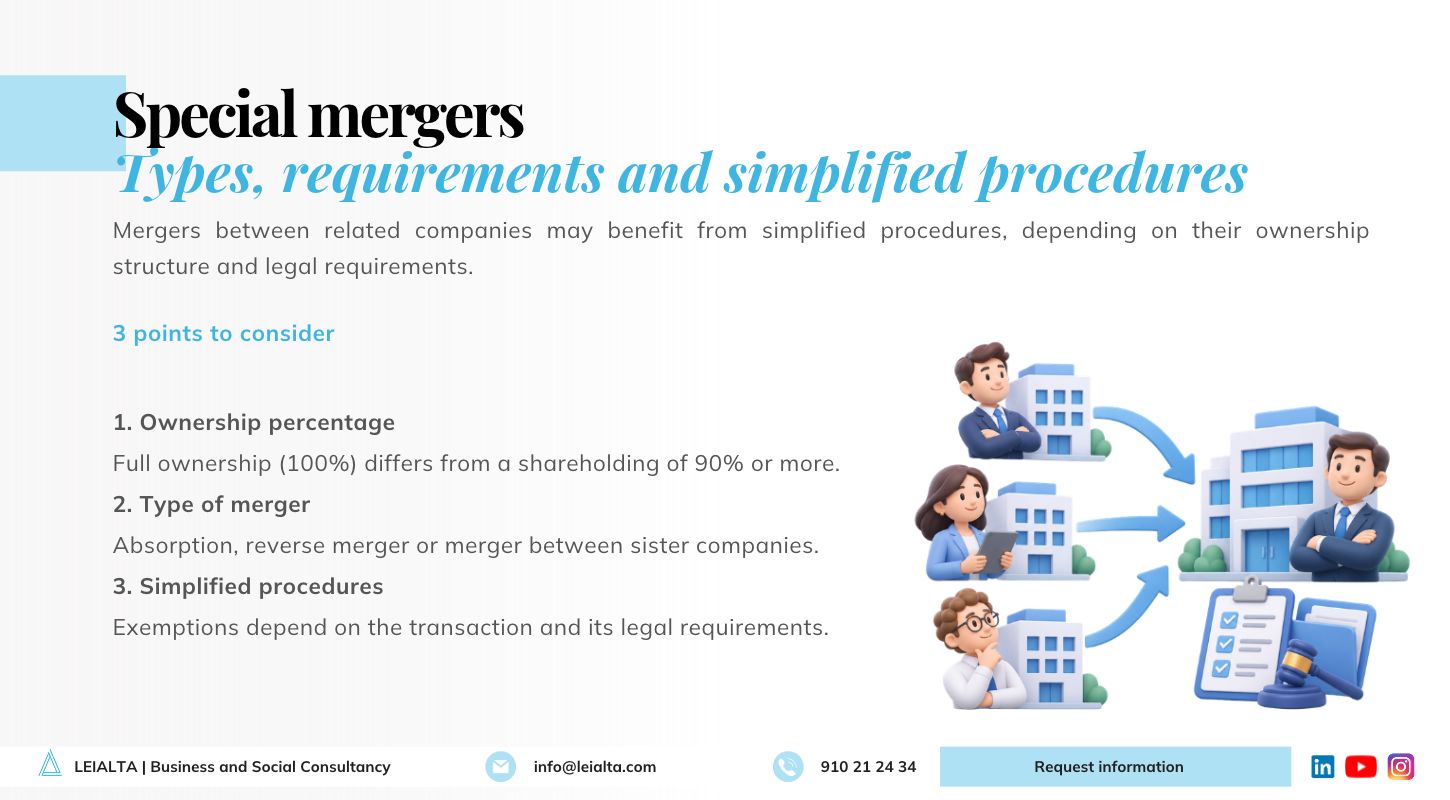
Where several companies within the same group are already linked by ownership, merging them may be easier than combining two independent businesses. Special mergers can streamline certain formalities where there is a specific shareholding relationship between the companies. However, not all transactions are subject to the same requirements or allow the same documents to be dispensed with.
To determine the appropriate procedure, it is essential to establish who owns each company, the percentage held and which entity will survive the transaction. These factors affect both the simplified merger regime and the obligations that must still be met.
Below, LEIALTA explains what special mergers are, the different types, the requirements that apply and when a special merger may be appropriate.
In brief: Special mergers in Spain involve companies with particular ownership relationships, such as the absorption of a wholly owned subsidiary, a reverse merger or a merger between sister companies. Articles 53 to 57 of Royal Decree-Law 5/2023 allow certain formalities to be simplified depending on the ownership structure and the legal conditions of the transaction.
What are special mergers?
Index of contents
Special mergers are corporate combinations for which legislation provides specific rules because of the ownership relationship between the companies involved.
In a standard merger, two or more companies combine their assets and liabilities into a single entity. By contrast, when one already controls another, or both have the same shareholders under certain conditions, some requirements may be unnecessary and the law allows them to be simplified.
For example, where a company owns 100% of the shares in its subsidiary, it can absorb that subsidiary without exchanging shares between independent shareholders. This allows certain formalities required in other mergers to be waived.
In Spain, special mergers are currently governed by Articles 53 to 57 of Royal Decree-Law 5/2023, which replaced the rules on structural changes previously contained in Law 3/2009.
These provisions address different ownership relationships between companies and specify which requirements may be reduced or waived in each case.
Are special mergers and simplified mergers the same thing?
Although the two expressions are often used interchangeably, they do not mean the same thing.
The term special merger refers to specific corporate scenarios recognised by law. A simplified merger, on the other hand, is a transaction that may proceed without meeting certain requirements of the standard procedure.
This distinction matters because not all special mergers benefit from the same simplifications. Some may dispense with certain reports, while others must retain them or adopt additional measures to protect shareholders.
Before relying on a simplified merger regime, therefore, the ownership structure must be identified accurately and the relevant legal conditions checked.
What types of special mergers are there?
The different types of special merger are distinguished mainly by the ownership relationships between the companies involved.
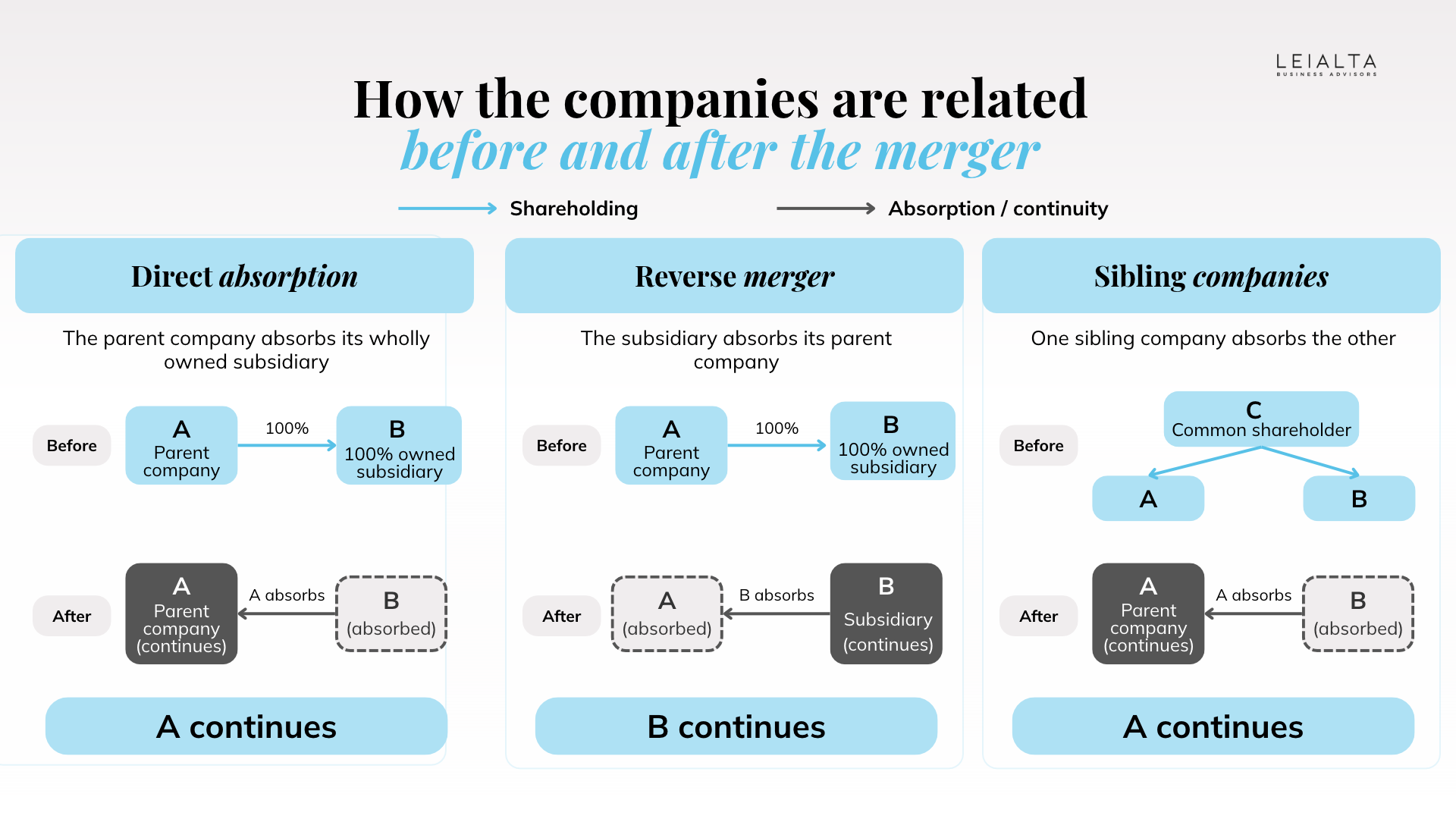
To illustrate them, we will use Companies A and B and identify the parent company, the subsidiary and the entity that survives each merger.
Absorption of a wholly owned subsidiary
This occurs when one company owns all the share capital of another company and decides to absorb it.
Suppose Company A owns 100% of the shares in Company B. If A absorbs B, B is dissolved and its assets and liabilities, including its rights and obligations, are transferred to A.
Because the absorbing company already wholly owns the absorbed company, certain steps relating to the exchange of shares or a share capital increase are not required.
This is commonly known in Spain as an improper merger. It is often used by corporate groups seeking to remove companies that no longer need to exist as separate legal entities. For more information, see our article on improper mergers in family businesses, which explores their features and practical uses.
A distinction must nevertheless be made between direct and indirect ownership. If A owns B through another intermediate company, additional obligations may apply. In particular, the law requires an independent expert’s report and envisages that a capital increase by the absorbing company or compensation to other affected companies may be necessary.
Absorption of a company owned at least 90%, but less than 100%
Special merger rules may also apply where the absorbing company directly owns at least 90%, but not all, of the share capital of the company to be absorbed.
For example, A may own 95% of B, while the remaining 5% is held by other shareholders. The transaction must therefore take account of the rights of these minority shareholders.
The offer must allow the shares to be acquired within two months of registration of the absorption. The legislation also provides mechanisms for challenging the proposed valuation and specific rules for shares that are not acquired.
Holding more than 90% of the shares therefore does not automatically remove every formality. The legal conditions must be checked and minority shareholders must be treated appropriately.
Merger between sister companies or companies with identical shareholders’ ownership interests
Sister companies are companies owned by the same shareholder or parent company, without necessarily owning the other.
For example, Company C may own 100% of A and 100% of B. If A absorbs B, they no longer exist as separate companies and their activities are brought together within A.
The rules also cover mergers between companies whose shareholders hold identical ownership percentages in each of them, even where there is no single owner.
These transactions can be useful when a group operates several companies with related activities and wishes to consolidate them.
However, the available simplifications must be assessed in light of each shareholder’s specific ownership interest. Where indirect holdings are involved, independent experts’ reports and other steps may be mandatory.
Reverse merger
A reverse merger occurs when a subsidiary absorbs its own parent company. In other words, the direction of the absorption is the reverse of the usual parent- subsidiary merger.
Suppose A owns 100% of B. Instead of A absorbing B, B absorbs A. The parent company is dissolved, and the subsidiary continues its operations, taking over the assets and liabilities of the absorbed company.
This may be appropriate where there are operational or business reasons to preserve the subsidiary’s legal entity.
For example, it may be worth considering if the subsidiary carries out the group’s main business activity or holds licences or contractual relationships that the group wishes to retain within that entity. However, the effects on contracts, licences and authorisations must be reviewed before the merger.
A reverse merger is therefore defined not by the relative size of the companies, but by which one absorbs the other and the ownership relationship between them.
Other transactions treated as mergers
In addition to the scenarios above, Article 57 covers a transaction in which one company is dissolved and transfers all its assets and liabilities as a whole to another company that owns its entire share capital.
The law treats this transaction as a merger, although its ownership structure may give rise to certain particular features.
Its legal classification and applicable procedure must nevertheless be checked. Transferring the assets and liabilities does not, in itself, remove all the obligations associated with a structural change.
Which merger formalities can be simplified, and under what conditions?
The simplified merger regime can reduce certain requirements where the nature of the transaction makes some of the steps normally required for a standard merger unnecessary.
Possible simplifications include waiving certain reports, omitting specific information from the draft terms of merger, dispensing with a share capital increase or removing the need for approval by certain general meetings.
However, these exemptions do not apply in the same way to every scenario. The law distinguishes between direct and indirect ownership, levels of control and specific corporate structures.
The following table summarises the main differences:
| Scenario | Conditions | Possible simplifications | Exceptions to review |
|---|---|---|---|
| Direct absorption of a wholly owned subsidiary | The absorbing company directly owns the entire share capital of the absorbed company. | Certain draft terms, reports, a capital increase and the general meeting of the absorbed company may be dispensed with. | The absorbing company’s general meeting may be dispensed with if the requirements of Article 55 are met. |
| Indirect absorption of a wholly owned subsidiary | The absorbing company owns the entire share capital of the absorbed company through another company. | The simplifications for wholly owned companies apply insofar as relevant. | An independent expert’s report is mandatory; a capital increase and compensation for other affected companies may also be required. |
| Direct absorption of a company owned at least 90%, but less than 100% | The absorbing company directly owns at least 90%, but less than 100%, of the absorbed company’s share capital. | Certain reports and the absorbing company’s general meeting may be waived if conditions are met. | Fair-value purchase offer to minority shareholders, protection of their rights and share-exchange rules. |
| Sister companies or companies with identical shareholdings | The companies have the same shareholder or shareholders with identical ownership percentages. | The wholly owned subsidiary rules apply where appropriate. | Indirect ownership may require an independent expert’s report, a capital increase and compensation. |
| Reverse merger | The absorbed company owns 100% of the absorbing company. | The rules for wholly owned subsidiary mergers may apply. | Where ownership is indirect, reports and other steps may be required. |
| Transaction treated as a merger under Article 57 | A company transfers its entire assets and liabilities to the entity that wholly owns its share capital. | Legally treated as a merger. | The applicable procedure must be determined without assuming further exemptions. |
Considering a merger within your corporate group in Spain?
LEIALTA assesses the ownership structure, corporate law requirements and tax implications of each transaction to help your business identify a suitable approach.
For direct absorptions of companies owned at least 90%, Article 55 also allows the absorbing company to dispense with its general meeting in certain circumstances.
The statutory publicity and documentation-access requirements must be met. Shareholders representing the legally required percentage may also request that the general meeting be held.
Determining the formalities for a simplified merger therefore requires more than checking the ownership percentage. The way ownership is structured and the rights of shareholders in the companies involved must also be considered.
What obligations still need to be reviewed in a simplified merger?
Using a simplified merger procedure does not mean that the companies are exempt from all legal obligations.
The transaction remains a structural change with legal, financial and, where applicable, employment-related consequences. Before proceeding, it is therefore necessary to establish which documents must be prepared, which corporate approvals are required and how affected interests must be protected.
Checklist: obligations in a simplified merger
| Draft terms of merger. Prepare the common draft terms with the legally required information, identifying what can be omitted in the specific case. | |
| Balance sheets and reports. Check the necessary accounting documentation and whether directors’ or independent experts’ reports must be prepared. | |
| Publication and corporate approvals. Review the requirements for publication, disclosure and approval by general meetings, including possible exemptions. | |
| Protection of shareholders and creditors. Identify affected shareholders’ rights and the safeguards or protection measures available to creditors. | |
| Employee information. Assess the employment implications and comply with the applicable information and consultation rights. | |
| Execution and registration. Execute the public deed with the required documentation and register the merger with the Spanish Commercial Registry. |
These checks must be tailored to each transaction. A simplified procedure does not mean that the same documentation can be used for every merger.
Registration with the Commercial Registry also remains essential, as a merger takes effect once it has been registered. At that point, the registry entries of the dissolved companies are cancelled.
Information and consultation of employees
One important distinction is between exemptions from corporate law reports and the continuing employment law rights to information and consultation.
Royal Decree-Law 5/2023 allows the directors’ report on the draft merger to be waived in certain cases. In its resolution of 16 December 2024, Spain’s Directorate- General for Legal Certainty and Public Faith clarified that, in the circumstances it examined, the exemption could cover both the section of the report intended for shareholders and the section intended for employees.
However, waiving that report does not remove employees’ rights to information and consultation.
Employment legislation continues to apply. The effects on jobs, working conditions and any transfer of undertaking must be assessed, together with the corresponding information and consultation obligations.
A merger may therefore be simplified from a corporate law perspective while still requiring specific steps under employment law.
Examples of special mergers
To understand how these transactions differ, consider two cases involving the same companies but a different direction of absorption.
Example 1. A parent company absorbs its subsidiary
Company A owns 100% of B. Both are part of a corporate group, but B no longer needs to remain a separate legal entity because its activities can be integrated into A.
The group decides on a merger by absorption. B is dissolved and transfers its assets and liabilities to A, which continues to exist.
This is the absorption of a wholly owned subsidiary and may benefit from the simplifications available for this scenario.
Example 2. A subsidiary absorbs its parent company
The initial structure is the same: A owns 100% of B. In this case, however, B carries out the operating activities that the group wishes to retain.
Rather than having the parent absorb the subsidiary, the group decides that B should absorb A. The parent company is dissolved, and its assets and liabilities are transferred to B, which survives.
This is a reverse merger and may qualify for the relevant special rules.
Both examples show why it is essential to decide which company should survive before designing the transaction. Even with the same ownership structure, the direction of the merger may reflect different business needs.
What if the merger follows a leveraged acquisition?
Sometimes a company acquires another using external borrowing and subsequently considers merging the two entities.
These transactions require particular care, as the financing used for the acquisition can trigger additional obligations.
The legislation sets specific requirements where a company involved in the merger has incurred debt in the preceding three years to acquire control of another participating company or certain significant assets of that company.
In such cases, the draft terms of merger must identify the resources and timetable for repaying the acquisition debt. The directors’ report must also justify the transaction and include an economic and financial plan.
An independent expert’s report on the reasonableness of the relevant information is also mandatory, even if the merger is approved unanimously.
A merger following a leveraged acquisition should therefore not be treated as an automatic route to simplification. The financing structure and the circumstances of the transaction must be assessed before the applicable procedure is determined.
When might a special merger make sense?
Special mergers may be useful where a business needs to reorganise its corporate structure without retaining entities that no longer serve a distinct purpose.
However, the decision should reflect the business’s actual needs, rather than simply the possibility of reducing formalities. Common situations include:
- Reorganising subsidiaries within a corporate group.
- Combining companies with overlapping functions.
- Simplifying a complex corporate structure.
- For family businesses, it can also be useful to review companies created at earlier stages, particularly when considering an asset reorganisation or succession planning.
These situations form part of a broader corporate restructuring strategy, which must take account of the legal, tax, financial and operational consequences of each decision.
Once the type of merger has been identified, the corporate, tax, accounting and employment aspects must be coordinated so that the transaction meets the business’s objectives and is carried out correctly.
Frequently asked questions about special mergers in Spain
Does a special merger require approval by a general meeting?
Not every participating company’s general meeting must always approve the merger. Certain exemptions may apply, depending on the type of transaction, ownership percentage and statutory conditions.
Is an independent expert’s report required for a special merger?
It depends on the transaction. Some mergers allow this report to be waived, while certain indirect ownership structures or mergers following a leveraged acquisition may require it.
What happens to the absorbed company’s debts?
In a merger by absorption, the absorbed company’s assets and liabilities, including its rights and obligations, are transferred as a whole to the absorbing company. Existing liabilities and creditor protection rules must therefore be reviewed before completion.
Can a special merger benefit from tax neutrality in Spain?
A transaction may qualify for Spain’s FEAC tax neutrality regime if the relevant requirements are met. A simplified corporate law procedure does not automatically result in tax neutrality.
How long does a simplified merger take?
There is no single timeframe. The duration depends on the ownership structure, required documents and reports, protection of affected parties, and execution and registration formalities.
At LEIALTA, we support companies and corporate groups through their merger processes, reviewing their structures and designing reorganisations tailored to each situation.