A family business may have incorporated several companies over the years to develop new activities, make investments or respond to specific business needs. However, as the business evolves, that corporate structure may no longer serve the same purpose.
For example, one company may no longer carry out a distinct activity, two companies within the group may now perform very similar functions, or maintaining several separate legal entities may create unnecessary costs and administrative obligations.
In these situations, the group may consider a **merger by absorption of a wholly owned subsidiary**, a transaction commonly referred to in Spanish corporate practice as a *fusión impropia*. This type of merger is particularly relevant where an ownership relationship already exists between the companies being integrated.
Under current Spanish legislation, the relevant rules are set out in Royal Decree-Law 5/2023, which regulates the absorption of wholly owned companies and other equivalent situations.
What is a merger by absorption of a wholly owned subsidiary?
Index of contents
A merger of this kind is a merger by absorption in which an ownership relationship already exists between the companies involved.
The simplest example is a parent company that owns 100% of a subsidiary and decides to absorb it.
Imagine a family-owned group structured as follows:
Company A → owns 100% of Company B
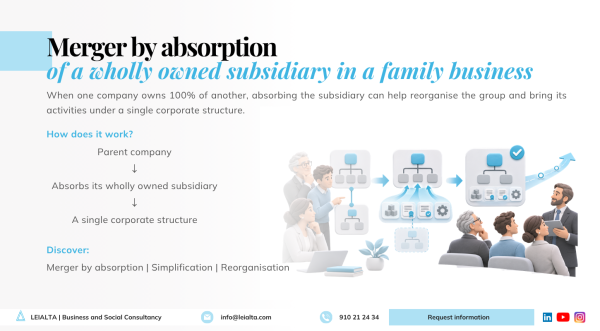
Over time, Company B no longer needs to operate through a separate corporate structure. If Company A absorbs it, Company B ceases to exist and transfers all of its assets and liabilities to Company A, which continues to exist.
The transaction does not involve the ordinary liquidation of the absorbed company. Its assets, rights and obligations are transferred to the absorbing company by universal succession, and the absorbed company legally ceases to exist once the merger has been registered.
The main difference compared with a merger between independent companies is that the absorbing company already owns the entire share capital of the absorbed company. As a result, there is no genuine exchange of shares or equity interests between shareholders, and Spanish legislation allows certain procedural requirements to be simplified.
If you would first like to understand how mergers work more generally, you can read our guide on company mergers in Spain: types, examples and process.
Why can this type of merger be useful in a family business?
In a family business, the corporate structure is often the result of decisions made at different stages in the company’s development.
One company may have been incorporated to carry out an activity that has since disappeared. Another may have been created to launch a new business line that was later integrated into the main activity. In other cases, several companies may now share management, employees, customers and processes without there being a clear business reason for keeping them separate.
In these circumstances, absorbing a wholly owned subsidiary may help **simplify the corporate group and align its legal structure with the current reality of the business**.
For example, a family may own a parent company and a subsidiary that originally carried out separate activities. Years later, their operations may have become largely integrated. Maintaining two accounting systems, two sets of corporate bodies, two annual accounts filing processes and other administrative obligations can add complexity without providing a genuine benefit.
A merger may allow these activities to be concentrated in a single company and make the group easier to manage.
It may also form part of a broader family business reorganisation, for example before a generational transition, when reorganising companies within the group or when preparing a simpler structure for the future.
However, simplification is not always the right solution. If the companies carry out activities with different risk profiles, or if certain assets should remain separate from the operating business, other restructuring alternatives may be more appropriate, such as a spin-off or a holding company structure.
At LEIALTA, we analyse mergers as one of several possible corporate restructuring tools. Their purpose may be to integrate companies and eliminate duplication, while other transactions may be more suitable where the objective is to separate assets, activities or risks.
Direct and indirect ownership structures
The applicable rules depend on how the ownership relationship between the companies is structured.
| Situation | Structure | Key considerations |
|---|---|---|
| Direct ownership | The absorbing company directly owns 100% of the absorbed company. | The simplified regime for wholly owned companies may apply. |
| Indirect ownership | The absorbing company owns 100% of the absorbed company through one or more intermediate companies. | Additional requirements apply. An independent expert’s report is required and a capital increase may also be necessary. |
| Companies with the same owner | Two companies are wholly owned, directly or indirectly, by the same shareholder or have an identical ownership structure. | The rules applicable to wholly owned companies may apply to the extent provided for under Spanish legislation. |
Spanish legislation also provides for equivalent situations, including a so-called reverse merger, where the absorbed company directly or indirectly owns all of the shares or equity interests in the absorbing company.
These distinctions can be particularly relevant in family-owned groups with holding companies or structures that have developed over several generations, where the relationship between the different entities may be more complex than a parent company directly owning a single subsidiary.
Which requirements can be simplified?
When the absorbing company directly owns the entire share capital of the absorbed company, Spanish legislation allows several requirements that would normally apply to a merger between independent companies to be simplified.
There is no need to establish an exchange ratio because there are no external shareholders in the absorbed company who need to receive new shares or equity interests. In this situation, a capital increase by the absorbing company is not generally required, and certain directors’ and independent experts’ reports on the merger plan may also be dispensed with.
The legislation may also allow the merger to proceed without approval by the general meeting of the absorbed company, provided that the relevant legal conditions are met.
However, this does not mean that the merger takes place automatically or that all formalities disappear.
It remains a corporate restructuring transaction and the applicable requirements concerning preparation, information, publication, protection of shareholders, employees and creditors, formalisation and registration must still be complied with.
Where the ownership is indirect, Spanish legislation provides for additional requirements. In particular, an independent expert’s report will be necessary and a capital increase may also be required depending on the structure of the transaction.
How is the merger carried out?
The process should begin before any legal documentation is drafted. The first step is to determine why the merger is being considered and how the business should be organised once it has been completed.
For a family business, this means reviewing the companies involved, their assets and liabilities, debts, contracts, employees, intra-group relationships and any potential contingencies. It is also necessary to determine whether integrating the companies will genuinely improve the structure or whether there are reasons to keep them separate.
Once the transaction has been defined, the process can be summarised as follows:
| Stage | What is reviewed or carried out |
|---|---|
| Preliminary analysis | The corporate structure, ownership interests, assets and liabilities, debts, contracts, tax position and business purpose of the transaction are reviewed. |
| Merger plan | The directors prepare the merger plan in accordance with Royal Decree-Law 5/2023, applying any available simplified requirements. |
| Information and publication | The applicable information requirements for shareholders, employees and creditors are completed, together with the relevant publication formalities. |
| Formalisation | The corporate resolutions required for the specific structure are adopted and the merger is formalised by public deed. |
| Registration | The merger becomes effective |
Royal Decree-Law 5/2023 generally requires a common merger plan and regulates the information that must be made available during the process. The legal effects of the merger arise upon registration with the Commercial Registry.
The simplified regime therefore reduces certain formalities, but it does not turn the absorption of a wholly owned subsidiary into a simple administrative closure of the company.
Example of a merger within a family-owned group
Consider a family that owns a holding company, Family Holding, S.L., which in turn owns 100% of Operating Company North, S.L.
Operating Company North was incorporated several years ago to develop a specific business line. Today, however, that activity is managed together with the rest of the group and maintaining the company as a separate legal entity no longer serves a clear business purpose.
If there are no operational, asset protection or strategic reasons for keeping the two structures separate, Family Holding could consider absorbing Operating Company North.
Following the merger, Operating Company North would cease to exist and its assets, contracts, rights and obligations would be transferred to Family Holding.
The objective should not simply be described as “eliminating a company”. The transaction should respond to a genuine business rationale, such as simplifying the corporate structure, removing duplicated functions, centralising certain activities or adapting the group structure to the way the business actually operates.
Before proceeding, particular attention should be paid to the assets and liabilities being transferred, the risks and potential contingencies within the absorbed company and whether concentrating them in the absorbing company is appropriate for the family-owned group as a whole.
How is this type of merger taxed in Spain?
Tax is another key area that must be analysed before the transaction is implemented.
Mergers that meet the relevant requirements may qualify for Spain’s special tax regime for mergers, spin-offs, contributions of assets and share-for-share exchanges, commonly known by its Spanish acronym as the FEAC regime.
The purpose of this regime is to prevent taxation from becoming an obstacle to genuine business reorganisations. In general terms, it may allow taxation of certain gains arising from the transaction to be deferred.
However, a merger is not automatically tax-exempt and should not be carried out solely to obtain a tax advantage.
Article 89 of the Spanish Corporate Income Tax Law provides that the special regime will not apply where the principal objective of the transaction is tax fraud or tax evasion. The existence of valid commercial reasons, such as the restructuring or rationalisation of business activities, therefore forms an important part of the analysis.
These transactions are also subject to specific notification requirements before the Spanish Tax Agency.
For a family business, simplifying an unnecessarily complex structure, removing duplication or integrating activities that already operate together may form part of the commercial rationale for the transaction. Nevertheless, the specific circumstances must always be reviewed before the merger is implemented.
When might a merger not be appropriate?
The fact that one company owns 100% of another does not automatically mean that the two companies should be merged.
Keeping them separate may be appropriate where they carry out activities with different risk profiles, where future shareholders or investors make separate structures desirable, where particular assets should remain ring-fenced from the operating business or where contracts, financing arrangements or potential liabilities make integration unsuitable.
Particular attention should also be paid to the debts and liabilities of the absorbed company. In a merger, its assets and liabilities are transferred as a whole, meaning that the transfer includes obligations as well as assets and rights.
For this reason, the analysis should not focus solely on the cost of maintaining an additional legal entity. The more important question is what the consequences would be of transferring all of its assets, liabilities and risks to the absorbing company.
Wholly owned subsidiary mergers and family business planning
The absorption of a wholly owned subsidiary can be a useful way to reorganise a family-owned group where the existing corporate structure no longer reflects how the business actually operates.
It may allow activities to be concentrated, duplicated functions to be reduced and management to be simplified. At the same time, however, it changes how assets, liabilities and risks are distributed within the group.
The transaction should therefore be assessed from a corporate, tax, accounting and labour perspective, while also taking into account the family’s longer-term business and succession objectives.
At LEIALTA, a business and social consulting firm based in Spain, we support family businesses, SMEs and corporate groups through company merger and corporate restructuring processes in Spain.
Our work begins with an analysis of the existing structure and the objectives of the reorganisation before determining which corporate transaction is most appropriate. We coordinate the corporate, tax, accounting and labour implications so that the resulting structure supports the business rather than simply reducing the number of legal entities.
The objective is not to have fewer companies for its own sake, but to ensure that the legal and corporate structure reflects the reality of the business and supports the family’s future objectives.